This is an archive of articles by Frank Jamerson
Two Men and Temptation
God made man a creature of choice, and all men are tempted in the same ways: the lust of the flesh, the lust of the eyes and the pride of life (1 Jn. 2:16). Notice how two men in the Old Testament dealt with temptation.
In Proverbs seven, the writer describes “a young man devoid of understanding” who saw a woman “with the attire of a harlot, and a crafty heart” (Prov. 7:7,10). She said “I have perfumed my bed with myrrh, aloes, and cinnamon. Come, let us take our fill of love until morning; Let us delight ourselves with love. For my husband is not at home; He has gone on a long journey; He has taken a bag of money with him, and will come home on the appointed day” (Prov. 7:17-20). The writer said that her enticing speech and flattering lips seduced him and “Immediately he went after her, as an ox goes to the slaughter, or as a fool to the correction of the stocks” (Prov. 7:22), and concluded “Her house is the way to hell, descending to the chambers of death” (Prov. 7:27).
Another young man, who was enticed by a married woman, reacted differently. The wife of Potipher “cast longing eyes on Joseph, and said, Lie with me,” but he “refused and said to his master’s wife, Look, my master does not know what is with me in the house, and he has committed all that he has to my hand. There is no one greater in this house than I, nor has he kept back anything from me but you, because you are his wife. How then can I do this great wickedness, and sin against God?” (Gen. 39:7-9). This happened over a period of time and finally she grabbed his garment, saying “Lie with me,” but he left the garment in her hand and fled fornication (Gen. 39:12).
One temptation led to sin, the other led to righteousness, patience and strength to help overcome the next temptation (Jas. 1:3,4). Temptation is not a sin, but deciding to act upon it, or actually doing it results in sin. Joseph said that fornication would have been a “sin against God.” Paul said, “Flee sexual immorality. Every sin a man does is outside the body, but he who commits sexual immorality sins against his own body” (1 Cor. 6:18). Every sin is against God, but this sin involves the whole of man in an intimate way and violates God’s purpose for the body.
Have You Noticed?
Have you ever noticed that when a man gets new car fever the old car all of a sudden falls apart? The paint looks terrible, it rattles all over and the motor probably will need overhauling. Often, the truth is that the old car is not so bad—he just wants a new one!
Have you ever noticed that when a man gets interested in some other woman, his wife suddenly has all kinds of short-comings? She always complains, never cooked or cleaned to suit him and he probably never loved her anyway. Do you know the real problem? He wants someone else and is looking for justification for his actions!
Have you ever noticed that when a man gets dissatisfied with the church, he goes through the same kind of rationalizations? All at once, no one is friendly, they offended my children, and I never did fit in anyway. Do you know the real problem? He has decided to make a change and is looking for an excuse!
The truth is that the old car does have imperfections, but it is paid for and if it were cleaned and tuned up it would probably be satisfactory. The old wife (or husband) does have imperfections, but if you looked for the good and worked on the problems, the relationship would probably go more smoothly. Likewise, the old church is composed of human beings who are not perfect, but if the problems were dealt with in God’s way, most of them would be resolved soon.
One more thought. Have you ever noticed that the fellow who gets the new car, soon has similar problems? Likewise, the man who gets the new wife soon finds imperfections in her, and the one who looks for a new church soon finds that it is composed of imperfect human beings also? One more thought—did you ever notice where the main problem was all along?
Reciprocal Action
To reciprocate means “to give and get, do, feel, etc. reciprocally; interchange… to make some sort of return for something done, given, etc.” (Webster). This describes the life God expects of a Christian. He is not simply a storehouse to receive, but a channel through which blessings are shared with others. Notice some things that Christians are to share.
A Christian has been taught in order to teach. Jesus told the apostles to make disciples of all nations and “teach them to observe all things that I have commanded you” (Mt. 28:20). Gratitude should cause the believer to want to share the good news with others. Paul told Timothy that “the things you have heard from me among many witnesses, commit these to faithful men who will be able to teach others also” (2 Tim. 2:2). We have not been taught just so we can learn, but to teach others. We must know the truth before we can teach others, but many are like the people described by the writer of Hebrews: For by this time you ought to be teachers, you need someone to teach you again the first principles of the oracles of God; and you have come to need milk and not solid food” (Heb. 5:12). When we learn and teach others, we grow.
The Christian forgives because he was forgiven. When Peter asked, “how often shall my brother sin against me, and I forgive him? Up to seven times?” (Mt. 18:21), Jesus told the story of two men who owed debts they could not pay. The first man was forgiven a ten thousand talent debt, but he was unwilling to forgive his fellow servant a hundred denarii. When his master heard about that, he “delivered him to the tormentors until he should pay all that was due him.” Then Jesus concluded, “So My heavenly Father also will do to you if each of you, from his heart, does not forgive his brother his trespasses” (Mt. 18:23-25). Paul told the Ephesians to be “kind to one another, tenderhearted, forgiving one another, just as God in Christ also forgave you” (Eph. 4:32).
The Christian has received love and should give it. The apostle of love wrote, “We love Him because He first loved us” (1 Jn. 4:19). We show our love for God by “keeping His commandments” (1 Jn. 4:3), and by loving our brethren (1 Jn. 4:21). The person who says he loves God, but does not keep His commandments in not telling the truth (1 Jn. 2:3,4), nor is one who says that he loves God but does not love his brother (1 Jn. 4:20). Jesus, Himself, said, “A new commandment I give to you, that you love one another, as I have loved you, that you also love one another. By this all will know that you are My disciples, if you have love for one another” (Jn. 13:34,35).
The Christian is comforted in order to comfort others. The Corinthians were told that the God of comfort, “comforts us in all our tribulation, that we may be able to comfort those who are in any trouble, with the comfort with which we are comforted by God” (2 Cor. 1:3,4). The person who has overcome a “thorn in the flesh” can empathize with those who are suffering similar trials. Just the knowledge that you have been there, and care, can be very encouraging to one who is experiencing the thorn at the moment.
Those who receive but never give, are never happy, just as those who are willing to give, but not receive, are unhappy. The Christian should learn to give and receive—both are evidences of humility and essential to enjoying the happiness that God has made available through reciprocal action.
Forgiving Forgetting
Many have a problem with forgiving themselves for things even after they have asked God’s forgiveness. Sometimes, even those who are baptized continue remembering their past and wondering whether God has truly forgiven them.
There is a difference between forgiving and forgetting. Saul of Tarsus was forgiven of his sins when he was baptized to wash them away (Acts 22:16), but he still remembered his past life and often referred to the things he had done. He said “many of the saints I shut up in prison, having received authority from the chief priests; and when they were put to death, I cast my vote against them” (Acts 26:10). He wrote Timothy that he had been “a blasphemer, a persecutor, and an insolent man…This is a faithful saying and worthy of all acceptance, that Christ Jesus came into the world to save sinners, of whom I am chief” (1 Tim. 1:13,15).
King David was forgiven of his sin with Bathsheba (2 Sam. 12:13), but later his conscience caused him to write, “my sin is ever before me. Against You, You only have I sinned, and done this evil in Your sight” (Ps. 51:3,4).
The apostle Peter denied the Lord, and his conscience was pierced by the crowing of a rooster (Lk. 22:54-61). How do you think he felt every time he heard a rooster crow?
When a child of God commits sin and asks for God’s forgiveness, how does he know that he has been forgiven? The same way that one who has obeyed the Lord in baptism knows that his past sins are washed away—by what God promised. John said, “If we confess our sins, He is faithful and just to forgive us our sins and to cleanse us from all unrighteousness” (1 Jn. 1:9). This does not mean that we cannot remember that we committed them, but it does mean that we can also remember that God forgave them.
The Bible records many sins of which God’s people had been forgiven. A man in Corinth, who was living with his father’s wife, obviously repented after the action of the church (1 Cor. 5), and later Paul told the Corinthians, “you ought rather to forgive and comfort him, lest perhaps such a one be swallowed up with too much sorrow” (2 Cor. 2:7). He remembered he had committed the sin, but he remembered also that he had repented and been forgiven.
Forgiveness, from God or from one another, does not mean that it is forgotten, but that it is no longer held against the person. When a person says, “I’ll forgive you, but I will not forget it,” they usually mean something wrong, but in a sense, we can forgive a person without forgetting.
Situation Ethics
Dr. Joseph Fletcher, an Episcopal theologian and author of “Situation Ethics—The New Morality,” was in Louisville, Kentucky in December of 1966. My next door neighbor invited me to go and listen to his presentation on this subject, and they gave me a copy of his book. The summary on the back page of the book says: “The sensational deductions which the author draws from this premise include the bold statement that any act—even lying, premarital sex, abortion, adultery, and murder—could be right, depending on the circumstances.”
The amazing thing about Mr. Fletcher’s theory is that he claims this is what Jesus taught. He said “Jesus and Paul replaced the precepts of Torah (Law) with the living principle of agape—agape being goodwill at work in partnership with reason” (p. 69). He said that Christianity is corrupted by pietism (which he defined as individualizing right conduct), moralism (which he defined as “trivializing over whose wife one sleeps with”) and Legalism (which means that the Bible is an absolute standard of right and wrong).
First, I would say that Jesus personalized morality by claiming to be without sin (Jn. 8:46; Heb. 4:15), therefore not violating God’s law. If Mr. Fletcher is correct, then Jesus corrupted Christianity!
Passages Mr. Fletcher used to prove his theory are abuses of Scripture. When Jesus healed on the Sabbath, He was doing what was lawful (Mt. 12:12; Dt. 23:25). When the disciples plucked train on the Sabbath, Jesus said they were guiltless (Mt. 12:7). He used David’s violation of the law as an argument against His accusers. They were condemning the disciples of Jesus for doing something that was permitted, but defended David doing what was unlawful (Lev. 24:5-9; 1 Sam. 21:6). They showed mercy toward David, but none toward those they wanted to condemn.
The second major error in this doctrine is the misunderstanding of love. He said, “Unlike all other principles you might mention, love alone when well served is always good and right in every situation. Love is the only universal” (p. 60). But “for the situationist there are no rules—none at all” (p. 55). In answer to the question—Is adultery wrong? His response was “I don’t know. Maybe. Give me a case. Describe a real situation” (p. 142). He said “If people do not believe it is wrong to have sex relations outside marriage, it isn’t, unless they hurt themselves, their partners, or others.” He said, “We follow law, if at all, for love’s sake; we do not follow love for law’s sake” (p. 70).
Jesus clearly contradicted Mr. Fletcher’s definition of love. He said, “If you love Me, keep My commandments… If anyone loves Me, he will keep My word; and My Father will love him, and we will come to him and make Our home with him. He who does not love Me does not keep My words; and the word which you hear is not Mine but the Father’s who sent Me” (Jn. 14:15,23,24).
Situation ethics is described by Paul as those who are “lovers of themselves,…lovers of pleasure rather than lovers of God” (2 Tim. 3:2-4). The “new morality” is the old immorality Paul described in the first chapter of Romans. Men who professed themselves to be wise become fools “and changed the glory of the incorruptible God into an image made like corruptible man– and birds and four-footed beasts and creeping things…who exchanged the truth of God for the lie, and worshipped and served the creature rather than the Creator, who is blessed forever…being filled with all unrighteousness, sexual immorality, wickedness, covetousness, maliciousness; full of envy, murder, strife, deceit, evil-mindedness…”
It is true that circumstances determine our actions in many things, but the Bible sets forth the principles that must be applied and we must lovingly apply those principles. One who rejects the Biblical principles does not have a law, for love is not a law. Love for God is what motivates us to obey His law.
Your Taste Buds
The word taste is used in many different ways. It may refer to sampling (I’ll taste your desert), preference(that house fits my taste), ability to recognize (she has a taste for men’s clothes), or to experience (he had a taste of freedom). The context in which it is used often determines its exact meaning.
The Bible uses the word in at least three ways. First, it uses it to refer to sampling. “And when they come to a place called Golgotha, that is to say, Place of a Skull, they gave Him sour wine mingled with gall to drink. But when He had tasted it, He would not drink” (Mt. 27:33,34). When Jesus turned the water into wine, the master of the feast “tasted the water that was made wine” (Jn. 2:9). When stores give a sample of something they are selling, that is just a taste.
Second, it is used to mean eating. Jesus told about a man giving a great supper, but those invited began to make excuses for why they couldn’t attend. The master said, “For I say to you that none of those men who were invited shall taste my supper” (Lk. 14:24). He was saying they would not be allowed to participate in the feast. The word is translated eaten in Acts 20:11. After Eutychus was raised from the dead, Paul went back into the house and ate (tasted) and talked until daybreak.
Third, the word is used in the sense of experiencing. The writer of Hebrews said, “But we see Jesus, who was made a little lower than the angels, for the suffering of death crowned with glory and honor, that He, by the grace of God, might taste death for everyone” (Heb. 2:9). Christ did not take just a sample, He experienced death fully. In the sixth chapter, the writer said, “For it is impossible for those who were once enlightened, and have tasted the heavenly gift, and have become partakers of the Holy Spirit, and have tasted the good word of God and the powers of the age to come, if they fall away, to renew them again to repentance, since they crucify again for themselves the Son of God, and put Him to an open shame” (Heb. 6:4-6). This passage clearly shows that a person can taste (experience) salvation and then fall away. The passage says those who do that cannot be renewed to repentance. Later, he said “if we sin willfully after we have received the knowledge of the truth, there no longer remains a sacrifice for sins” (Heb. 10:26). Those who experience salvation in Christ and then willfully turn away are classified with those who murdered the Son of God. As long as a person has that attitude toward Christ, he cannot be renewed to repentance. Christ is not going to die again, and God will offer no other sacrifice to change that person’s mind. He can led to repent only by going back to the sacrifice that he willfully turned away from.
Those who obeyed the gospel were told to desire the spiritual milk “if you have tasted that the Lord is gracious” (1 Pet. 2:3). Those who have tasted the joy of salvation should eat willingly and greedily of the word of God, not just sample it! The Psalmist said, “How sweet are Your words to my taste, Sweeter than honey to my mouth” (Ps. 119:103). How are your taste buds?
Which God Should we Serve?
Pantheism is “the doctrine that the universe, taken as a whole, is God; the doctrine that there is no God but the combined forces and laws which are manifested in the existing universe” (Webster). In a book called “The Source,” John Clayton discussed the conflict between belief in the true God and Pantheism. I am going to quote several statements from his chapter on “which God should we serve?”
In Genesis 1:28, God said, “Be fruitful and multiply; fill the earth and subdue it; have dominion over the fish of the sea, over the birds of the air, and over every living thing that moves on the earth.” Brother Clayton said: “Now, that is a radical concept. It is totally opposed to pantheism. It is saying to man, ‘Look man, you control the earth. You use the earth. You manipulate the earth.’ The opposing forces of pantheism would say, “You conform to the earth. Do not build a dam, you might make the river god angry. You don’t drill holes in the ground to reach water, that is the same as as mutilating your being. You don’t manipulate the lands in this way for agriculture.’ Compare their ideas with Genesis 2:15, where it says, ‘God took man and put him in the garden of Eden to dress and keep it.’ Notice ‘to dress it and keep it.’ I believe that you have to put Genesis 1:28 and 2:15 together. Man not only is instructed by the Word of God that he is supposed to use and subdue the earth, but also that he is supposed to take care of it” (pg. 100,101).
Under the Old Covenant there were certain kinds of animals, fish, birds and insects that were not to be eaten (Lev. 11), but that covenant is no longer in effect.
When the Lord showed Peter that he should go to the Gentiles, He sent a vision of a sheet bound at the four corners, with “all kinds of four-footed animals of the earth, wild beasts, creeping things, and birds of the air. And a voice came to him, Rise, Peter, kill and eat” (Acts 10:12,13). Granted that the point here is to show Peter a spiritual lesson, the principle is still true that the Old Covenant restrictions on clean and unclean are not binding today. Clayton said that the alternative to not calling anything unclean is “food restrictions. Do not eat meat. Do not eat various kinds of materials because they may be a reincarnated ancestor…It is obvious that the solution to our food shortages on the earth is to make better use of what we have. Christianity allows that and encourages it” (p. 101).
Clayton discussed the problem of pain and suffering in the same chapter. Human wisdom sees no purpose in suffering and therefore advocates self murder. The God whom we serve says there is a purpose in suffering and we should use it to be made better. Unbelief says, “do anything you want. Don’t pay any attention to anybody else because since this life is all you have there is no reason to be moral. Get what you can and enjoy it” (p. 102).
Although we may have difficulties that we cannot explain, we understand our primary mission in life and we can use the creation God has provided to prepare ourselves for His provisions beyond this world. With Paul, we can say “Therefore take heart, men, for I believe God that it will be just as it was told me” (Acts 27:25).
The Nature of Christ
“In the beginning God created the heavens and the earth” (Gen. 1:1). The word God in this verse is the plural form (Elohim) which indicates that more than one Being have the nature of Deity. The Bible teaches the Father, the Word (the Son) and the Holy Spirit have the same nature—Godhood or Deity. To affirm that they are Divine Beings is to affirm their eternity. We want to notice specifically the claims of Jesus to be God, or Deity.
At the burning bush, God said to Moses, “I Am” (Ex. 3:10). The term denotes “un-originated, immutable, eternal and self-sustained existence” (Vine). God said to Moses “I am eternal.” Jesus claimed the same for Himself—”before Abraham was born, I AM” (Jn. 8:58). He was saying He was “with God and was God” (Jn. 1:1). Other passages clearly show His Deity. Isaiah said, “Prepare the way of the LORD; Make straight in the desert a highway for our God” (Is. 40:3). Matthew quotes this and applies it to John the Baptist’s preparation for Christ (Mt. 3:1-3). The angel told Mary that her Son would be called “Immanuel, which is translated, God with us” (Mt. 1:23). When Jesus claimed “I and the Father are one,” the Jews started to kill Him “because You, being a Man, make Yourself God” (Jn. 10:30,33). The word God is often used of the Father, but sometimes is used of the Godhead—the Father, Son and Holy Spirit.
Does the term begotten indicate Jesus had a beginning? As a human being, Jesus was conceived of the Holy Spirit (Mt. 1:20), but that is not the whole story of how Jesus was begotten. The Psalmist’s statement (Ps. 2:7), is quoted in Acts 13:33-35 and applied to the resurrection of Jesus. It had nothing to do with origin, but with position.
Does the Son of God prove that Jesus had a beginning? No! The word son often refers to sameness. Jabal was “father of those who dwell in tents and and have livestock” (Gen. 4:20). His brother, Jubal, was “the father of all those who play the harp and flute” (Gen. 4:21). This indicates they were of the same trade. Zebedee’s children were known as “sons of Thunder” (Mk. 3:17). Jesus told the Sadducees, “the sons of this age” marry (Lk. 20:34). The word son may simply indicates sameness, or likeness, not origin.
W.E. Vine commented that Son of God is “an eternal relation subsisting between the Son and the Father in the Godhead is to be understood. That is to say, the Son of God, in His eternal relationship with the Father, is not so entitled because He at any time began to derive His being from the Father (in which case He could not be co-eternal with the Father), but because He is and ever has been the expression of what the Father is…” Then he quoted “He who has seen Me has seen the Father; so how can you say, Show us the Father?” (Jn. 14:9), and “who being the brightness of His glory and the express image of His person,” (Heb. 1:3) then concluded “absolute Godhead, not Godhead in a secondary or derived sense, is intended in the title.”
We cannot grasp eternity, but we can understand that God is eternal.
The Deity of Christ
(This is a slightly condensed version of a letter I wrote to a man who disagreed with my letter to the Courier Journal on the Deity of Christ.)
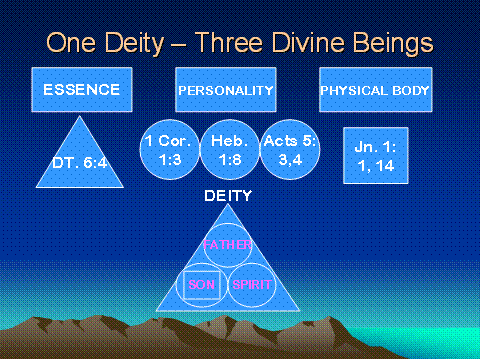
I appreciate you taking the time to respond by my letter to the editor about the Godhead…First, I do not believe in three Gods—neither does anyone else who believes what the Bible says about the Godhead. There are basically three words in the O.T. describing God—El (Elohim, plural), which means Mighty One; YHWH (Jehovah, though we do not know how it should be spelled) which indicates Eternal (I Am), and Adonai (Master, Lord) which indicates Sovereignty. The N.T. does not use the word “Jehovah” but uses Kurios (Lord) and Theos (God). Dt. 6:4 is the classic statement of the Godhead in the O.T. “Hear O Israel: The LORD (YHWH, singular) our God (Elohim, plural), the LORD (YHWH, singular) is one!” This indicates a plurality of beings called God, and yet they are one. There is one Deity, Godhead or Godhood, but there are three Diving Beings composing the one Godhead. Now, I will give further evidence for these assertions.
Moses wrote: “In the beginning God (plural) created the heavens and the earth” (Gen. 1:1). A plurality of beings are viewed as singular—a united one, not a numerical one. Then “God said, Let Us make man in Our image.. So God created man in His Own image; in the image of God He created him; male and female He created them” (Gen. 1:26,27). The passage says nothing about angels creating, nor about men being created in the image of angels. God created and they were created in His image. The rest of God’s revelation confirms who was involved in creation. John said, “In the beginning was the Word and Word was with God (a separate Being), and the Word was God (same in essence). All things were made through Him, and without Him nothing was made that was made” (Jn. 1:1-3). That tells us tells us who “Us” and “Our” is in Gen. 1:26,27. Hebrews 1:2 also says that God has spoken to us through His Son “through whom also He made the worlds.” Paul nailed it down securely, when he wrote: “For by Him all things were created that are in heaven and that are on earth, visible and invisible…All things were created through Him and for Him” (Col. 1:16). If Jesus is a created Being, He had to create Himself! Or, Paul did not tell the truth. Furthermore, when Jesus appeared to Thomas and told him to “reach your hand here and put it into My side,” Thomas exclaimed: “My Lord and My God” (Jn. 20:25-28). Jesus commended him for that conclusion! Paul said if you “confess with your mouth the Lord you will be saved” (Rom. 10:9,13. The NWT, by Watchtower Society, says Lord in v. 9 and Jehovah in v. 13.)
You said “Michael (chief angel, Logos) was Jesus.” First, “chief angel” does not mean Logos. (Logos means Word.) Daniel said that Michael was “one of the chief princes” (Dan. 10:13). He also mentioned Gabriel, though he does not call him a chief angel (Dan. 9:21)…The writer of Hebrews asked the question: “To which of the angels did He ever say: You are My Son, today I have begotten You? And again: I will be to Him a Father, and He shall be to Me a Son?” (Heb. 1:5). That is a rhetorical question, and the answer is clearly implied! Then, the writer said: “But to the Son He says: Your throne, O God is forever and ever” (Heb. 1:8). Yes, I know that Jesus will come “with the voice of an archangel,” but that no more proves He is an archangel than “with the trumpet of God” proves (within itself) that He is God (1 Thess. 4;16).
I want to present one more evidence that Jesus is Deity. Isaiah said: “The voice of one crying in the wilderness: Prepare the way of the LORD (Jehovah); Make straight in the desert a highway for our God” (Is. 40:3). That clearly refers to the work of John the Baptist (Mt. 3:1-3; Lk. 1:76). The NWT (Jehovah Witness Version) says “Jehovah” in these two passages. The word “Jehovah” is not in the N.T., but the word “Kurios” refers to the same person as “YHWH.” So, John prepared the way for Jehovah! This harmonizes with what Jesus said: “Most assuredly, I say to you, before Abraham was, I AM” (Jn. 5:58). When God spoke to Moses at the burning bush, He said: “I AM WHO I AM. And he said, Thus you shall say to the children of Israel, I AM has sent me to you” (Ex. 3:13,14). There are other evidences that could be presented to produce faith in Jesus as “Immanuel, which is translated, God with us” (Mt. 1:23). This is not a matter of indifference.
Led by the Spirit
Jeremiah cried, “O Lord, I know the way of man is not in himself; It is not in man who walks to direct his own steps” (Jer. 10:23). Paul wrote, “For as many as are led by the Spirit of God, these are the sons of God” (Rom. 8:14). He told the Galatians, “Walk in the Spirit, and you shall not fulfill the lusts of the flesh…But if you are led by the Spirit, you are not under the law” (Gal. 5:16,18). Peter said, “for prophecy never came by the will of man, but holy men of God spoke as they were moved by the Holy Spirit” (2 Pet. 1:20).
Although “all Scripture is given by inspiration of God” (2 Tim. 3:16), this article will focus on the revelation of the Spirit in the New Testament. How did the Holy Spirit work in the first century and how does He work today in conversion and edification?
How the Spirit Leads
Jesus promised the apostles that the Holy Spirit “will teach you all things and bring to your remembrance all things that I said to you” (Jn. 14:26). Later, He said, “However, when He, the Spirit of truth, has come, He will guide you into all truth; for He will not speak on His own authority, but whatever He hears He will speak; and He will tell you things to come” (Jn. 16:13). The Holy Spirit accomplished this work during the lifetime of the apostles. He is not bringing to our remembrance things we heard Jesus say, nor guiding us into all truth through inspiration, as He did the apostles and other Spirit-guided men. Paul affirmed: “Things which eye has not seen and ear has not heard, and which have not entered the heart of man, all that God has prepared for those who love Him. For to us God revealed them through the Spirit; for the Spirit searches all things, even the depths of God. For who among men knows the thoughts of a man except the spirit of the man, which is in him? Even so the thoughts of God no one knows except the Spirit of God. Now we have received, not the spirit of the world, but the Spirit who is from God, that we might know the things freely given to us by God, which things we also speak, not in words taught by human wisdom, but in those taught by the Spirit, combining spiritual thoughts with spiritual words” (1 Cor. 2:9-13, NASV). The things of God are not accessible through the senses of man. Before the Spirit revealed the gospel message, no eye could see, no ear could hear and no heart could understand God’s plan, but after the Spirit revealed it, through the apostles and prophets, every eye can see, every ear can hear and every heart can understand what God has prepared for those who love Him. This is the only way we can know the mind of God.
When Jesus sent out the seventy He said, “He who hears you hears Me, he who rejects you rejects Me, and he who rejects Me rejects Him who sent Me” (Lk. 10:16). Men cannot reject the word of God without rejecting the God of the word! Later, the message that was inspired in men was written. Paul said, “how that by revelation He made known to me the mystery (as I wrote before in a few words, by which, when you read, you may understand my knowledge in the mystery of Christ), which in other ages was not made known to the sons of men, as it has now been revealed by the Spirit to His holy apostles and prophets” (Eph. 3:3-5). The message of the Spirit was first known only through hearing, later it was learned by both hearing and reading, and finally was known only through reading what was written by inspiration of the Spirit.
The Spirit and Conversion
Jesus promised the apostles, “you shall receive power when the Holy Spirit has come upon you; and you shall be witnesses to Me in Jerusalem, and in all Judea and Samaria, and to the end of the earth” (Acts 1:8). About ten days later, the Holy Spirit came upon them and they “began to speak in other tongues, as the Spirit gave them utterance” (Acts 2:4). Peter began his sermon by saying “heed my words” (v. 14), then he quoted the words of Joel and said “Men of Israel, hear these words: Jesus of Nazareth, a Man attested by God to you by miracles, wonders, and signs which God did through Him in your midst, as you yourselves also know” (v. 22). He concluded that God had made Jesus both Lord and Christ. “Now, when they heard this, they were cut to the heart, and said to Peter and the rest of the apostles, Men and brethren, what shall we do?” (v. 37).They were told to “repent and be baptized in the name of Jesus Christ” (v. 38). “Then those who gladly received his word were baptized…” (v. 41). Their conversion was a result of hearing and obeying the word of the Spirit.
The first Gentile convert, Cornelius, reveals some interesting facts about how the Holy Spirit worked in the conversion of Gentiles. First, Cornelius saw a vision telling him to send to Joppa for Peter, who “will tell you what you must do” (Acts 10:3-6). In Joppa, Peter saw a vision of a sheet bound at the four corners descending to earth with “all kinds of four-footed animals of the earth, wild beasts, creeping things, and birds of the air,” and the Lord told him to “Rise, Peter; kill and eat” (vs. 12,13). Peter declined, but Jesus said “What God has cleansed you must not call common” (v. 15). He understood the message necessarily implied: “God has shown me that I should not call any man common or unclean” (v. 28). When Peter arrived at Cornelius’ household and began explaining his mission, “the Holy Spirit fell upon all those who heard the word” (v. 44). All these events contributed to their conversion, but none of these things saved them! When Peter was criticized for going to the house of a Gentile (Acts 11:1-3), he recounted the events that had transpired and said that Cornelius was told “Send men to Joppa, and call for Simon whose surname is Peter, who will tell you words by which you and all your household will be saved” (vs. 13,14). Cornelius was told that Peter would tell him what to do; Peter said that Cornelius was saved by words. What did Peter tell him to do to be saved? After seeing that the Holy Spirit had fallen upon them, he said, “Can anyone forbid water, that these should not be baptized who have received the Holy Spirit just as we have? And he commanded them to be baptized in the name of the Lord…” (vs. 47,48). That was the same message the Spirit revealed for Jews on Pentecost. When the Jews asked what to do, Peter said, “Repent, and let every one of you be baptized in the name of Jesus Christ for the remission of sins” (Acts 2:38). The Holy Spirit did not have one plan for Jews and another for Gentiles. All were saved by obedience to the Spirit’s message when they were baptized in water for the remission of sins. Peter later wrote, “Since you have purified your souls in obeying the truth through the Spirit in sincere love of the brethren, love one another fervently with a pure heart, having been born again, not of corruptible seed but by incorruptible, through the word of God which lives and abides forever” (1 Pet. 1:22). The Holy Spirit always converted through the word, and He still does. God’s plan has not changed.
The Spirit and the Believer
In the first century, the apostles, and those upon whom they laid hands (Acts 8:18), had miraculous ability to reveal and confirm the truth. Paul listed nine miraculous gifts that were given “for the profit of all” (1 Cor. 12:7-11). These gifts were “in part,” but “when that which is perfect has come, then that which is in part will be done away” (1 Cor. 13:9,10). Just as surely as “all truth” (the perfect) was revealed through the Spirit, miraculous gifts ceased. There are no new revelations or confirmations. Near the conclusion of his discussion of miraculous gifts, Paul said, “If anyone thinks himself to be a prophet or spiritual, let him acknowledge that the things which I write to you are the commandments of the Lord” (1 Cor. 14:37). The message that was “first spoken by the Lord,” was “confirmed to us by those who heard Him, God also bearing witness both with signs and wonders, with various miracles, and gifts of the Holy Spirit, according to His own will” (Heb. 2:3,4). The gospel was revealed and confirmed, as Jesus promised (Mk. 16:15-20) and we are led by the Spirit as we conform our lives to that message.
In the parables Jesus told about the kingdom, as recorded in chapter four of Mark, Jesus mentioned “hearing” a dozen times. In the letters to the seven churches of Asia, seven times Jesus said, “hear what the Spirit says to the churches.” Near the end of the book, John wrote: “For I testify to everyone who hears the words of the prophecy of this book: If anyone adds to these things, God will add to him the plagues that are written in this book; and if anyone takes away from the words of the book of this prophecy, God shall take away his part from the book of Life, from the holy city, and from the things which are written in this book” (Rev. 22:18,19). Granted, this speaks directly of the book of Revelation, but men who would please God are not free to take from, or add to, any of His revelation.
God’s divine power has “given us all things that pertain to life and godliness” (2 Pet. 1:3), or “all truth” (Jn. 16:13). Scripture is “profitable for doctrine, for reproof, for correction, for instruction in righteousness, that the man of God may be complete, thoroughly equipped for every good work” (2 Tim. 3:16,17). People who are led by the Spirit do not act independently of that message. That revelation was first given through men who were led by the Spirit, then it was partly spoken and partly written, finally the perfect revelation was written and the only way the Spirit leads today is through that revelation. Paul told the Ephesians to be “filled with the Spirit” (Eph. 5:18). He told the Colossians to “Let the word of Christ dwell in you richly in all wisdom” (Col. 3:16). We are filled with the Spirit as we allow His word to permeate our lives by reading and practicing its precepts, examples and the things necessarily implied in those. “Be diligent to present yourself approved to God, a worker who does not need to be ashamed, rightly dividing the word of truth” (2 Tim. 2:15).
The Godhead and the Nature of Jesus
“Hear, O Israel: The Lord our God, the Lord is one” (Dt. 6:4). This verse is used by some to deny the Deity of Christ. It proves the very opposite! The word “God” is in plural form and the passage teaches that in the one Godhead, or Deity, there is a plurality of Beings, just as the plural pronouns in Genesis 1:26,27 indicate. The word one (echad) means a united one, not a numerical one (Hebrew and English Lexicon, Gesenius, p. 28). The same word is used in Gen. 2:24 – “they shall become one flesh” (see also Mt. 19:6; Eph. 5:31).
Jesus prayed that believers “may be one as We are” – a united one, not a numerical one (Jn. 17:11,20-23). In this unity, there is a plurality of personalities. Jesus said: “I and My Father are one” (Jn. 10:30). He also said they were two (Jn. 8:17,18). Both are true. They are separate Beings, but one Deity.
Isaiah prophesied: “Behold, the virgin shall conceive and bear a Son, and shall call His name Immanuel” (7:14). Matthew quotes this passage and adds: “which is translated God with us” (Mt. 1:23). Jesus is God, but He is not the Father.
Jn. 1:1-3 – “In the beginning was the Word, and the Word was with God (a distinct personality) and the Word was God (the same in nature). All things were made through Him, and without Him nothing was made that was made.” Paul said: “For by Him all things were created that are in heaven and that are on earth, visible and invisible, whether thrones or dominions or principalities or powers. All things were created through Him and for Him” (Col. 1:16). Everything that was created in heaven and on earth was created by Him. (The “New World Translation” of the Jehovah’s Witnesses, inserts the word “other” five times in Col. 1:15-20. There is no Manuscript evidence for such an addition.)
Genesis confirms this. “In the beginning God (plural form) created the heavens and the earth” (1:1). “Then God said, Let Us make man in Our image, according to Our likeness…” (v. 29). “So God created man in His own image,” (v. 27). “Then the Lord God said, Behold the man has become like one of Us to know good and evil…” (3:22). “ Come, let Us go down…” (11:7). Who is – US? It is the Godhead.
Isaiah prophesied: “For unto us a Child is born, Unto us a Son is given; And the government will be upon His shoulder. And His name will be called Wonderful, Counselor, Mighty God, Everlasting Father, Prince of Peace” (9:6). The same expression “Mighty God” is used in 10:21 – “The remnant will return, the remnant of Jacob, To the Mighty God” (see also 1:24).
He is “everlasting Father” – not a created Being. The same expression is used of the Father (Isa. 40:28). God is “from everlasting” (Ps. 93:2). Micah, speaking of one to be born in Bethlehem, said: “But you, Bethlehem Ephrathah, Though you are little among the thousands of Judah, yet out of you shall come forth to Me The One to be ruler in Israel, Whose goings forth have been from of old, From everlasting” (Micah 5:2). Both Jesus and the Father are “from everlasting” – eternal Beings.
Isaiah 40:3 – “The voice of one crying in the wilderness; Prepare the way of the Lord (Jehovah) Make straight in the desert A highway for our God.” For whom did John prepare the way? John wrote: “I am the voice of one crying in the wilderness; Make straight the way of the Lord” (Jn. 1:23). Luke wrote: “And you, child, will be called the prophet of the Highest; For you will go before the face of the Lord to prepare His ways” (Lk. 1:76). John wrote: “You yourselves bear me witness, that I said, I am not the Christ, but, I have been sent before Him” (Jn. 3:28). The Holy Spirit said that Jesus was “the Lord” who was predicted by Isaiah.
We are to worship only God: “You shall worship the Lord your God, and Him only you shall serve” (Mt. 4:10). Idolaters “exchanged the truth of God for the lie, and worshiped and served the creature rather than the Creator, who is blessed forever. Amen” (Rom. 1:25). Peter refused to accept worship. When Cornelius tried to worship him, Peter said, “Stand up; I myself am also a man” (Acts 10:26). John was rebuked for trying to worship an angel – “Then he said to me, See that you do not do that. For I am your fellow servant, and of your brethren the prophets, and of those who keep the words of this book. Worship God” (Rev. 22:9).
Jesus received worship: The wise men said “we have seen His star in the East, and have come to worship Him” (Mt. 2:2); “And when they had come into the house, they saw the young Child with Mary His mother, and fell down and worshiped Him” (v. 11).
A leper “came and worshiped Him, saying, Lord, if You are willing, You can make me clean” (Mt. 8:2).
A ruler “came and worshiped Him, saying, My daughter has just died, but come and lay Your hand on her and she will live” (Mt. 9:18).
The disciples, after Jesus calmed a storm, “came and worshiped Him, saying, Truly You are the Son of God” (Mt. 14:33).
A Canaanitish woman “came and worshiped Him, saying, Lord help me” (Mt. 15:25).
Mary Magdalene and the other Mary saw Jesus after His resurrection “And they came and held Him by the feet and worshiped Him” (Mt. 28:9).
Jesus did not rebuke any of these for worshiping Him.
Jesus was never an angel (a created being, Ps. 148:1-5). The writer of Hebrews said: “For to which of the angels did He ever say: You are My Son, Today I have begotten You? ” (Heb. 1:5). (This is applied to the Lord’s resurrection, not His birth, Acts 13:33.) The Father said: “Let all the angels of God worship Him” (Heb. 1:6; Ps. 97:7).
Jesus said: “I am the Alpha and the Omega, the First and the Last…” (Rev. 1:11,17). Isaiah said of God: “Thus says the Lord, the King of Israel, And his Redeemer, the Lord of hosts: I am the First and the Last; Besides Me there is no God” (Is. 44:6). Are there two “firsts and lasts,” or is what Jesus said true? “I and My Father are one” (Jn. 10:30). In the throne scene (Rev. 5), referring to the “Lion of the tribe of Judah, the Root of David” who “redeemed us to God by Your blood” – “And the twenty-four elders fell down and worshiped Him who lives forever and ever” (Rev. 5:5-14).
With Thomas, we should say of Jesus – “My Lord and my God” (Jn. 20:28).
Godhead – Trinity Chart
Blasphemy Against the Spirit
The Bible speaks of different sins against the Holy Spirit, but one of those sins was said to be unforgivable.
First, notice some sins that may be unforgiven but are not unforgivable. Ananias and Sapphira tried to deceive their brethren into thinking that they had given the entire price of a piece of land. Peter said: “Why has Satan filled your heart to lie to the Holy Spirit and keep back part of the price of the land for yourself?” (Acts 5:3). The next verse says that Ananias had not lied to men “but to God.” When he thought he could deceive God and those guided by the Spirit, he lied to Deity. That sin was not forgiven, but it was not called unforgivable.
Stephen accused disobedient Jews of “always resisting the Holy Spirit” (Acts 7:51). They resisted by persecuting and killing the prophets and by not keeping the teaching that God gave through them (vs. 52,53). When people today do not like the message that the Holy Spirit has revealed through inspired men, they are not simply rebelling against the word, but also “resisting the Holy Spirit.” This is not un-forgivable, but if they do not change, it will remain unforgiven.
Paul admonished the Ephesians not to “grieve the Holy Spirit of God, by whom you were sealed for the day of redemption” (Eph. 4:30). The context indicates that the Spirit could be grieved by sinful living (vs. 25-32). When God’s children live contrary to the instructions of the Holy Spirit, they are grieving Him, but this is not called unforgivable.
The writer of Hebrews said, “if we sin willfully after we have received the knowledge of the truth, there no longer remains a sacrifice for sins” (Heb. 10:26). He calls this “insulting the Spirit of grace” (v. 29). If one turns away from the sacrifice of Christ, there is no other means of forgiveness, but this is not called unforgivable. A person may return through repentance and prayer (Acts 8:22)
Any sin against the Holy Spirit that a person does not turn from will result in condemnation, just as any sin that is committed against Christ will lead to condemnation if one does not turn from it. Jesus said, “anyone who speaks a word against the Son of Man, it will be forgiven him; but whoever speaks against the Holy Spirit, it will not be forgiven him, either in this age or in the age to come” (Mt. 12:32). These people had seen Jesus cast out a demon, admitted that He did it, but ascribed the power by which He worked to “Beelzebub, the ruler of demons” (v. 24). Mark’s account says, “Assuredly, I say to you, all sins will be forgiven the sons of men, and whatever blasphemies they may utter; but he who blasphemes against the Holy Spirit never has forgiveness, but is subject to eternal condemnation—because they said, He has an unclean spirit” (Mk. 3:29,30). It is doubtful that those who saw Jesus cast out a demon and ascribed the power by which He worked the miracle to the devil could ever be moved to repentance. This is the blasphemy that Jesus said could never be forgiven.
Men today may sin against God, Christ and the Holy Spirit, and if they do not repent they will be lost, but no one today has seen Jesus cast out a demon, therefore cannot commit the unforgivable sin—the blasphemy of the Holy Spirit.
The Godhead and Baptism in the Name of Christ
(Note: In 1981, someone gave me a booklet on “Baptism in the name of Jesus Christ.” It was defending the Jesus only doctrine (one person in the Godhead) and affirming that baptism is not into the name of the Father, Son and Holy Spirit, but in the name of Jesus only. In this article, I quote from that booklet and respond by showing passages that contradict this teaching.)
The author (Jim Farmer) teaches that the Holy Spirit is Jesus. He said, “Now look. The four gospels: Matthew, Mark, Luke, and John were written to establish our faith in Christ. Acts of the apostles teaches us what the apostles did under the direct guidance of the Holy Spirit, Jesus Christ, through them” (p. 14). On page six, he said that Peter was “filled with the Holy Ghost (Word of God).” Since he capitalized “Word” I suppose he is using it in the sense of John 1:1, referring to Jesus.
JESUS IS NOT THE HOLY SPIRIT
1. One verse is enough to answer this error.” And whosoever shall speak against the Son of man, it shall be forgiven him; but whosoever shall speak against the Holy Spirit, it shall not be forgiven him, neither in this world, nor in that which is to come” (Mt. 12:32). If a man could be forgiven for speaking against the SON, but not for speaking against the HOLY SPIRIT, clearly the Holy Spirit is not the Son. That should be enough proof, but there is much more.
2. Jesus said: “But the comforter, even the Holy Spirit, whom the FATHER will send in MY name…” (Jn. 14:26). The Holy Spirit would be sent from the Father “in the name” (by the authority or request) of the Son. That is THREE persons, or Jesus was saying that He would send Himself from Himself. In verse 16 of the same chapter, Jesus said: “I will pray the Father, and he shall give you another Comforter…” If there was no other Comforter than Himself, Jesus was misleading the apostles. When He used the word another, He used the Greek word allos which “expresses a numerical difference and denotes another of the same sort” (W.E. Vine).
3. When Jesus was baptized, the SPIRIT descended as a dove, and the FATHER said, “this is my beloved SON, in whom I am well pleased.” The Jesus only doctrine has Jesus on earth, also descending from heaven in the form of a dove, and speaking to himself from heaven to commend himself. That is not Bible doctrine!
The writer teaches that the Father is Jesus. In arguing that Father, Son and Holy Spirit are titles of Jesus, he says: “I am a father, I’m a son; and I’m a husband. But none of these is my name.” Then he said: “Let us light a candle and speak of it as the father, call that the flame if you may. Then call the light that the flame gives off the Son and separate it if you can” (p. 17).
JESUS IS NOT THE FATHER
1. Using his illustration, I would say; I am a father, but I am not my own father. I am a son, but not my own son, and I am a husband, but not my own husband! His illustration makes Jesus His own Father and His own Son. The Bible does not teach that.
2. The gospel of John is filled with verses that show a distinction between the Father, the Son and the Holy Spirit. Let us notice a few of them. “In the beginning was the Word, and the Word was WITH God, and the Word WAS God” (1:1). Jesus is God the Son, but this says that He was with God, which shows a separate Being. “For God so loved the world, that He gave His only begotten Son…For God sent not the Son into the world to judge the world…” (3:16,17). It was the Son who died on the cross, not God the Father. The Son cried: “MY God, My God, why hast THOU forsaken Me?” (Mt. 27:46). He said, ”I can of mine own self do nothing; as I hear, I judge: and My judgment is just; because I seek not mine own will, but the will of the FATHER which hath sent me. If I bear witness of Myself, My witness is not true. There is ANOTHER that beareth witness of Me; and I know that the witness which he witnesseth of Me is true…And the Father Himself, which hath Me, hath borne witness of me. Ye have neither heard His voice at any time, nor seen His shape” (5:30-32,37). They were looking at, and listening to the Son, but Jesus said that they had not heard nor seen the Father.
How can people honestly read these passages and still say that the Son is the Father? “Yea and in your law it is written, that the witness of TWO men is true. I am he that beareth witness of Myself, and the FATHER that sent me beareth witness of Me” (8:17,18). Is there one witness, or two in these verses? “So they took away the stone. And Jesus lifted up His eyes, and said Father, I thank Thee that Thou heardest Me” (11:41). When Jesus lifted up his eyes and prayed to the Father, was He praying to Himself? He said, “My Father is greater than I” (14:28). “These things spake Jesus; and lifting up His eyes to heaven, He said, FATHER, the hour is come; glorify thy Son, that the Son may glorify Thee” (17:1). If Jesus was His own Father, why would He have deceived those people into believing that His Father was in heaven? “Neither for these only do I pray, but for them also that believe on me through their word; that they may all be one; even as Thou, Father, art in Me, and I in Thee, that they also may be in us: that the world may believe that Thou didst Me” (17:20,21). If the Father and Son are one person, then believers are one person! Jesus said to Mary, after His resurrection, “Touch me not; for I am not yet ascended unto the FATHER, but go unto My brethren, and say to them, I ascend unto MY FATHER, and YOUR FATHER, and My God and your God” (20:17). If Jesus meant that He was His own Father, why would not his “brethren” in this verse, be their own Father? Read it carefully. There are many other passages in this one gospel that show a distinction, but these should be sufficient to clearly show that God the Son is not God the Father.
3. There is a sense in which the name of Jesus is “everlasting Father” (Isa. 9:6). He is Creator of all things (Jn.1:1-3), therefore is Father of creation. He is also said to have children (Heb. 2:13), therefore would be Father in this sense. But no passage teaches that Jesus is His own Father as Oneness believers teach.
4. There is a sense in which Jesus and the Father are one. No one denies this, but that does not prove that they are the same person. They are ONE in nature (Deity), just as all men are one in nature (one humanity) (Acts 17:26). Believers are to be one just as the Father and Son are one (Jn. 17:20,21). There is one humanity, but many human beings. There is one God (Deity), but three Divine Beings.
5. There is a sense in which those who saw the Son, saw the Father (Jn. 14:7-10). Yet, there is a sense in which no man hath seen God at any time” (Jn. 1:18; 1 Jn. 4:12). God, the Son, became a man and thus showed man what God in the form of man would be and do (Mt. 1:23; Col. 2:9). He fully revealed, or represented the Father to man, but the Father remained in heaven (Mt. 6:9; 7:21; 12:50; 18:19; Jn. 16:28; 20:17).
The writer referred to a third century advocate of his theory named Sabellius. Those who believed Jesus to be the only person in the Godhead were called Sabellians, because he taught the theory. The author said: “Here is their explanation. At one time this divine being was God the Creator, at another time he was Jesus the Redeemer, and at another time he was the Holy Spirit or the sustainer of the universe. Beloved, This is the only way under heaven and upon earth that there can be one Lord and his name one. Zech. 14:9” (p.16).
SABELLIANISM IS FALSE
1. Sabellius taught that Jesus was the Father at one time, the Son at another and the Holy Spirit at another. Arius, in the early part of the fourth century, taught that the Father is the only Divine Being and that Jesus and the Holy Spirit are not God. (This theory is believed by Jehovah’s Witnesses today.) Both theories are false.
2. The Bible says: “Whosoever goeth onward and abideth not in the teaching of Christ hath not God: he that abideth in the teaching hath both the Father and the Son” (2 Jn. 9). This was written after the Son had redeemed man and had ascended to heaven. John said that those who obeyed Christ had “both the Father and the Son.”
3. “Whosoever denieth the Son, the same hath not the Father: he that confesseth the Son hath the Father also. If that which ye heard from the beginning abide in you, ye also shall abide in the Son and in the Father” (1 Jn. 2:23,24). How can this be true if there is only one Divine Being and He is the Father at one time and the Son at another?
4. Christ is the Mediator between man and God the Father (1 Jn. 2:1,2; 1 Tim. 2:5). The Jesus only doctrine denies that Christians have a Mediator between themselves and God.
5. The passage he uses says, “And the Lord shall be king over all the earth: in that day shall there be one Lord, and his name one” (Zech. 14:9). This simply does not prove his conclusion.
a. The prophet is speaking of the rule of Christ over his kingdom, when the names of the idols would be cut off (Zech. 13:2).
b The word name in the singular may refer to more than one being. In blessing Joseph, Jacob said, “And let my name be named on them, and the name of my fathers Abraham and Isaac…” (Gen. 48:16). Abraham and Isaac were two beings, but their virtues, in a sense, were singular. In Gen. 5:21 we read that “God called their name Adam, in the day when they were created.”
c. There is one Lord in the sense of one authority, but this does not prove Jesus only doctrine. Jesus said, “all authority hath been given unto me…” (Mt. 28:18). Who gave it to Him? The Bible plainly says that God, the Father, gave him authority (1 Cor. 15:24-28). Paul said that when the Father subjected all things to the Son, the Father himself was not subjected to Him. This whole passage is non-sense if Jesus is his own Father.
d. When Jesus said to baptize “into the name of the Father, and of the Son, and of the Holy Spirit” (Mt. 28:19) the word “name” is applied to three Beings. (The International Standard Bible Encyclopedia has an excellent discussion of this point under Trinity. Vol. 5, pages 3017, 3018). It basically says that the name of the Father, Son and Holy Spirit cannot be taken as three names of a single person, but the description of the Godhead.
e. Jesus was not giving a formula to be repeated when baptizing, but affirming that baptism puts one into a relationship with Deity – the Father, Son and Holy Spirit. There is nothing wrong with saying what you are doing, but Jesus told them what to do, not what to say. The apostles were to teach, baptize and teach those baptized to do the same things. If the great commission (Mt. 28:19) did not apply to Pentecost and afterward, when did it apply? If they, and those they taught, observed all things Christ commanded them (Mt. 28:20), they baptized people into the name of the Father, Son and Holy Spirit (Mt. 28:19). If verse 19 does not apply today, neither does verse 20! What about the parallel accounts? Mark said they were to preach to every creature and “he who believes and is baptized will be saved” (Mk. 16:15,16). Did that apply to Pentecost and afterward? Luke said “repentance and remission of sins should be preached in His name to all nations, BEGINNING AT JERUSALEM” (Lk. 24:47). If Matthew’s teaching does not apply to Pentecost and afterward, why does Mark’s and Luke’s? All of them were talking about the gospel of Christ going to the whole world, beginning from Jerusalem.
A SUMMARY OF BIBLE TEACHING ON GOD
1. The Bible does not teach that there are three human beings in the Godhead. Jesus was God in the flesh (Mt. 1:23; Phil. 2:5-9), while he was on earth, but He existed from eternity as a Spirit Being (Jn. 1:1; 4:24).
2. The Bible does not teach three Gods.
a. “Hear, O Israel: The Lord our God is one Lord” (Dt. 6:4). Oneness believers claim that this means “one person.” The context, and other such passages, contrasts the true Deity with false gods (see vs. 12-14). God (Elohim) in this verse is plural, as it is in many O.T. passages. “In the beginning God (Elohim) created the heaven and the earth.. And God said let US make man in OUR own image, after OUR likeness…” (Gen. 1:1,26). These are plural pronouns, indicating more than one Being, but there is only one true Deity (God) and the idols are false gods.
b. We may clarify it with some comparisons. The Bible says that all human beings are “one” (Acts 17:26 ASV). There is one humanity, but many human beings. There is one Deity (Godhead) but three Divine Beings.
c. A husband and wife are to become one flesh (Gen. 2:24). They are still two persons, but in a sense are one.
d. Jesus prayed that believers “may all be one; even as thou Father, art in me, and I in thee, that they also may be one in us…” (Jn. 17:20,21). That is the Lord’s illustration and to deny that He and the Father are distinct is to deny that believers are distinct! We are to be one, even as He and the Father are one.
3. The Bible does teach that:
a. The FATHER is GOD (Jn. 20:17), but He is not the Son (Jn. 8:16-18), nor the Holy Spirit (Jn. 14:26).
b. The SON is GOD (Jn. l:l), but He is not the Father (Jn. 14:16,17), nor the Holy Spirit (Jn. 16:13,14).
c. The HOLY SPIRIT is GOD (Acts 5:3,4), but He is not the Father (Jn. 14:26) , nor the Son (Jn. 14:16,26).
WHAT ABOUT BAPTISM IN THE NAME OF JESUS CHRIST?
Oneness believers contend that the words “in the name of Jesus Christ” must be said when you baptize a person. Their problem with Mt. 28:19,20 is generally the product of their misunderstanding of the Godhead. If they believed the truth about the Godhead, they would have no problem with baptism into the name of the Father and of the Son and of the Holy Spirit. On pages 10 and 11, the author said, “Therefore, the name that’s of the Father, and of the Son, and of the Holy Ghost, must be Jesus Christ.” That simply is not true, as we have shown in these pages. The name of the Son is Jesus Christ, but the Bible does not teach that the name of the Father and the Holy Spirit is Jesus Christ.
What does it mean to baptize “in the name of Jesus Christ,” or “in the name of the Lord Jesus” (Acts 2:38; 8:16)? To act in a person’s name is to act by his authority (Lk. 6:46; Acts 3:6; 4:7). One who claims to act in the Lord’s name but does not do what the Lord commanded is not doing what he claims to be doing. Paul said, “And whatsoever ye do in word or deed, do all in the name of the Lord Jesus, giving thanks to God the Father through him” (Col. 3:17). This means that what I teach and practice must be authorized by Christ. When I sing praises to God, I do so by the authority (in the name) of Christ, although I do not say those words before each song. When I help the needy, love my wife, discipline my children, etc., I do it by the authority of Jesus. When we baptize, we are to do what Jesus authorized. A person who baptizes unbelievers, or sprinkles believers may say he is doing it “in the name of Christ,” but he is not doing what Jesus taught. The person who denies that baptism is into a relationship with the Father, the Son and the Holy Spirit, is not doing what Jesus taught His disciples, and those whom they baptized, to practice.
Baptism in the Name of Christ
The expression in the name of Christ is found several times in the New Testament. It generally means by His authority. Paul said “And whatever you do in word or deed, do all in the name of the Lord Jesus, giving thanks to God the Father through Him” (Col. 3:17). Peter told the lame man, “In the name of Jesus Christ of Nazareth, rise up and walk” (Acts 3:6). When he was asked “by what power or by what name have you done this?” (Acts 4:7), he said “by the name of Jesus of Nazareth…by Him this man stands here before you whole” (Acts 4:10).
The Greek scholar, Joseph Thayer, said the expression “in the name” means “by the command and authority of Christ, rooted (so to speak) in his name, i.e. mindful of Christ: Col. 3:17; Eph. 5:20; to ask a thing, as prompted by the mind of Christ and in reliance on the bond which unites us to him, Jn. 14:13” (p. 448). W.E. Vine says, “for all that a name implies, of authority, character, rank, majesty, power, excellence, etc., of everything that the name covers…in recognition of the authority.” Our words and actions are to be by the authority of Christ. This does not require that we begin every speech or action with the formula, “in the name of Christ,” but it does demand that we speak and act by His authority. Simply saying the words does not make it true. Jesus asked, “But why do you call Me Lord, Lord, and do not the things which I say?” (Lk. 6:46).
Prayer is in the name of Christ. He said, “And whatever you ask in my name, that I will do, that the Father may be glorified in the Son” (Jn. 14:13). Paul said, “For there is one God and one Mediator between God and men, the Man Christ Jesus” (1 Tim. 2:5). This demands that we understand that Christ is the only Mediator, but it is not a formula that must be stated at the end of every prayer. It is good to say, at some point, what we are doing, but the important thing is that we accept Him as the only Mediator. One who prays for the baptism of the Holy Spirit “in the name of Christ,” has not prayed by the authority of Christ, because He did not authorize that request.
Baptism “in the name of Christ” (Acts 2:38), as well as repentance “in His name” (Lk. 24:47), are acts that Christ authorized and must be done in obedience to Him. Christ told the apostles to baptize people “in the name of the Father and of the Son and of the Holy Spirit” (Mt. 28:19). We should understand that baptism is into (eis), a relationship with the Godhead.
Those who deny the Godhead, either by denying the Deity of Christ or by denying the Deity of the Father (by teaching the “Jesus only” doctrine), cannot obey the command of Christ to be baptized into a relationship with the Father, Son and Holy Spirit. Those who deny that the baptism Jesus authorized in the “great commission” (Mt. 28:18-20; Mk. 16:15,16; Lk. 24:46,47) was practiced on Pentecost, and afterward, need to tell us when it was practiced and when it ended! If that was not what the apostles did on Pentecost, there is no record of it ever being practiced!
Again, this is not some formula that must be recited before baptism, but a truth that needs to be understood by the person being baptized. If a person does not understand the Godhead, saying the words will not make his baptism right. If he understands what he is dong, the person doing the baptizing would not have to say anything. The Lord told us what to do, not what to say, though there is nothing wrong with saying what we are doing.
The Glorious Covenants
Judaizing teachers in Corinth were boasting about their letters of commendation from important brethren. Paul defended his work by appealing to the Corinthians themselves as his letters of commendation, and then totally undermines the errors of the Judaizers by showing the demise of the Old Covenant. The third chapter of second Corinthians is one of the most devastating chapters in the New Covenant to the doctrine of Sabbath observance today and to the doctrine that God only gave one Covenant.
The chapter contrasts the glory of the Old Covenant and New Covenants. The background of Paul’s argument is found in Exodus 34. When Moses came down from Mt. Sinai, he did not realize that the skin of his face was shining. Aaron and the people saw “the skin of his face shone, and they were afraid to come near him” (v. 30). It was “when Moses had finished speaking with them, (that) he put a veil on his face” (v. 33). “But whenever Moses went in before the Lord to speak with Him, he would take the veil off until he came out; and he would come out and speak to the children of Israel whatever he had been commanded. And whenever the children of Israel saw the face of Moses, that the skin of Moses’ face shone, then Moses would put the veil on his face again, until he went in to speak with Him” (vs. 33-35). The Old Covenant does not tell us the purpose of Moses’ veil, but the Holy Spirit revealed through Paul that it was to prevent the people from seeing the fading of the glory on Moses’ face (2 Cor. 3:13), which was typical of the passing of the covenant being given.
The First Covenant and Mount Sinai
It was an impressive, frightening and glorious occasion when the ten commandment law was revealed. This was the covenant that was “written and engraved on stones” (2 Cor. 3:7). It is important to understand that this law was not given at creation, but after the Israelites came out of Egypt. Moses said, “The Lord did not make this covenant with our fathers, but with us, those who are here today, all of us who are alive…And remember that you were a slave in the land of Egypt, and that the Lord your God brought you out from there by a mighty hand and by an outstretched arm; therefore the Lord your God commanded you to keep the Sabbath day” (Dt. 5:3,15). He said, “So He declared to you His covenant which He commanded you to perform, that is, the Ten Commandments; and He wrote them on two tablets of stone” (Dt. 4:13). Again, he said, “When I went up into the mountain to receive the tablets of stone, the tablets of the covenant which the Lord made with you, then I stayed on the mountain forty days and forty nights. I neither ate bread nor drank water” (Dt. 9:9). Later, Solomon said, “And there I have made a place for the ark, in which is the covenant of the Lord which He made with our fathers, when He brought them out of the land of Egypt” (1 Kgs. 8:21). The ark of the covenant was called that because it contained “the two tablets which Moses put there at Horeb, when the Lord made a covenant with the children of Israel, when they had come out of Egypt” (2 Chron. 5:10). The covenant that contained the Sabbath observance was given at Mount Sinai, not at creation. (Genesis 2:3 does not contradict these passages. When Moses wrote Genesis, the Sabbath had been sanctified, but this verse does not tell when God sanctified it. Early in the ministry of Jesus, Matthew records that Judas betrayed Him, Matthew 10:4. The verse does not say when Judas betrayed Him, but it had been done when Matthew wrote the book.) Nehemiah confirms that the Sabbath was given at Mt. Sinai. “You came down also on Mount Sinai, And spoke with them from heaven, And gave them just ordinances and true laws, Good statutes and commandments. You made known to them Your holy Sabbath, And commanded them precepts, statutes and laws” (Neh. 9:13-14).
The covenant that was given on Mt. Sinai was a “ministry of death” or a “ministry of condemnation,” and it passed away (2 Cor. 3:7,9,11). In writing to the Romans, Paul said, “I was alive once without the law, but when the commandment came, sin revived and I died. And the commandment, which was to bring life, I found to bring death” (Rom. 7:9,10). Paul was not blaming the law, in fact, he said that the law was good (v. 13), but justification by perfect law-keeping was futile; it produced death. The law served its purpose, “that sin might become exceedingly sinful,” and to show man his need for a better system which was fulfilled in Christ (Gal. 3:24-25). It was glorious, but temporary. “For even what was made glorious had no glory in this respect, because of the glory that excels. For if what is passing away was glorious, what remains is much more glorious” (2 Cor. 3:10-11).
Glorious and More Glorious
Moses put the veil over his face, “so that the children of Israel could not look steadily at the end of what was passing away” (v. 13). The “end” here may refer simply to the fading of the glory on his face, which typified the passing of the covenant being given, or it may refer to the purpose of that covenant. Paul told the Galatians that “the law was our tutor to bring us to Christ, that we might be justified by faith. But after faith has come, we are no longer under a tutor” (Gal. 3:24-25). Jesus said that He came to fulfill the Law and the Prophets, and that “one jot or one tittle will by no means pass from the law till all is fulfilled” (Mt. 5:17-18). If Christ fulfilled His mission, and He did (Lk. 24:44), every jot and tittle of the Law passed away.
Paul said that those who did not understand the passing of the Old Covenant had a spiritual veil over their hearts (v. 14). (Translators use the word “Testament” here, which is from the identical word translated “covenant” in verse 6.) When “Moses is read,” without understanding the purpose of his writing, a “veil lies on their heart” (v. 15). “When one turns to the Lord, the veil is taken away” (v. 16, NKJV). Others translate “one” as “it, a man, he, or they,” but either word indicates that the heart that turns to the Lord will see clearly the purpose of the Old Covenant and its fulfillment in Christ.
Only the More Glorious
The New Covenant is referred to as the ministry of the Spirit, or of righteousness. It is a covenant that produces spiritual liberty (v. 17). Paul told the Galatians that “if righteousness comes through the law, then Christ died in vain” (Gal. 2:21). The writer of Hebrews said, “Therefore, if perfection was through the Levitical priesthood (for under it the people received the law), what further need was there that another priest should rise according to the order of Melchizedek, and not be called according to the order of Aaron?” (Heb. 7:11). The blood of animals, which dedicated the Old Covenant (Ex. 24:7-8), could not genuinely forgive sins (Heb. 10:1-4). When one turns to the revelation of the Spirit of the Lord, the New Covenant, “there is liberty” (2 Cor. 3:6,17).
The prophets clearly foretold that in the last days a New Covenant would be given. Isaiah, speaking concerning the last days, said, “For out of Zion shall go forth the law, And the word of the Lord from Jerusalem” (Isa. 2:3). Jeremiah’s prophecy of the new covenant is well known (Jer. 31:31-34). God said it would not be “according to the covenant that I made with their fathers in the day that I took them by the hand to bring them out of the land of Egypt…” (v. 32). The writer of Hebrews quoted this prophecy and added, “In that He says, A new covenant, He has made the first obsolete. Now what is becoming obsolete and growing old is ready to vanish away” (Heb. 8:13). When God, through Jeremiah, promised a new covenant, that indicated that the one then in existence was going to grow old and become obsolete. Ezekiel predicted the coming of David as “prince among them,” and said, “I will make a covenant of peace with them, and cause wild beasts to cease from the land…” (Ezek. 34:23-24). This is the same spiritual state that Isaiah described as the wolf and lamb dwelling together, the calf and the young lion and the fatling together and the lion eating straw like the ox (Isa. 11:6,7). Later, he said “No lion shall be there, Nor shall any ravenous beast go up on it; It shall not be found there. But the redeemed shall walk there” (Isa. 35:8-9). These prophets were not talking about taming wild beasts, nor their destruction, but describing the coming of a New Covenant and a peaceful kingdom in which the prince of peace would sit on David’s throne (Acts 2:29-31; Eph. 2:14-16).
Conclusion
Notice two applications of these principles. First, Moses removed his veil when he went into the presence of God. He was the only Israelite to have that privilege. Paul said “But we all, with unveiled face beholding as in a mirror the glory of the Lord, are being transformed into the same image from glory to glory, just as by the Spirit of the Lord” (2 Cor. 3:18). With the passing of time, the glory on Moses’ face declined, but when we come into the fellowship of God and behold the glory of Christ, by looking into the mirror (Jas. 1:22-25), our glory increases with the passing of time. Second, the old covenant was glorious, like the stars on a dark night. In St. Augustine, Florida, there is a presentation on how the Spaniards used the stars to navigate to the new world, but when the sun arises, though the stars are still there, they cannot be used for navigation. The Old Covenant once directed God’s people, but when the Son arrived, the Old Covenant can no longer be used for our navigation!
Jesus and Hermeneutics
The word hermeneutics has been generally reserved for college classrooms, but in recent years has become popular with many brethren. It means “the art or science of the interpretation of literature” (Webster). The Greek word “hermeneuo” is defined as, “(cp. Hermes, the name of the pagan god Mercury, who was regarded as the messenger of the gods), denotes to explain, interpret (Eng., hermeneutics)” (W.E. Vine). A strengthened form of it is found in Luke 24:27. Jesus “expounded to them in all the Scriptures the things concerning Himself.” It simply refers to the principles by which we interpret, explain or expound the Scriptures.
Those who are calling for a new hermeneutic are saying they do not believe the methods of interpretation we have used are correct. The appeal to precept, example and necessary inference should be discarded and we should look for another way of understanding Biblical authority. Some say we should “study the life of Jesus and do what we feel He would do in the situation.” It seems strange that people who profess to follow Jesus would suggest a standard that He neither suggested nor exemplified. If we are to follow the example of Jesus, surely that would include following His example in how to establish God’s Biblical authority.
In every temptation of Jesus, He appealed to the word of God. When the devil said, “If You are the Son of God, command that these stones become bread,” Jesus responded, “It is written Man shall not live by bread alone, but by every word that proceeds from the mouth of God” (Mt. 4:3,4). When the tempter quoted Scripture (Ps. 91:11,12), Jesus countered by saying, “It is written again, You shall not tempt the Lord your God” (Mt. 4:7). To the third temptation, Jesus said, “Away with you Satan! For it is written, You shall worship the Lord your God, and Him only you shall serve” (Mt. 4:10). If I understand the example of Jesus, He taught us to act only by the authority of God, to accept everything He said, not just a text out of context. That does not sound like some subjective feeling of what God might want us to do in a certain situation.
Jesus used precepts (commands or statements of fact) when He was asked about the Father’s will. A lawyer wanted to know what to do to inherit eternal life, and Jesus said “What is written in the law? What is your reading of it?” (Lk. 10:26). The lawyer quoted God’s words as revealed through Moses, and Jesus said, “You have answered rightly, do this and you will live” (Lk. 10:28). When the Pharisees asked Him about divorce, he quoted Genesis 2:24 and concluded, “Therefore what God has joined together, let not man separate” (Mt. 19:6). The Pharisees objected to His application of that passage and tried to circumvent it by appealing to what Moses permitted, but Jesus insisted that the statement of Genesis 2:24 revealed God’s intention for men.
Jesus also appealed to examples in the Old Testament and taught His disciples to follow them. Certain scribes and Pharisees asked Jesus to show them other signs, but He said, “An evil and adulterous generation seeks after a sign, and no sign will be given to it except the sign of the prophet Jonah. For as Jonah was three days and three nights in the belly of the great fish, so will the Son of Man be three days and three nights in the heart of the earth. The men of Nineveh will rise in the judgment with this generation and condemn it, because they repented at the preaching of Jonah; and indeed a greater than Jonah is here. The queen of the South will rise up in the judgment with this generation and condemn it, for she came from the ends of the earth to hear the wisdom of Solomon, and indeed a greater than Solomon is here” (Mt. 12:39-42). Jesus used three examples (Jonah, Nineveh, and the Queen of Sheba) to teach them that they needed to listen to His teaching!
After demonstrating humility, in the washing of His disciples’ feet, Jesus said, “If I then, your Lord and Teacher, have washed your feet, you also ought to wash one another’s feet” (Jn. 13:14). Not only did He give them an example, he commanded them to follow it! Those who say we do not learn from examples are not following the example of Jesus. In fact, even the commands in Scripture come to us through examples.
Jesus also established authority through necessary inference. The Sadducees thought they had Jesus in a dilemma because of the woman who had been married to seven brothers, but Jesus said, “You are mistaken, not knowing the Scriptures nor the power of God. For in the resurrection they neither marry nor are given in marriage, but are like angels of God in heaven. But concerning the resurrection of the dead, have you not read what was spoken to you by God, saying, I am the God of Abraham, the God of Isaac, and the God of Jacob? God is not the God of the dead, but of the living” (Mt. 22:29-32). The example of God speaking to Moses from the burning bush ( Ex. 3:6), necessarily implied that Abraham, Isaac and Jacob continued to exist, therefore the Sadducees were wrong about their doctrine. Again, at the end of the chapter, Jesus drew a necessary inference from David’s statement, “The Lord said to my Lord, Sit on My right hand, Till I make Your enemies Your footstool” (Mt. 22:44; Ps. 110:1). He concluded, “If David then calls Him Lord, how is He his Son?” (Mt. 22:45). They had no answer, because they could not deny the necessary implication in the Scripture.
Yes, we should follow the example of Jesus, but that should include His example of respect for precept, example and necessary inference. Jesus never told anyone to study the life of Moses and do what he felt Moses would do under your circumstance. He quoted precepts and examples from God’s word and drew necessary conclusions. Those who say we should study the life of Jesus and do what we feel He would do, are not following Jesus.
The Apostles and Hermeneutics
Some brethren have decided that the old way of establishing Bible authority (precept, example and necessary inference) needs to be discarded for a new way of determining God’s will for us. They seem to think that this method of interpretation originated in the Restoration Movement, is a church of Christ tradition, and needs to be rejected. The fact is that this has always been God’s way of communicating His will to mankind, and has always been men’s way of communicating with one another.
In a previous article, we showed that Jesus used this hermeneutic. Now, let us study the example of the apostles of Jesus, and other inspired men, and see how they established God’s will.
The classic New Testament chapter on Biblical hermeneutics is Acts 15. Some Jewish believers were teaching the Gentiles, “Unless you are circumcised according to the custom of Moses, you cannot be saved” (Acts 15:1). God could have given a direct revelation for them to quit teaching that doctrine, without any explanation of why the doctrine was not true, but He did not do that. Instead, the Holy Spirit showed how differences should be settled.
Peter’s speech is first recorded (Acts 15:7-11). He reminded them of the example of Cornelius (Acts 10). When he was told to go to the house of a Gentile, he took six Jewish brethren with him, evidently as witnesses (Acts 11:12). As Peter was preaching to Cornelius and his household, “the Holy Spirit fell upon all those who heard the word. And those of the circumcision were astonished, as many as came with Peter, because the gift of the Holy Spirit had been poured out on the Gentiles also” (Acts 15:45). The purpose of this is given when Peter is called on the carpet in Jerusalem for going “to the uncircumcised” (Acts 11:3). Peter recounted this event to those Jewish brethren and “when they heard these things they became silent; and they glorified God, saying, Then God has also granted to the Gentiles repentance to life” (Acts 11:18). At the house of Cornelius, Peter drew a necessary inference – that the Gentiles could be baptized (Acts 10:46-48). At the Jerusalem conference, he used the example and then drew this conclusion: “Now therefore, why do you test God by putting a yoke on the neck of the disciples which neither our fathers nor we were able to bear?” (Acts 15:10).
Paul and Barnabas then spoke, though their speeches are not recorded, and “declared how many miracles and wonders God had worked through them among the Gentiles” (Acts 15:12). Those examples and the necessary inference proved that Gentiles were accepted by God without being circumcised.
James then spoke and quoted the prophet Amos (Acts 15:13-21; Amos 9:11,12). He said the promise to “rebuild the tabernacle of David…So that the rest of mankind may seek the Lord, even all the Gentiles who are called by My name” had been fulfilled by the Gentiles hearing and obeying the gospel. That was a precept (statement of fact) that was applied to the issue at hand. Then, his necessary inference was, “Therefore I judge that we should not trouble those from among the Gentiles who are turning to God” (Acts 15:19).
We learn from command that elders are to be appointed in every city (Titus 1:5), but we learn from example that elders were appointed in every church (Acts 14:23). We learn from example that the Lord’s supper is to be observed on the first day of the week (Acts 20:7), and the necessary conclusion from that is weekly. We learn from command that we are to assemble in order to exhort one another to love and good works (Heb. 10:24,25). We necessarily infer that a place to assemble is authorized.
There is nothing new about precept, example and necessary inference. The first verse in the Bible has a statement of fact and two necessary implications. “In the beginning God created the heavens and the earth.” That statement of fact implies first that God exists and second that He had the power to create. Neither is specifically stated, but are just as true as if they were mentioned.
The rejection of pattern authority is the rejection of the Bible as the source of authority. The apostles in Jerusalem did not ask the Judaizers how they felt about admitting Gentiles into the church without circumcision, or what they felt Moses would do in their situation. They appealed to precept (statement of fact), examples and necessary inference. That hermeneutic is as old as Scripture, but the new hermeneutic is a rejection of Scripture and is simply old modernism in new clothing.
Hermeneutics and Silence
The proper attitude toward the silence of God has become a problem with many in interpreting the Scripture. Some believe that “silence gives consent,” while others believe that authority gives consent. Which attitude does the Bible teach?
The very nature of revelation answers this question. Paul wrote, “For what man knows the things of a man except the spirit of the man which is in him? Even so no one knows the things of God except the Spirit of God” (1 Cor. 2:11). He went on to say the things of God have been revealed “not in words which man’s wisdom teaches but which the Holy Spirit teaches, comparing spiritual things with spiritual” (v. 13). Just as a man cannot know what pleases me from silence, he cannot know what pleases God from silence. If we could have known it from silence, He could have remained silent! But He spoke His will, because we could not otherwise know it.
In previous articles we studied the attitude of Jesus and the apostles toward God’s word. The doctrine of the Judaizers was based upon the silence of God. After showing, from precept, example and necessary inference, that Gentiles could be accepted without circumcision, a letter was sent stating: “Since we have heard that some who went out from us have troubled you with words, unsettling your souls, saying ‘You must be circumcised and keep the law’ – to whom we gave no such commandment – it seemed good to us, being assembled with one accord, to send chosen men to you with our beloved Barnabas and Paul, men who have risked their lives for the name of our Lord Jesus Christ” (Acts 15:24-26). The Judaizers had been speaking where God was silent, therefore without authority for their doctrine.
According to some advocates of the new hermeneutic we do not need pattern authority for what we do and some even say “instrumental music is neither scripturally allowed nor scripturally forbidden.” The Bible is also silent about whether we should have a Pope, pray through Mary or observe the Lord’s supper on Saturday.
What should be our attitude toward the silence of Scripture? There are two examples in the book of Hebrews that show the Holy Spirit’s answer to this question. In Hebrews 1:5-8, the writer makes an argument for the unique deity of Christ based upon God’s silence. “For to which of the angels did He ever say: You are My Son, Today I have begotten You?” The answer implied is that God never said that about any angel. “But to the Son He says: Your throne, O God, is forever and ever; A scepter of righteousness is the scepter or Your Kingdom.” We know from revelation that Jesus is the Son of God, and we know from silence that angels are not! Later, the writer said concerning Christ, “For He of whom these things are spoken belongs to another tribe, from which no man has officiated at the altar. For it is evident that our Lord arose from Judah, of which tribe Moses spoke nothing concerning priesthood” (Heb. 7:13,14). His necessary inference from this silence was, “For if He were on earth, He would not be a priest, since there are priests who offer the gifts according to the law” (Heb. 8:4). According to some of the non-Spirit led teachers today, the writer should have said since Moses said nothing either way about priests from Judah, we cannot know whether or not Jesus could be a priest on earth.
Leaders in the Reformation Movement had different attitudes toward the silence of Scripture. “Luther said we may do what the Bible does not forbid. Zwingli said what the Bible does not command we may not do, and on that account he gave up images and crosses in the churches…Organs in church also were given up. The Lutherans love to sing around the organ. The Zwinglians, if they sang at all, did so without any instrument” (“The Thunderous Silence of God,” Joe Neil Clayton, p. 70).
Thomas Campbell coined the phrase “Where the Bible speaks, we speak; where the Bible is silent, we are silent.” This is based upon 1 Peter 4:11, but also upon other clear teachings of the word of God. When Campbell made that statement: “A Scottish bookseller, Andrew Munro, a rather sentimental person, was the first to break the silence. ‘Mr. Campbell,’ he said, ‘if we adopt that as a basis, then there is an end of infant baptism.’ Campbell replied: ‘Of course, if infant baptism be not found in the scriptures, we can have nothing to do with it’” (“The Search for the Ancient Order,” Earl West, Vol. 1, p. 48). The Campbells, and others who were dissatisfied with denominational doctrines, determined to leave anything not authorized in the New Testament and go back to the Bible and build according to God’s pattern. The advocates of new hermeneutics have become dissatisfied with the restrictions of God’s pattern and have begun the cycle back to denominationalism. One talented young man who spoke in the Nashville exchange between institutional and conservative brethren (Dec., 1988) said, “command, example and necessary inference, and generic and specific authority is Greek to me.” After he returned to the institutional church in Dallas, and was fired by the elders, he drew his followers out and started his own sect. When brethren do not know how to establish Bible authority, they drift further and further from the pattern, even though they had traditionally done the things authorized in the New Testament.
One brother, who no longer believes this statement, said: “If we are not silent where the Bible is silent, it matters not what we speak nor whether we speak at all.” If the Bible is true, that is true! The apostle of love said: “He who says, ‘I know Him,’ and does not keep His commandments, is a liar, and the truth is not in him. But whoever keeps His word, truly the love of God is perfected in him. By this we know that we are in Him” (1 Jn. 2:3,4). In his second epistle, he said: “Whoever transgresses and does not abide in the doctrine of Christ does not have God. He who abides in the doctrine of Christ has both the Father and the Son” (2 John 9). We cannot abide in the doctrine of Christ if we do not know how to establish New Testament authority. It is sad to see brethren become dissatisfied with the New Testament pattern and call it “just the church of Christ tradition.” It has been my experience that once this root of bitterness springs up it is nearly impossible to remove it. They become bent on changing a congregation or destroying it, and often they completely leave anything akin to New Testament Christianity.
Hermeneutics and Modernism
The first time I heard anyone who professed to be a Gospel preacher advocate the new hermeneutic method was in the exchange between liberal (some ultra-liberal) and conservative brethren in Nashville in December, 1988. After the first ultra-liberal speaker had finished, I met one of the speakers who was going to speak on the liberal side and asked: Where did you all get that man? His response was: “Frank, that was rank Modernism.” One of the speakers said the first century Christians could not have looked upon apostolic teaching as a pattern because the New Testament canon was not accepted until the fourth century. Another said we should study the life of Jesus and do what we feel He would do in a situation.
I went home and got out my “Modernism – Trojan Horse in the Church,” written by James D. Bales in 1971. It amazed me that the “new” part of “hermeneutics” was basically the same old arguments that James Bales was answering against Modernists in the church back then. Certainly, the two positions are not identical, but the end result – denying the New Testament as an objective pattern for God’s people is identical. The Modernistic approach ended with those who advocated it leaving the New Testament pattern and joining denominationalism, which the New Testament identifies as a work of the flesh (Gal. 5:20). It does not take a prophet to foresee that the same end will come to those today who are embittered toward the New Testament as a pattern.
I am going to quote extensively from James Bales’ book, and it will be obvious that you can change a few words and have the same arguments for and against the new hermeneutics philosophy. He said: “One liberal said: ‘We must avoid the proof-text mentality in which statements of Paul addressed to a specific historical situation, are erroneously transformed into absolute statements valid for all times and appropriate for every circumstance…’”
“To this we reply: First, if texts do not prove anything for us today, it is futile to appeal to the Bible at all. If its text is not related to our times, and valid for our times, the Bible must be abandoned as God’s revelation to man and as our authority. Second, care must be exercised that a passage not be taken out of context and used to prove something which is not taught by the passage. Third, even when a specific local situation is being dealt with, it is important for us to accept and to utilize the principle which Paul applied to a specific situation” (p. 106).
“One of the signs of error and confusion which can lead into modernism or other types of error, is the charge of ‘legalism’ when someone insists on teaching people to do what Jesus commanded (Matt. 28:20)…These confused individuals, however, do not abandon law. They firmly believe and may even fiercely proclaim, ‘Thou shalt not be a legalist. It is wrong to be a Pharisee!’…One is not being a legalist in maintaining that we are in some sense under law to Christ. There are commandments which we are to keep (Matt. 28:20; Acts 2:42; 1 Cor. 9:21; Heb. 8:10)” (p.112).
“There is a love of novelty which pants as it pursues the latest fad in theological circles. They are like those in Athens who ‘spent their time in nothing else, but either to tell or to hear some new thing’ (Acts 17:21). They want both to be different and on the frontier of what they consider to be the intellectual boundaries of the day. As Reuel Lemmons put it, in speaking of some being attracted to neo-orthodoxy, ‘It’s popular because it is something different from the centuries old fundamentalism; we are suckers for something new and different. We do not want to ‘parrot the party line.’ We want to know what it is to be ‘free.’ We want to ‘cast off restraints’ so we become suckers for neo-orthodoxy’” (p. 141). Does that sound familiar in the voices, and writings, of new hermeneutics advocates?
“What is called ‘new’ may be a new revival of an old error. Although there are new fads and wrinkles there are, basically speaking, few new errors. Even the modern errors in modernism are the results, as a general rule, of applications of old errors” (p. 145). “Many people assume that there is some sort of inevitable evolutionary process which is carrying man upward and onward. Therefore, the old is out of date or false and the new is relevant and true. These people overlook several facts. First that truth is not tarnished with the passage of time, and error is not turned into truth just because is it a new error.
Second, the new errors are usually not new errors, but new revivals of old errors. They may be dressed in some different verbiage but their nature has not been changed” (p. 149).
In the chapter entitled “Are Liberals the Only Scholars?” he said: “It is true that there is certainly a need for more scholarship amongst brethren. We must not put a kind of premium on ignorance. But scholarship is not to be equated with liberalism. If one cannot be a scholar without being a liberal, there is no place in the New Testament church for scholars. On the other hand, there is no place for the New Testament church itself if modernism is right” (p. 186). I would say the same is true of the new hermeneutics philosophy. If the New Testament is not a pattern, there can be no New Testament church, and history shows that when men give up the pattern they take up denominationalism and build by their own patterns.
A former college room-mate of mine, who later went to Harding College, has been caught up in the new hermeneutics, and in February of this year, he responded to a message I sent him with these words: “I can’t believe you’re still hung up on that ‘pattern’ nonsense! No, there is nothing wrong with instrumental music in worship (the N.T. is silent on the subject), observing the Eucharist once a month, or teaching the doctrine of salvation by faith only – depending on what one means by faith. And I’m quite sure there are good Christians who are members of that Baptist Church of Christ.” I wonder what present advocates of new hermeneutics among brethren would say to my friend, and why? The fact is, they have no hermeneutical principle by which they can say anything he believes is wrong. If so, what are they and how do they apply to his statements? They have accepted the cultural hermeneutic of our age which says whatever a person sincerely believes to be true is truth for him and this makes him free from legalism and able to fully develop spiritually!
In his conclusion, Bales talked about people criticizing “the traditional song-prayer-sermon-invitational service.” He accurately said: “It should be obvious that it is not just traditional, but is scriptural to sing, pray, teach, give and observe the Lord’s supper in the assembly on the Lord’s day…However, we should not be deceived. When ‘renewalists’ (he named one) speak of breaking with the past in so far as the ‘worship hour’ is concerned, they are out to change far more than the ‘worship hour.’ The influences of society, or some segment of society, rather than the influence of Scripture constitutes the decisive influence with this type of ‘renewalist.’” (pg. 226,227).
When men are more impressed with the scholarship of the world than with the ancient order of the New Testament, they endanger their own souls and the souls of others. The canon of Scripture did not become authoritative in the fourth century (as advocated in the Nashville meeting in 1988), but what the apostles bound and loosed on earth was what God had bound and loosed in heaven and constituted a pattern before it was ever written. People knew the pattern on how to be saved before the book of Acts was written, and they knew when to observe the Lord’s supper before Acts 20 was written. God’s word was a pattern when it was spoken and we have that same message preserved for us in written form (1 Pet. 1:23-25). The principles of Bible interpretation did not begin with Francis Bacon (as so-called scholars argue), but has always been God’s way of communicating with men. Jesus used precept, example, necessary inference and generic and specific authority in answering the question about divorce in Matthew 19. The apostles used precept, example and necessary inference in revealing God’s will on whether Gentiles had to be circumcised in order to be saved (Acts 15). When men lose their respect for what the apostles bound and loosed, by the direction of the Holy Spirit, they are following the wisdom of men, not the wisdom of God. It reminds me of a ship in a swift stream that has lost its rudder and has no paddle. It may drift safely for a little while because it had been guided into safe waters, but the end will not be pretty.
Law and Love
Respect for Biblical authority begins with respect for God. False conceptions concerning authority spring from misconceptions of the nature of God. With some, “might makes right” because they have no respect for the rules of the Creator. With others, subjective feelings make right because God gave no law. “We are not under law, but under grace” (Carl Ketcherside). Jack Cottrell commented: “It is too bad that Ketcherside does not see that there is no incompatibility between absolute obligation to obey the Creator’s commandments and a motivation of love grounded in God’s grace. Grace frees us from law (i.e., law-keeping) as a means of salvation, but it does not free us from the obligation to obey God’s commandments as an ethical code” (What the Bible Says About God the Creator, p. 169).
Love is not a law, but a motivation. The apostle of love (John) wrote: “By this we know that we love the children of God, when we love God and keep His commandments. For this is the love of God that we keep His commandments. And His commandments are not burdensome” (1 Jn. 5:2,3). Just as God’s love was manifested by sending His Son into the world (1 Jn. 4:9), we manifest our love by action – obedience to His word.
Cottrell commented: “The sinful heart is hostile toward law; but even many Christians, as the result of a misunderstanding of the relation between law and grace, are quite indifferent toward law (i.e., God’s commands as they apply today) and do not consider it to be binding upon them. They disdain the so-called ‘letter of the law’ and embrace a false freedom in which the only imperative’ is a nebulous subjectivity euphemistically known as ‘love.’ Such an approach may begin as an honest misunderstanding, but it is always secretly fed by the heart’s sinful tendency toward lawlessness. What must be understood is this: since God’s law is the outward expression of his own holy nature, the outward expression of his own holy nature, any rebellion against law is also a rebellion against God personally” (What The Bible Says About God the Redeemer, pg. 269,270).
Jesus said, “He who rejects Me, and does not receive My words, has that which judges him—the word that I have spoken will judge him in the last day” (Jn. 12:48). It is true that we should obey God out of love, but the standard of judgment is “the word” not our feeling of love. Love or hatred are motivations and may be right or wrong, depending on the object that we love or hate. The person who loves sin, is not excused because he is acting out of love. The person who does not “hate every false way” (Ps. 119:104) is not justified because he does not hate!
The Lord Himself said, “If you love Me, keep My commandments” (Jn. 14:15). Again, “If anyone loves Me, he will keep My word…He who does not love Me does not keep My words” (Jn. 14:23,24). There is no conflict between truly loving God and keeping His commandments.
Baptist Preacher and Instrumental Music
I recently bought a book called “Old Light on New Worship” by John Price. Mr. Price “is a graduate of Trinity Ministerial Academy, Montville, New Jersey. He is currently the Pastor of Grace Baptist Church in Rochester, New York, where he has served since 1995” (copied from back cover of book). The book was published in 2005 and the Foreword was written by Edward Donnelly “Pastor, Trinity Reformed Presbyterian Church, Newtownabbey Principal, Reformed Theological College, Belfast Northern Ireland). It is the best book I have read on the history of instrumental music in worship.
He begins by affirming that God has always regulated what should be done in worship to Him. He said: “There is no record in Scripture of a musical instrument ever being used in public worship without an explicit divine command. We will then establish the following three basic theological principles of worship: (1) The Old Testament Temple worship in all of its outward ceremonies and rituals has been abolished; (2) We must look to Christ and His apostles alone for the worship of the church; and (3) With no command, example, or any indication whatsoever from the Lord Jesus that He desires musical instruments in His church, we have no warrant for their use” (p. 21).
He shows clearly that we are not under the Old Testament and said, “The difference with us in the New Testament is that we can no longer look back to Moses or David for authority in regard to the worship of the church. The New Testament clearly states that the Temple worship, in all of its outward ceremonies and rituals, has been abolished by the coming of Jesus Christ. This includes the Levitical priesthood and the musical instruments that were an inherent part of that priesthood. Having been abolished by Christ, there is no ceremony or ritual of that Temple worship that we may bring forward into the New Testament worship” (p. 40).
In chapter two, Mr. Price gave a detailed history of instrumental music in worship. He said that the instruments that had been used in the Temple were never used in the Jewish synagogues. “The synagogue worship was focused on the more spiritual elements of the reading and exposition of the Scripture, with prayer and praise through the singing of Psalms. One of the distinctions of the synagogue singing as compared to that of the Temple was that it was unaccompanied by musical instruments” (p. 68). He said that after the Temple was destroyed in 70 A.D., “instrumental music among the Jews appears to have completely disappeared. It was the singing of the synagogues, unaccompanied by musical instruments, which continued both among the Jews and the early Christian church…The hymns of the early church were primarily sung by the whole congregation with their voices united” (p. 71).
Mr. Price gave quotations from many early church leaders. Justin Martyr (ca. 100-165) wrote: “The use of singing with instrumental music was not received in the Christian churches as it was among the Jews in their infant state, but only the use of plain song.” Origin (ca. 185-ca. 254), a pupil of Clement of Alexandria, said “He who makes melody with the mind makes melody well, speaking spiritual songs and singing in his heart to God.” He gave several other quotations from early church leaders and all of them opposed the use of instrumental music in worship.
The he gave evidence from the Council of Laodicea (367) which forbad “the use of musical instruments in worship, and this has remained the policy of the Eastern Orthodox Church to the present day.” The Council of Carthage (416) addressed the issue and declared “On the Lord’s day let all instruments of music be silenced” (pgs. 80,81).
He said that Pope Vitalianus was the first to introduce instrumental music into worship in about 670. Then, “There was no general acceptance of it in the churches until at least the late 1200s” (p. 84). Thomas Aquinas (1225-1274), a prominent Roman Catholic wrote: “The Church does not use musical instruments such as the harp or lyre when praising God, in case she should seem to fall back into Judaism…For musical instruments usually move the soul more to pleasure than to create inner moral goodness…” Cajetan (a Catholic Cardinal) in the 16th century said “even to this day, the Church of Rome does not use them in the Pope’s presence” (p. 85).
A book by the above title was written by John Price, “Pastor of Grace Baptist Church in Rochester, New York.” We quoted some from it last week, and if you have not read that bulletin, but sure to read it.
Mr. Price showed that many of the Reformation leaders opposed the use of instrumental music in worship. Here are some quotes. “John Wycliffe (1320-1384), the “morning star of the Reformation,” censured the English churches of his day for their extreme sensuousness in worship. He considered the many ceremonies and images of the church, along with its use of the organ, ‘a relapse into Judaism, which seeks after signs, and a departure from the spiritual nature of Christianity.’…Wycliffe strongly encouraged the unaccompanied singing of psalms by the entire congregation” (p. 89).
Zwingli (1484-1531) “pastor of the Great Minister Church in Zurich…was the first reformer to clearly articulate what we know today as the regulative principle of worship: only what Christ has explicitly commanded in His Word should be part of the worship of the church. Zwingli applied this principle to the use of musical instruments…The organ in the Great Minster Church ceased to be used after June 1524” (pg. 94,95).
John Calvin (1509-1564), condemned the use of instrumental music as following the Pope. He said: “In Popery there was a ridiculous and unsuitable imitation (of the Jews). While they adorned their Temples and valued themselves as having made the worship of God more splendid and inviting, they employed organs, and many other such ludicrous things, by which the Word and worship of God are exceedingly profaned, the people being much more attached to those rites than to the understanding of the divine Word” (p. 101).
Mr. Price, discussing music in the eighteenth and nineteenth centuries said: “In America, the Baptists were among the last to give way before the rising flood of the use of organs. David Benedict (1779-1874), a New England Baptist pastor and historian, states that the first organ in a Baptist church was about 1820 in Pawtucket, Rhode Island” (p. 134).
Charles Spurgeon (1834-1892), one of the most famous Baptist preachers, preached in London, England, and that church did not use instrumental music in worship. Commenting on Psalm 42:4, he said: “David appears to have had a peculiarly tender remembrance of the singing of the pilgrims, and assuredly it is the most delightful part of worship and that which comes nearest to the adoration of heaven. What a degradation to supplant the intelligent song of the whole congregation by the theatrical prettiness of a quartette, the refined niceties of a choir, or the blowing off of wind from inanimate bellows and pipes! We might as well pray by machinery as praise by it” (p. 137).
Mr. Price quoted John L. Dagg (1792-1884), who was “one of the most respected Baptist theologians in America during the late 19th century. In his Manual of Theology, Dagg wrote, ’Instrumental music formed a part of the Temple worship; but it is nowhere commanded in the New Testament; and it is less adapted to the more spiritual services of the present dispensation’” (p. 139).
Mr. Price quoted Robert L. Dabney, a Southern Presbyterian (writing in 1889): “Christ and his apostles ordained the musical worship of the New Dispensation without any sort of musical instrument, enjoining only the singing with the voice of psalms, hymns, and spiritual songs. Hence such instruments are excluded from Christians’ worship. Such has been the creed of all churches, and in all ages, except of the Popish communion after it had reached the nadir (lowest point) of its corruption at the end of the thirteenth century, and its prelatic (high ranking bishops) imitators” (p. 139).
Mr. Prince concluded: “For hundreds of years before the coming of Christ, the Jewish synagogues…knew nothing of musical instruments. For 1300 years after the apostles, the vast majority of the church continued to deny their use. It was only during the dark ages of Roman Catholicism in the 14th and 15th centuries that we find the rise of musical instruments in the worship of the church” (p. 144).
Old Light on New worship
A book by the above title was written by John Price, “Pastor of Grace Baptist Church in Rochester, New York.” We quoted some from it last week, and if you have not read that bulletin, but sure to read it.
Mr. Price showed that many of the Reformation leaders opposed the use of instrumental music in worship. Here are some quotes. “John Wycliffe (1320-1384), the “morning star of the Reformation,” censured the English churches of his day for their extreme sensuousness in worship. He considered the many ceremonies and images of the church, along with its use of the organ, ‘a relapse into Judaism, which seeks after signs, and a departure from the spiritual nature of Christianity.’…Wycliffe strongly encouraged the unaccompanied singing of psalms by the entire congregation” (p. 89).
Zwingli (1484-1531) “pastor of the Great Minister Church in Zurich…was the first reformer to clearly articulate what we know today as the regulative principle of worship: only what Christ has explicitly commanded in His Word should be part of the worship of the church. Zwingli applied this principle to the use of musical instruments…The organ in the Great Minster Church ceased to be used after June 1524” (pg. 94,95).
John Calvin (1509-1564), condemned the use of instrumental music as following the Pope. He said: “In Popery there was a ridiculous and unsuitable imitation (of the Jews). While they adorned their Temples and valued themselves as having made the worship of God more splendid and inviting, they employed organs, and many other such ludicrous things, by which the Word and worship of God are exceedingly profaned, the people being much more attached to those rites than to the understanding of the divine Word” (p. 101).
Mr. Price, discussing music in the eighteenth and nineteenth centuries said: “In America, the Baptists were among the last to give way before the rising flood of the use of organs. David Benedict (1779-1874), a New England Baptist pastor and historian, states that the first organ in a Baptist church was about 1820 in Pawtucket, Rhode Island” (p. 134).
Charles Spurgeon (1834-1892), one of the most famous Baptist preachers, preached in London, England, and that church did not use instrumental music in worship. Commenting on Psalm 42:4, he said: “David appears to have had a peculiarly tender remembrance of the singing of the pilgrims, and assuredly it is the most delightful part of worship and that which comes nearest to the adoration of heaven. What a degradation to supplant the intelligent song of the whole congregation by the theatrical prettiness of a quartette, the refined niceties of a choir, or the blowing off of wind from inanimate bellows and pipes! We might as well pray by machinery as praise by it” (p. 137).
Mr. Price quoted John L. Dagg (1792-1884), who was “one of the most respected Baptist theologians in America during the late 19th century. In his Manual of Theology, Dagg wrote, ’Instrumental music formed a part of the Temple worship; but it is nowhere commanded in the New Testament; and it is less adapted to the more spiritual services of the present dispensation’” (p. 139).
Mr. Price quoted Robert L. Dabney, a Southern Presbyterian (writing in 1889): “Christ and his apostles ordained the musical worship of the New Dispensation without any sort of musical instrument, enjoining only the singing with the voice of psalms, hymns, and spiritual songs. Hence such instruments are excluded from Christians’ worship. Such has been the creed of all churches, and in all ages, except of the Popish communion after it had reached the nadir (lowest point) of its corruption at the end of the thirteenth century, and its prelatic (high ranking bishops) imitators” (p. 139).
Mr. Prince concluded: “For hundreds of years before the coming of Christ, the Jewish synagogues…knew nothing of musical instruments. For 1300 years after the apostles, the vast majority of the church continued to deny their use. It was only during the dark ages of Roman Catholicism in the 14th and 15th centuries that we find the rise of musical instruments in the worship of the church” (p. 144).
-To be continued next week.
The book—”Old Light on New Worship,” by John Price, preacher for the Grace Baptist Church in Rochester, N.Y., since 1995, discusses the issue of whether instrumental music helps or hurts spiritual worship.
Mr. Price said, “From 1880 to 1920, many churches were adversely affected by the concert ambitions of choirs and quartets who were more interested in performance than worship. William Rice writes, ‘Many large congregations listened each Sunday to the operatic effusions of a well-paid quartet whose concern for worship was often negligible. Others listened to equally operatic, but less efficient quartet choirs. Smaller congregations did their best to fall into line, using whatever talents were at hand. Choirs, where they existed, were often used for the display of talent, temperament, and jealousies—often all to the detriment of the church’.” (p. 142).
He said that in the 1950s and 60s, the western world was shocked by the rapid popular success of rock-and-roll music among young people. Many instruments that had rarely, if ever, been used in worship before, such a the guitar, drums, saxophone, etc. began to find acceptance in many churches. With the development of technology, the electronic keyboard and synthesizer, along with amplification, were also added. By the end of the 20th century, the entire ethos of the world had found its way into the church through music. In many worship services today, little difference can be found between a rock-and-roll concert and the music of the church” (p. 143).
Mr. Price said that with many: “What God desires in His worship is hardly a consideration. What appeals to man and what makes him feel comfortable in church is the theme of countless books on worship. The increasing use of musical instruments and the sensuality of modern worship is a manifestation of this man-centeredness. This is what our Reformed brethren from the past are crying out to us about. The Reformers, the Puritans, and others since have seen the connection between the use of musical instruments and the sensuality of false worship” (p. 147).
Mr. Price continued: “As we look back over the entire history of the church, the evidence rejecting the use of musical instruments in New Testament worship is overwhelming. For hundreds of years before the coming of Christ, the Jewish synagogues, from which the apostolic church derived its worship, knew nothing of musical instruments. For 1300 years after the apostles, the vast majority of the church continued to deny their use. It was only during the dark ages of Roman Catholicism in the 14th and 15th centuries that we find the rise of musical instruments in the worship of the church. The Church Fathers, the Reformers, the English and American Puritans, the Scottish, Irish, and American Presbyterians, and many of the most prominent theologians since have all declared that musical instruments are to have no part in Christian worship” (p. 144).
Mr. Price asked: “What is the source of this pressure on our generation to have musical instruments? It does not come from the New Testament Scripture, and it certainly does not come from church history. One is left to suspect that the real source of this pressure is from the world and from a modern church that has embraced so much of the world with little regard for God’s rights in His worship” (p. 151).
Mr. Price concluded: “The powerful impact of music upon the human emotions has a direct bearing upon hymnody in the church. It is in this subtle and seductive power of music that lies its greatest danger to the intelligent worship of the gospel, which is ’in spirit and truth.’
In Christian worship, all things are to be done to edification, and our singing must engage all the faculties of the mind. As the apostle says, ’Let the Word of Christ richly dwell within you, with all wisdom teaching and admonishing one another with psalms and hymns and spiritual songs, singing with thankfulness in your hearts to God’ (Col. 3:16), and ’I will sing with the spirit and I will sing with the mind also’ (1 Cor. 14:15). It is true that the emotions must be involved in worship, but it must be truth in the mind that leads the emotions” (p. 157).
Does Instrumental Music Enhance Worship?
The book—”Old Light on New Worship,” by John Price, preacher for the Grace Baptist Church in Rochester, N.Y., since 1995, discusses the issue of whether instrumental music helps or hurts spiritual worship.
Mr. Price said, “From 1880 to 1920, many churches were adversely affected by the concert ambitions of choirs and quartets who were more interested in performance than worship. William Rice writes, ‘Many large congregations listened each Sunday to the operatic effusions of a well-paid quartet whose concern for worship was often negligible. Others listened to equally operatic, but less efficient quartet choirs. Smaller congregations did their best to fall into line, using whatever talents were at hand. Choirs, where they existed, were often used for the display of talent, temperament, and jealousies—often all to the detriment of the church’.” (p. 142).
He said that in the 1950s and 60s, the western world was shocked by the rapid popular success of rock-and-roll music among young people. Many instruments that had rarely, if ever, been used in worship before, such a the guitar, drums, saxophone, etc. began to find acceptance in many churches. With the development of technology, the electronic keyboard and synthesizer, along with amplification, were also added. By the end of the 20th century, the entire ethos of the world had found its way into the church through music. In many worship services today, little difference can be found between a rock-and-roll concert and the music of the church” (p. 143).
Mr. Price said that with many: “What God desires in His worship is hardly a consideration. What appeals to man and what makes him feel comfortable in church is the theme of countless books on worship. The increasing use of musical instruments and the sensuality of modern worship is a manifestation of this man-centeredness. This is what our Reformed brethren from the past are crying out to us about. The Reformers, the Puritans, and others since have seen the connection between the use of musical instruments and the sensuality of false worship” (p. 147).
Mr. Price continued: “As we look back over the entire history of the church, the evidence rejecting the use of musical instruments in New Testament worship is overwhelming. For hundreds of years before the coming of Christ, the Jewish synagogues, from which the apostolic church derived its worship, knew nothing of musical instruments. For 1300 years after the apostles, the vast majority of the church continued to deny their use. It was only during the dark ages of Roman Catholicism in the 14th and 15th centuries that we find the rise of musical instruments in the worship of the church. The Church Fathers, the Reformers, the English and American Puritans, the Scottish, Irish, and American Presbyterians, and many of the most prominent theologians since have all declared that musical instruments are to have no part in Christian worship” (p. 144).
Mr. Price asked: “What is the source of this pressure on our generation to have musical instruments? It does not come from the New Testament Scripture, and it certainly does not come from church history. One is left to suspect that the real source of this pressure is from the world and from a modern church that has embraced so much of the world with little regard for God’s rights in His worship” (p. 151).
Mr. Price concluded: “The powerful impact of music upon the human emotions has a direct bearing upon hymnody in the church. It is in this subtle and seductive power of music that lies its greatest danger to the intelligent worship of the gospel, which is ’in spirit and truth.’
In Christian worship, all things are to be done to edification, and our singing must engage all the faculties of the mind. As the apostle says, ’Let the Word of Christ richly dwell within you, with all wisdom teaching and admonishing one another with psalms and hymns and spiritual songs, singing with thankfulness in your hearts to God’ (Col. 3:16), and ’I will sing with the spirit and I will sing with the mind also’ (1 Cor. 14:15). It is true that the emotions must be involved in worship, but it must be truth in the mind that leads the emotions” (p. 157).
Answers to Defenses of Instrumental Music
The book “Old Light on New Worship” by John Price, who preaches for the Grace Baptist Church in Rochester, N.Y., has a chapter answering common arguments for instrumental music in worship.
He begins by discussing “the regulative principle” of authority, which means that God has revealed what He wants in worship. Some say “musical instruments are only an aid to the commanded element of singing and therefore their use is not bound by the regulative principle of worship” (p. 176). Mr. Price showed that instrumental music is not an aid, but an addition. “Singing and playing musical instruments are two separate actions that can exist independently of each other…Some will say that musical instruments are necessary to singing with decency and propriety. If this is true, then we must accuse the church throughout the greater part of its existence of singing without decency and propriety” (pg. 179,180). Often instruments are played with no singing.
The second argument he discusses is that the instrument is authorized in the word psallo. He traced the history of the meaning of this word from 900 B.C. until New Testament days. First it meant “to rub, wipe; to handle, touch” and “to pluck off, pull out,” with no reference to instrumental music. Later it came to mean “to sing to the music of the harp.” He quoted E.A. Sophocles (professor of Greek at Harvard University for 38 years) as saying: “by 146 B.C. this verb had already lost it association with musical instruments and from that time forward referred to the human voice” (p. 188). Mr. Price pointed out the “historical fact that the Church Fathers vehemently rejected the use of musical instruments in the worship of the church. These same men were also masters of the Greek language, many of them speaking and writing fluently in it, since it was the language of their day…If they had understood the word to include musical instruments, surely they would have brought them into the church” (p. 191).
Next, he discussed the argument that “musical instruments assist the devotion of the people of God.” Mr. Price said, such arguments are subjective and depend upon individual preferences, then he concluded: “Acceptable worship is to be determined not by what is deemed to enhance dignity and elegance, but by God’s command alone. These arguments of assisting the devotion of the people and adding an attractiveness to the services of the church were the very same arguments used by the Roman Catholic church to bring in all its unbiblical ceremonies and rituals in the dark ages, including its musical instruments… Such arguments will lead the church directly back to the sensuality of Medieval worship” (p. 199).
Mr. Price has an excellent discussion of the argument that instruments are mentioned in heaven, therefore should be in the church. He pointed out that heaven also has “golden bowls full of incense”
(Rev. 5:8; 15:7), a “golden altar” (8:3), twenty-four elders “clothed in white garments, and golden crowns on their heads” (4:4). He concluded, “The apostle John is speaking figuratively of heaven’s worship under the image of the Old Testament Temple” (p. 202). He continued, “We must obey the clear commands and examples of His Word for worship on earth. If there are changes in the worship of heaven, we must wait for those to come. There are many things that will change with our entrance into heaven. For example, we will ‘neither marry nor be given in marriage.’ If this example of heaven becomes our rule on earth, then we would cease to exist after one generation” (p. 202).
He briefly discussed several other arguments, then came to the pitch-pipe. He said: “The differences between a pitch-pipe and a musical instrument are quite apparent and should hardly need to be mentioned. The pitch-pipe is used before the hymn actually begins, and it remains silent throughout the entire act of singing. Once the singing begins, not another sound is made from it, and only the human voice is heard. There can be no reasonable comparison between this and the use of a musical instrument that continues to sound its own notes with every note of singing throughout the entire hymn. If a musical instrument is used for the same purpose as the pitch-pipe, namely, to set the pitch with a single note before the hymn begins, we will have no objection to its use” (pg. 206-207). Mr. Price did an excellent job in discussing both the Biblical and the historical evidence against the use of instrumental music in worship.
Importance of Singing
John Price (preacher for Grace Baptist Church in Rochester N.Y.) wrote a book “Old Light on New Worship,” in which he showed that Biblically and historically there is no evidence for instrumental music in worship.
Here are some concluding arguments that he made that are true and worth our consideration. He said that instrumental music tends “to choke congregational singing, and thus to rob the body of God’s people of their God-given right to praise him in his sanctuary” (p. 209). He continued: “To whatever extent musical instruments are used in public worship, the atmosphere of human performance will also enter with them. The one cannot be separated from the other. Once the atmosphere of human performance enters, the full communion of the soul must be lost to some degree. This is especially true of the instrumentalists. It is psychologically impossible for the instrumentalists to play their instruments and to be fully engaged in worship at the same time.”
Commenting on the exalted place of singing, he said: “It is in singing that our worship on earth comes closest to that of heaven. We enter into the work of angels…Singing is the only ordinance of the church that shall continue for eternity in heaven. When we see Him face to face, preaching, prayer, and the sacraments (his reference to the Lord’s supper) shall all be done away with. But singing is an eternal ordinance and shall continue forever. Our singing is just the tuning of our hearts and the beginning of our singing the everlasting songs of heaven” (p. 225).
He pointed out that “Singing involves both the inward realities of our hearts and the outward use of our voices in singing.” In discussing the importance of the heart, he quoted Ephesians 5:18,19 and concluded, “It is remarkable that just after commanding us to be ‘filled with the Spirit,’ the very first thing the apostle mentions is singing…’speaking one to another…and making melody in your hearts to the Lord.’ There is an immediate connection between the two. It is as if the first effect of the Spirit’s work in our hearts is singing. True spiritual singing begins with a ‘melody in the heart’ that rises to Christ…Singing involves, in the second place, the outward use of the voice (Heb. 13:15). We have in our voices the most wonderful God– given instrument on earth, and yet most of us are unfamiliar with even the basic principles of its use. Singing is almost a lost art in our generation. In many modern evangelical churches, great attention is paid to the skillful use of musical instruments, while the art of singing is completely neglected…Those who have never learned the fundamentals of proper singing should seriously consider making such an effort. We learn how to use our physical bodies to perform almost every other task. We learn how to use our feet to walk and our hand to write and our eyes to read. We learn various sports and other skills that require physical dexterity, and we are often willing to do so at great pains. But far too often we fail to make any serious effort in learning how to perform one of the highest purposes for which we were created and saved, to sing God’s praise” (pgs. 227,228).
He concluded, “Some believe that without musical instruments worship will be ‘dreary, dry, and joyless.’ Rather than being a justification for the use of instruments, such statements expose the deficiencies of our singing. Take away musical instruments, and the deadness and dreariness of the singing will be seen for what it truly is. And if our singing is dead and dreary, is the use of musical instruments really the way to resolve this problem? Should we not deal with the problem at its root, which is our lack of spiritual zeal and ability to sing?
Let us labor that in His church Christ may have the singing of human voices that He desires, both inwardly and outwardly. Let us take whatever pains necessary to insure that singing truly is the exalted ordinance Christ intends. May He be pleased to fill us with the Spirit and be present in our worship to sing the praise of the Father through us” (p. 228).
It is amazing that a Baptist preacher in New York, and a Presbyterian preacher in Belfast, Northern Ireland (who wrote the Foreword of this book—commending it and stating that for a lifetime, he “has sung unaccompanied praise to God”), would oppose instruments in worship while at the same time, some of our brethren are turning from God’s pattern of worship and are introducing instruments into their worship.
Church and Churches
The word church is translated from the Greek word ekklesia (ek, out of, and klesis, a calling). The English words used are: church, assembly and congregation. It is used in two senses when applied to followers of Christ.
First, it refers to the Universal Church—all the saved of all the world. Jesus said, “I will build My church” (Mt. 16:18), and those who are baptized into Christ (Rom. 6:3) are baptized into His body, which is the church (1 Cor. 12:13). When a person is baptized, the Lord adds him to the church (Acts 2:47).
Second, it refers to local churches –disciples who agree to work together. When people do not understand the difference between these two uses, confusion results. Some talk about “joining the church” as becoming a member of the universal church—which they cannot join. Others think that when they are baptized, the Lord adds them to a local church—which is not true. The Ethiopian was baptized by Philip, but there was no local church there (Acts 8:36-39).
There are two things essential for local church membership: the desire to belong and willingness to receive. After Saul of Tarsus was baptized into Christ at Damascus, and persecution arose against him, he left and went to Jerusalem where he “tried to join the disciples” (Acts 9:26). They had heard about his persecution of believers but not about his conversion, and were unwilling to accept him. Barnabas brought him to the apostles and explained his change of life; then “he was with them at Jerusalem, coming in and going out” (Acts 9:28). Just because a person wants to be part of a local church does not mean it must receive him. If they want him to be a part of the congregation and he is unwilling, they cannot force him to be a member. When Apollos wanted to go to Achaia, “the brethren (at Ephesus) wrote, exhorting the disciples to receive him” (Acts 18:27). This is where some denominations get the idea of a “church letter.” The letter was simply a recommendation of Apollos, just as the mouth of Barnabas was a recommendation for Saul of Tarsus. A person is his membership, but there must be desire to belong, and a congregation must agree to receive in order to have local church membership.
Local church membership is also taught in the appointment of elders. When Paul and Barnabas was returning from the first missionary journey, “they appointed elders in every church” (Acts 14:23). Elders are to “Shepherd the flock of God which is among you…those entrusted to you” (1 Pet. 5:2,3). Those entrusted to the oversight of elders are those who have agreed to be part of “the flock” that has agreed to work together.
Local church membership is also taught in church discipline. Paul rebuked the church in Corinth for not withdrawing from that brother among you who was living with his father’s wife (1 Cor. 5:1-4). The church in Thessalonica was told to “withdraw from every brother who walks disorderly, and not according to the tradition which he received from us” (2 Thess. 3:6). They certainly did not have the responsibility to withdraw from every believer in the world who was walking disorderly, but to “some who walk among you” (v. 11), those who were part of the local church.
Several years ago, a brother who had soured on elders, decided that there was no such group as a local church and no such work as elders in local churches. He did much damage in a number of areas, partly because of the tendency among people to “fight the system.” Some do not like to be overseen by elders, so they are willing to follow any teacher who will lead them against God’s appointed leaders. The movement grew by their mutual dislike of God’s pattern, because of their charismatic leader. They would have “assemblies” (churches) in hotels or other public buildings on occasions because they needed to be motivated to continue some kind of religious practice. After their leader became ill, the movement fell apart.
God ordained that believers join together and provided common oversight, a common treasury and common work to be accomplished. I believe He did that because He knew that we need one another. The disciples in Jerusalem were together—not only in worship, but in their lives (Acts 2:42-46). People who belong to Christ, should also belong to one another. That’s a local church!
Church Kitchens and Gymnasiums
When I was young (a few years ago) nearly every gospel preacher (in fact everyone that I knew) taught that churches should have divine authority for everything they practice. They taught that the church should teach the gospel at home and support preachers in other places and take care of their own needy members and help other congregations that had needy members they could not care for without assistance. Anything that was necessary, or incidental to the accomplishing of these works would be included, but other works such as providing social meals or recreation were opposed as being without Biblical authorization.
In 1944, Floyd A. Decker (who preached for a time at the Rose Hill congregation in Columbus, Ga., where I preached for six and a half years) wrote an article on why he left the Christian Church.
One of the reasons he gave for his change was “The Christian Church emphasizes society and the physical man by appealing to the carnal nature, with church carnivals, bands, plays, choruses, dramatics, church kitchens, church camps, and elaborate fellowship halls; the church of Christ does not (1 Cor. 10:7; Rom. 14:17; 1 Cor. 11:22,34).” In 1948, B.C. Goodpasture wrote in the Gospel Advocate: “For the church to turn aside from its divine work to furnish amusement and recreation is to pervert its mission…as the church turns its attention to amusement and recreation, it will be shorn of its power as Samson was when his hair was cut.” A TV ad used to say, “we have come a long way, baby!” When brethren neglected to teach on how Bible authority is established and the difference between individual and congregational actions, the door was opened for church kitchens, gymnasiums, etc.
The Bible teaches that some things should be done at home, rather than when we assemble as the church. Paul said, “What! Do you not have houses to eat and drink in? Or do you despise the church of God and shame those who have nothing? Shall I praise you in this? I do not praise you” (1 Cor. 11:22). They were either turning the Lord’s supper into a common meal, or they were eating a common meal in connection with the Lord’s supper. Paul concluded his rebuke of this by saying, “But if anyone is hungry, let him eat at home, lest you come together for judgment. And the rest I will set in order when I come” (v. 34). If the church is authorized to provide a place for social meals, it may also provide whatever else is necessary, or incidental to such meals—including the food and support for those who serve it.
Some have tried to justify such by our providing rest rooms and water fountains and children playing on the grounds owned by the church. This thinking simply shows that they do not understand the principle of authority and the difference between incidental matters and additions. There are incidental things to our coming together for the purposes the church is to assemble. When a mother feeds her baby, or a member takes a nap on the pew, the church has not provided for a social meal nor a bedroom for a siesta. In fact, when brethren used to bring their food and eat on church grounds, then spend the day singing and studying together, the churches had not provided those activities. Granted, that some may have used this as their justification for building kitchens and recreation halls. Whether these things are right or wrong, they provide no Scriptural authority for churches building kitchens, ball fields, bowling alleys or anything else for socials and recreation. Authority can only be established by the teaching of Scripture.
Some think that when we oppose churches providing social and recreational facilities we think the church property is holy. No, but the work of the church is holy—set apart by the word of God. When members talk about sports before or after the worship, that does not mean that the church may provide for whatever sports activity they are discussing. When brethren are friendly and socialize with one another before or after worship, that does not mean that the church is engaged in providing social activities. There are things that are incidental to our coming together, but they should be kept as incidental and not made a part of the mission of the church. The church provides the place, personnel and provisions for accomplishing its work, not for things that are not its work.
Ashamed of the Gospel
John MacArthur, who preaches for Grace Community Church in Sun Valley, Ca., wrote a book by the above title lamenting the entertainment craze in the denominational world.
MacArthur defined pragmatism as “the notion that meaning or worth is determined by practical consequences…(it) ultimately defines truth as that which is useful, meaningful, and helpful. Ideas which don’t seem workable or relevant are rejected as false.” Pragmatism has led many churches of Christ to spend hundreds of thousands of dollars on gymnasiums and entertainment—because it works! They are ashamed of the Gospel, so they must use human wisdom and human schemes to draw people to the meeting house.
John MacArthur told about a church’s attempt to “perk up attendance at Sunday evening services. The church staged a wrestling match, featuring church employees. To train for the event, 10 game employees got lessons from Tugboat Taylor, a former professional wrestler, in pulling hair, kicking shins and tossing bodies around without doing real harm.” You see, once people turn from Biblical authority and start justifying their practices by what works, rather than by what God said, there is no end to such.
The Times Daily (Sept. 13, ‘08) carried a story, with pictures, of Faith Church’s “Kidztown, a $3.78 million children’s center that combines worship with more secular activities and entertainment in an effort to attract and increase the younger generation of the faithful.” They interviewed the youth minister at Cross Point Church of Christ, who said we need to be competitive with all the available distractions that compete for children’s attention…The Upward Bound branded soccer program (at Cross Point) includes devotionals at every practice and every game.”
But in some cases, such as “Burger King and bowling weekly outings don’t involve Biblical lessons, but a chance for children to bond.” He further said “I don’t think they (children) would be as encouraged to come if we didn’t have the other stuff.” In other words, the Gospel is not the drawing power—recreation and entertainment is God’s power unto salvation.
MacArthur said that gospel preaching is being given a secondary place in the work and worship of the church, entertainment is being exalted and Christ is being ignored or forgotten in many modern churches. Almost anything goes if it will attract large audiences and increase the income of the church.
There is a place for recreation and entertainment, just as there was a place for exchanging money and providing animals for sacrifice at the temple, but Jesus “made a whip of cords (and) drove them all out of the temple…And He said to those who sold doves, Take these things away! Do not make My Father’s house a house of merchandise” (Jn. 2:15,16).
Jesus would need more than a whip—maybe a bulldozer to clean house in many churches today! Those who turn the church into a social club are not drawing people to God’s way.
Same Arguments – Different Organizations
In September, 1908, W.E. Otey debated J.B. Briney in Louisville, Ky., on the Missionary Society that brethren had established in 1849, through which churches cooperated in accomplishing their work. The same arguments Mr. Briney used to defend the practice were later used to defend churches working through benevolent societies.
Mr. Briney’s first argument for the M.S. was: “They are voluntary organizations composed of Christian people who are banded together for the promotion of the cause of Christ…And just here I lay down this principle, and it is to constitute the foundation of nearly my whole argument upon this question…When a thing is commanded to be done, and the method of doing it is not prescribed, those commanded are at liberty to use their best judgment in devising ways and means to carry out the command…” (pg. 161,162).
What is wrong with this argument? The Missionary Society was not a method of preaching the gospel, but an organization that used methods, just as the church was using methods. The same is true of Benevolent Societies, and other human organizations (Preacher Training Schools, Colleges, etc.), which assume that since they are doing good works churches may support them.
His next argument was “a church building committee” that takes the lead in supervising the construction of a church building. His conclusion was “when you have a committee like that, you have a missionary society.” He also used the seven men chosen to serve tables (Acts 6), as parallel to the Missionary Society (pg. 168).
What is wrong with this assertion? The church provides methods of doing any of its work, but the missionary, or benevolent society, is a separate organization doing the work. Another argument was to accuse those who opposed the Missionary Society of doing nothing. He said: “I would be very glad to know of him and those who sympathize with him in his ideas, if they are doing anything worthy of the name in mission work…I would be glad to rejoice to know that they are doing something, either orderly or in a disorderly way” (pg. 195).
What is wrong with this argument? First, churches of Christ had probably grown faster than in any period since the first century by following the New Testament pattern of local churches doing their own work. Second, even if the Missionary Society was doing good, the end does not justify the means. It was an unscriptural organization.
Some brethren accused the M. S. of dictating to the churches. Briney said: “I say to you it is voluntary…An individual or a church may go in today and out tomorrow: going in is voluntary, remaining is voluntary and going out is voluntary” (pg. 197). Those who objected were accused of being “anti-missionary” because they contended for the sufficiency of the local church.
The Missionary Society was wrong because it was an addition to the Lord’s organization. The fact that it was voluntary, and did good work, had nothing to do with whether the Scripture authorized men to form organizations and solicit funds from churches to do their assumed work. That does not fit the N.T. pattern.
Mr. Briney denied “that these societies are anything else than agencies employed by the church, the one body, to carry on this work systematically” (p. 284). His concept was that the universal church is composed of local churches and when local churches cooperated through the M.S., that was simply the one body working through that organization.
What is wrong with that concept? The universal church (the one body) is composed of individuals, not congregations. Local churches were given organization (elders and deacons), and joint functions. The universal church was given no earthly organization and no joint function to perform. When men depart from God’s pattern, they are engaged in that which is not authorized, which inevitably leads to further apostasy, as illustrated in the Christian Church today. It has no respect for Bible authority. The same process is evolving with those who began defending church support of Schools, then Benevolent Societies in the work of churches, and the same result is almost inevitable.
The Mirror of a Movement
The lesson tonight will be on the problem that arose among brethren in 1849 with the establishment of the American Christian Missionary Society, with Alexander Campbell as the first president. It was a departure from “speaking where the Bible speaks and being silent where the Bible is silent.”
In 1965, William Banowsky wrote a book, by the above title, tracing events in churches basically from speakers at the Abilene Christian College lectures. He was in agreement with the movement toward church supported institutions, and sponsoring churches, but gave an accurate discussion of the basic problem that arose over those things.
Referring to the division that brought into existence the Christian Church, he said: “The two items of controversy traditionally assigned to the disciples’ division as its dissension producing causes were the introduction of instruments of music in worship and the performance of missionary work by means of extra-congregational societies…They were unquestionably, the tangible, emotion-packed issues of specific contention…These were the issues of division, to be sure. But there is a difference between issues and causes. It may be categorically stated that neither the missionary society, nor L.L. Pinkerton’s melodeon was the primary cause. Both were secondary. Both were issues. Both were results. And the results were occasioned by the real root cause: a loss of respect among restorationists for the ‘New Testament as a perfect constitution for the worship, discipline and government of the New Testament Church, and as a perfect rule for the particular duties of its members.’ That premise from Thomas Campbell’s Declaration and Address was no longer acceptable to liberal disciples” (pg. 51,52).
He said: “L.L. Brigance analyzed the real cause: ‘The little end of the tap–root of the division in the ranks of the Restoration movement is not instruments of music and human societies, but a lack of respect for the authority of God’s word. The bedrock question is, and has been throughout, one of religious authority. Once trusted and infallible authority has been undermined, as it was with the great segment of the disciples, the gateway to unlimited apostasy has been opened…the Christian Church is now a denomination which no longer subscribes to the notion that the New Testament contains the pattern authority for the organization, work and worship of the church” (pg. 55,56).
Farmers know that when you let one pig, or cow, go through a hole in the fence, others will go through the same hole and the hole will grow larger! That is spiritually what happened in the church in the 1800’s and is happening again. Many brethren have no concept of how to establish Bible authority. One preacher said “precept, example and necessary inference, and generic and specific authority is Greek to me.” Those who do not know how to establish authority will certainly lose all respect for Bible authority.
When brethren do not respect Bible authority, they, like Israel, look to the nations about them to see how things should be done. Brother Banowsky, who agreed with the sponsoring church arrangement said: “They could not resist the temptation to shop about and contrast their plight with the obvious strong points in denominational machinery. Thus, they sought for some practical, scriptural means of brotherhood-wide co-ordination without creating an agency for brotherhood-wide control” (p. 313). This is where brethren found the sponsoring church arrangement.
In 1919, F.B. Shepherd said: “Shall the church in the aggregate send out missionaries? If so, it needs some official board and the Bible makes no provision for such. Is it not the God-ordained appointment of the local institution?” (p. 314).
In 1920, M.C. Kurfees said: “two or more churches, if need be, may co-operate in the work…and in such a case, each church maintains its own independence and sends directly to the support of the missionary in the field” (p. 314).
We should remember that if there is no pattern (no divinely revealed way) to do a thing, there is no wrong way. When brethren decide that the New Testament is not a pattern, or do not know how to apply it, there is no limit to their apostasy—except their own wisdom.
May the church do what Jesus did?
The word of God teaches that Christ is the “head over all things to the church, which is His body…” (Eph. 1:22,23). Since the head directs the body, we must not act unless the head have given directions. Did Jesus teach that the church may do what He did? Look at what Jesus taught about individual and congregational action.
The head taught a clear distinction between individual and congregational action. He said: “Moreover if your brother sins against you, go and tell him his fault between you and him alone. If he hears you, you have gained your brother. But if he will not hear you, take with you one or two more, that by the mouth of two or three witnesses every word may be established. And if he refuses to hear them, tell it to the church. But if he refuses even to hear the church, let him be to you like a heathen and a tax collector” (Mt. 18:15-17). Here Jesus authorized individual, plural and collective action. Individual action is not church action. When the individual acts alone, or takes one or two more with him, the church has not acted. Is it a good work to restore a brother? Yes, but Jesus said the church has not acted until it gets involved.
Jesus was a carpenter’s son (Mt. 13:55) and no doubt helped his father earn a living by working. That was “good,” for Paul wrote, “Let him who stole steal no longer, but rather let him labor, working with his hands what is good, that he may have something to give him who has need” (Eph. 4:28). It is good to work to earn money. May the church do what Jesus did?
Jesus went about doing good (Acts 10:38). He began His miracles by providing wine at a marriage feast (Jn. 2:1-11). He healed the sick, fed over five thousand men with five loaves and two fish and raised the dead (Mt. 14:14-20; Lk. 7:11-15). He surely has not given these tasks to churches. He also washed His disciples’ feet and taught individuals to do the same for one another. (Jn. 13:1-14). We know this is a “good work” because Paul said so. Paul said the widow to be “taken into the number” was not to be “under sixty years old,” and she must be “well reported for good works: if she has brought up children, if she has lodged strangers, if she has washed the saints’ feet, if she has relieved the afflicted, if she has diligently followed every good work” (1 Tim. 5:9,10). Are all these things works of the church? In the same context, Paul clearly shows that some “good works” of the individual are not acts of the church. He said, “If any believing man or woman has widows, let them relieve them, and do not let the church be burdened, that it may relieve those who are really widows” (1 Tim. 5:16). The distinction is also seen in the fact that churches are not to take younger widows into the number, but this restriction does not apply to an individual Christian (1 Tim. 5:4).
Paul also taught servants to be good workers for their masters, “knowing that whatever good anyone does, he will receive the same from the Lord, whether he is a slave or free” (Eph. 6:5-8). Is the church to work faithfully for some master to earn a good living? In the letter to Corinth, Paul taught Christians to give bountifully and as they purpose in their hearts (2 Cor. 9:6,7). That is a good work, but congregations are not to purpose in their hearts to give.
The individual earns his treasury by working, but the church raises its treasury by individuals giving on the first day of the week. When people do not know this distinction, they have churches in all kinds of businesses to earn money. In fact, we regularly get calls and letters with promotions for churches to raise money. Earning money is good. The Head of the church did that, but He never authorized churches to do so.
There are many good works that individuals may do. Paul told the Galatians “as we have opportunity, let us do good to all, especially to those who are of the household of faith” (Gal. 6:10). The context shows he is talking to individual believers, not to congregations. “If anyone thinks himself to be something…let each one examine his own work…whatever a man sows, that he will also reap…He who sows to his flesh…As many as desire to make a good showing in the flesh, these try to compel you(plural) to be circumcised…For not even those who are circumcised keep the law, but they desire to have you circumcised…” (Gal. 6:1-14). It is good for individuals to earn money, wash feet, provide secular education, recreation and entertainment, but the church has no authority to do those things.
Social Meals
Paul told the Corinthians: “What! Do you not have houses to eat and drink in? Or do you despise the church of God and shame those who have nothing? Shall I praise you in this? I do not praise you… But if anyone is hungry, let him eat at home, lest you come together for judgment. And the rest I will set in order when I come” (1 Cor. 11:22,34).
In studying this chapter for our Bible classes, I read some interesting comments from denominational preachers. John Calvin wrote: “We know what the church ought to meet together to do; to hear teaching; to pour out prayers and sing hymns to God; to celebrate the mysteries (the Lord’s supper,fj) to make confession of our faith; to take part in religious rites and other godly exercises. Anything else that is done there is out of place. Each person has a home of his own, which is intended for him to eat in and drink in; it is therefore improper to do these things in the gathering for worship” (The First Epistle of Paul to the Corinthians, p. 241).
Albert Barnes commented on 1 Cor. 11:22: “This whole verse is designed to convey the language of severe rebuke for having so grossly perverted the design of the Lord’s supper. Do you not know that the church of God is not designed to be a place of feasting and revelry; nor even a place to partake of your ordinary meals? Can it be, that you will come to the places of public worship, and make them the scenes of feasting and riot? Even on the assumption that there had been no disorder; yet on every account it was grossly irregular and disorderly to make the place of public worship a place for a festival entertainment.”
Adam Clarke wrote: “They should have taken their ordinary meal at home, and have come together in the church to celebrate the Lord’s Supper…Let him not come to the house of God to eat an ordinary meal, let him eat at home—take that in his own house which is necessary for the support of his body before he comes to that sacred repast (eating,fj), where he should have the feeding of his soul alone in view.”
Not many years ago, nearly all gospel preachers taught the same. N.B. Hardeman said: “it is not the work of the church to furnish entertainment for the members. And yet many churches have drifted into such an effort. They enlarge their basements, put in all kinds of gymnastic apparatus, and make every sort of an appeal to the young people of the congregation. I have never read anything in the Bible that indicated to me that such was a part of the work of the church. I am wholly ignorant of any Scripture that even points in that direction” (Hardeman’s Tabernacle Sermons, Vol. 5, p. 50; 1942). The Bible has not changed since 1942!
Is Benevolence Evangelism?
Many brethren feel that benevolence should be used as a method of teaching, therefore churches should give benevolent assistance to non-believers. What does the Bible say about that?
Luke tells us “Then the twelve summoned the multitude of the disciples and said, It is not desirable that we should leave the word of God and serve tables” (Acts 6:2). If serving tables was a method of teaching, why would the apostles not want to do all they possibly could in that work? The fact is that the benevolence in this context was for disciples who had been neglected in the daily distribution (v. 1). The money “laid at the apostles’ feet” was used to relieve those among the disciples who were in need, not to make disciples.
Paul told the Thessalonians that some “among you” were walking disorderly, by being lazy. He said “For even when we were with you, we commanded you this; If anyone will not work, neither shall he eat…Now those who are such we command and exhort through our Lord Jesus Christ that they work in quietness and eat their own bread” (2 Thess. 3:10,12). If feeding is teaching, and we are not to feed a lazy man, does that mean that we should not use opportunities to teach him?
After Jesus fed the multitude, he said, “Most assuredly, I say to you, you seek Me, not because you saw the signs, but because you ate of the loaves and were filled” (Jn. 6:26). If benevolence was a method of teaching, why did Jesus scold them for seeking loaves? Furthermore, Jesus said the gospel is to be preached to all men—rich and poor (Mk. 16:15). Does that mean we should provide food for everyone, regardless of whether they are rich or poor?
Individuals are authorized to help anyone who has need (Gal.6:10), but churches were never authorized to give benevolent assistance to any except needy saints, and every example of congregational relief was for disciples who were needy.
God provided for every worthy object of benevolence. Family has the first responsibility (1 Tim. 5:8). If the individual cares for his widow, “the church is not burdened” with that work (1 Tim. 5:16). There is a clear distinction between the individual and the local church in this passage. If the family cannot help, then other individuals practice pure and undefiled religion by helping as they have ability and opportunity (Jas. 1:27; 1 Jn. 3:17,18; Gal. 6:10-14).
Individuals practice good works, such as: bringing up children, lodging strangers, washing the saints’ feet and relieving the afflicted (1 Tim. 5:10), but Paul made a clear distinction between individual and congregational action (1 Tim. 5:16). That does not mean the church cannot do good works—it just means that the church does what it is authorized to do. Individuals use food, recreation, entertainment and their jobs as opportunities to teach the gospel, but churches are not authorized to provide social meals, recreation, entertainment or jobs to draw people. When this Biblical distinction is not recognized, churches get involved in all kinds of unscriptural activities.
Acknowledgement: the basic thoughts in this article were taken from an article by Dick Blackford in Truth Magazine.
* * *
A Voice From The Past
N.B. Hardeman said: “Now, may I ask, what is the purpose of the church of the Lord? Suppose I discuss the negative side first. I may say some things with which you do not agree, but I bid you hear me regardless. I do not consider it a part of the work of the church to try to run the government. I am taught in the Bible to be subject unto the powers that be, just so far as I think they do not conflict with some law of God. Again, I say to you, with caution and thought, that it is not the work of the church to furnish entertainment for the members. And yet many churches have drifted into such an effort. They enlarge their basements, put in all kinds of gymnastic apparatus, and make every sort of an appeal to the young people of the congregation. I have never read anything in the Bible that indicated to me that such was a part of the work of the church. I am wholly ignorant of any Scripture that even points in that direction. Furthermore, it is not the work of the church to try to adjust labor troubles, or to supervise our social conditions. It was never intended that the church should run politics, stop wars, supervise public morals, or to be any kind of a collecting agency to pile up a large sum of money. The church should not go into the banking business” (Hardeman’s Tabernacle Sermons, Vol. 5, p. 50; 1942).
Is The Church of Christ a denomination?
While preparing the series on denominationalism, I found a booklet written by G.C. Brewer by the above title, with the sub-title “Can a man be a Christian and not belong to any denomination?” Brother Brewer lived in 1884-1956, but neither the date nor publisher of the booklet is given. After googling G.C. Brewer’s name, I found that in 1938 he had called for churches to support colleges. That indicates this booklet was written before 1938.
Following are some quotes from Mr. Stranger, Mr. Partyman and responses by brother Brewer.
Mr. Partyman said: “Now, I find here in Lubbock an organization of religious people wearing the name of church of Christ. They…have their official board, own property, employ a preacher of their own faith, and carry on religious activities…In Fort Worth I find another body of the same people…I find they have a school at Abilene and a paper—a party paper—at Austin. They also have one or two orphanages…Is the Abilene Christian College a church school? Did not this church recently send a donation to that school? Do they not have men out soliciting aid all the time?”
Brewer’s response was: “Some Christians are conducting a college at Abilene, but the institution must make its own way, be financed from the individual funds of its promoters or by freewill offerings. The same is true of papers and orphanages that are operated by members of the church of Christ. If they were denominational institutions, they would be supported by denominational money, appropriated by the denominational officials, and would not need to have a man out begging funds. But the churches of Christ have no denominational officials, no denominational money, no denominational institutions—for the reason that the church of Christ is not a denomination.”
Mr Stranger said: “Well, you know the Lord teaches us to take care of orphans and educate our children. We need organizations for this purpose. You admitted that if your institutions were church owned, they would not have to beg. That seems to be an admission that the denominational method is the best.”
Brewer replied: “No, it only shows that men will work according to their own own plans more readily than they will submit to the laws of the Lord. Members of the denominations pay taxes, but members of the body of Christ give as they are prospered (1 Cor. 16:2). They give as they purpose in their hearts (2 Cor. 9:8), not grudgingly or of necessity because required by their church officials. The Lord doesn’t want his work carried on by the devil’s money… To serve the Lord acceptably we must serve him willingly, gladly, gratefully, and from the heart fervently.”
Mr. Stranger asked: “Do you people have any organization except the local church?”
Brewer’s answer: “Absolutely none.”
As we mentioned in the beginning, brother Brewer later changed his mind, and by 1938 had decided that churches of Christ should support colleges. Those who supported the American Christian Missionary Society (established in 1849), soon added instrumental music to their worship. Many congregations that have supported Abilene Christian and other organizations are now introducing instrumental music into their worship. Do you see any lesson from history? When people lose their respect for Bible authority, and do not know how to establish authority, they do not stop with one departure. Those who oppose church support of human organizations are not opposed to the work of teaching or benevolence, but are for doing things according to the laws of the Lord.
Salvation and Works
David W. Bercot wrote a book entitled “Will the Real Heretics Please Stand Up.” I do not know the religious affiliation of Mr. Bercot, but he found some interesting things in researching the writings of early believers (between 90 and 199 A.D.)
He said: “When I first began studying the early Christian writings, I was surprised by what I read. In fact, after a few days of reading, I put their writings back on the shelf and decided to scrap my research altogether. After analyzing the situation, I realized the problem was that their writings contradicted many of my own theological views.”
In discussing salvation and works, he said: “If there’s any single doctrine that we would expect to find the faithful associates of the apostles teaching, it’s the doctrine of salvation by faith alone…The early Christians universally believed that works or obedience play an essential role in our salvation. This is probably quite a shocking revelation to most evangelicals.” After quoting several early writers, he concluded, “In fact every early Christian writer who discussed the subject of salvation presented this same view…They recognized and emphasized the fact that faith is absolutely essential for salvation, and that without God’s grace nobody can be saved…Our problem is that Augustine, Luther, and other Western theologians have convinced us that there’s an irreconcilable conflict between salvation based on grace and salvation based on works or obedience. They have used a fallacious form of argumentation known as ‘false dilemma,’ by asserting that there are only two possibilities regarding salvation: it’s either a gift from God or it’s something we earn by our works.”
He said the early Christians “would have replied that a gift is no less a gift simply because it’s conditioned on obedience…the Bible says that ‘it is by grace you have been saved, through faith– and this not from yourselves, it is the gift of God—not by works’ (Eph. 2:8,9). And yet the Bible also says, ‘You see then how that by works a man is justified and not by faith alone’ (Jas. 2:24 KJV). Our doctrine (referring to his denomination) of salvation accepts that first statement but essentially nullifies the second. The early Christian doctrine of salvation gave equal weight to both.”
As pointed out earlier, he continued, “the early Christians didn’t believe that man is totally depraved and incapable of doing any good. They taught that humans are capable of obeying and loving God. But they also believed that for a person to live obediently throughout his entire life, he needed God’s power. So obedience wasn’t totally dependent on human strength, nor totally dependent on God’s power. It was a mixture of both.
To them, salvation was similar. The new birth as spiritual sons of God and heirs of the promise of eternal life was offered to all of us purely as a matter of grace. We do not have to be ‘good enough’ first. We do not have to earn this new birth in any way. And we do not have to atone for all the sins we have committed in our past. The slate is wiped clean through God’s grace. We are truly saved by grace, not by works, as Paul said.
Nevertheless, we also play a role in our own salvation, according to the early Christians…Ultimately, salvation depends on both man and God. For this reason, James could say we are saved by works and not by faith alone.”
This man’s research surprised him, but the writings of the early Christians simply agree with the teaching of the New Testament writers. When Paul said that Abraham was not justified by works (Rom. 4:1-5), he was talking about perfect works, and when James says that Abraham was justified by works (Jas. 2:21), he was talking about obedience. Faith without works (obedience) is like the body without the spirit—it is dead (Jas. 2:26).
Justification and Works
When God rejected Abram’s suggestion that Eliezer become his heir, because he was childless, God assured him that one from his own body one would be his heir, and the record says “he believed the Lord, and He accounted it to him for righteousness” (Gen. 15:6).
Paul quoted this passage to prove that Abraham was not justified by works (perfect works), which would make salvation by grace through faith void. “For if Abraham was justified by works, he has something of which to boast, but not before God…Now to him who works, the wages are not counted as grace but as debt” (Rom. 4:2,4). James quoted the same passage to prove that Abraham was saved by works (obedience), which makes faith perfect. “Was not Abraham our father justified by works when he offered Isaac his son on the altar? Do you see that faith was working together with his works, and by works faith was made perfect? (Jas. 2:21,22).
In the New King James Version, the word works appears 128 times and work 70 times, for a total of 198 times. There are many different kinds of works discussed in the New Testament, but concerning the matter of justification, there are basically two classes of works – those excluded and those included. Notice first some that are not a part of justification: works of the Law (Gal. 2:16; 3:10), works of one’s own righteousness, or human merit (Tit. 3:5), works of the flesh (Gal. 5:19-21), works of the devil (1 Jn. 3:8) and works of darkness (Rom. 13:12). Now, notice some works that are included: belief in Christ is the work of God, because He has commanded it, not because He does it for us (Jn. 6:29; Rom. 10:17), works of righteousness (Acts 10:34,35; Ps. 119:172), works of faith (1 Thess. 1:3; Rom. 1:5; 16:26) and works of obedience (Jas. 2:21). Other passages could be given, but these are sufficient to show that if no work is necessary for justification, faith in Christ is not necessary, nor is obedience to the commands of God.
Some teach that Paul (Rom. 4) was talking about Abraham’s justification as an alien and James (Jas. 2) was talking about his justification as a believer. First, note that Abraham’s justification in Romans 4 is not discussing the action of an unbeliever. By faith he had left Ur (Gen. 11:31; Acts 7:2,3; Heb. 11:8), built an altar in Shechem (Gen. 12:6,7), and between Bethel and Ai (Gen. 12:8). Later, he returned to the same area and “called on the name of the Lord” (Gen. 13:3,4). He was also blessed by Melchizedek (Gen. 14:19,20) before the statement, “Abraham believed God, and it was accounted to him for righteousness” was made (Rom. 4:3; Gen. 15:6).
Both Paul and James were talking about Abraham’s justification as one who was already a believer in God. James used three examples to show the necessity of works in James 2:21-26. First, Abraham was justified by works when he offered his son (vs. 21-23). Second, Rahab, a harlot and a Gentile, was justified by works (v. 25). Third, faith without works is like the body without the spirit – it is dead (v. 26). Faith without obedience (works) is worthless for one who is not a child of God as well as for one who has become a believer. If works of faith (obedience) nullifies justification by grace through faith for the non-Christian, why would it not do the same for the Christian? It did not nullify it for Abraham nor for Rahab! The fact is that if a person does not have enough faith to obey, he does not have enough faith to be saved by faith!
David W. Bercot, who identified himself as an evangelical, wrote a book entitled, “Will The Real Heretics Please Stand Up (A New Look at Today’s Evangelical Church in the Light of Early Christianity)”. He researched what early believers (between 90 and 199 A.D.) wrote about various subjects, including what they taught about salvation. He said that he was surprised at what he found and for a while decided to scrap his research because their writings contradicted many of his own views, but later he continued his study. In the chapter on “What They Believed About Salvation,” he said, “If there’s any single doctrine that we would expect to find the faithful associates of the apostles teaching, it’s the doctrine of salvation by faith alone.” That is not what he found, rather he found that “the early Christians universally believed that works or obedience play an essential role in our salvation.” After quoting ten early writers he concluded: “In fact, every early Christian writer who discussed the subject of salvation presented this same view. No, the early Christians did not teach that we earn salvation by an accumulation of good works. They recognized and emphasized the fact that faith is absolutely essential for salvation, and without God’s grace nobody can be saved.” He quoted Ephesians 2:8,9 (we are saved by grace) and James 2:24 (man is justified by works) and concluded, “Our doctrine of salvation accepts that first statement but essentially nullifies the second. The early Christian doctrine of salvation gave equal weight to both.”
He said the problem arose because Augustine, Luther and other theologians “have convinced us that there’s an irreconcilable conflict between salvation based on grace and salvation based on works or obedience. They have used a fallacious form of argumentation known as the ‘false dilemma,’ by asserting that there are only two possibilities regarding salvation: it’s either a gift from God or it’s something we earn by our works. The early Christians would have replied that a gift is no less a gift simply because it’s conditioned on obedience.”
This man’s research surprised him, but the writings of the early Christians simply agreed with the teaching of the writers of the New Testament. When Paul said that Abraham was not justified by works (Rom. 4:1-5), he was talking about perfect works, which is the only kind that would justify a man. When James said Abraham was justified by works (Jas. 2:21), he was talking about obedience, and both are true. “Though He was a Son, yet He learned obedience by the things which He suffered. And having been perfected, He became the author of eternal salvation to all who obey Him” (Heb. 5:8,9).
Faith in Romans
It is only by faith that we can be saved, but we are not saved by faith only. The word faith, or belief, is mentioned over sixty times in the book of Romans and it is used in at least five different ways in the book.
By metonymy, it refers to what is believed, the gospel or teaching of Christ. After affirming, “For I am not ashamed of the gospel of Christ, for it is the power of God to salvation for everyone who believes, for the Jew first and also for the Greek” (Rom. 1:16), Paul affirmed “For in it the righteousness of God is revealed…” (v. 17). Earlier, he had said he was “separated to the gospel of God” (v. 1), and that his mission was that all nations may respond in “obedience to the faith” (v. 5). The faith they obeyed obviously refers to the gospel, as it does in the tenth chapter, where he wrote, “the word is near you, even in your mouth and in your heart (that is, the word of faith which we preach)” (v. 8). Paul was sent to preach the faith, or the gospel of Christ.
Sometimes the word faith refers to the act of believing, or mental assent. Paul, speaking of the gospel, said “For in it the righteousness of God is revealed from (Greek: ek – out of) faith unto (Greek: eis – unto/into) faith, as it is written, the just shall live by faith” (Rom. 1:17). In the tenth chapter, he shows clearly that mental assent by itself will not save a person. “For whoever calls upon the name of the Lord shall be saved. How then shall they call on Him in whom they have not believed? And how shall they believe in Him of whom they have not heard? And how shall they hear without a preacher?” (vs. 13,14). First, notice that four things are mentioned as essential to salvation. The word must be preached (referring to the original Spirit-guided messengers of the word), then a person must hear (faith comes by hearing, v. 17). It must be believed (accepted as true) and then the person must call on the name of the Lord. Calling refers to obeying, not simply believing (vs.13,16). Note that a person cannot hear unless the message has been preached, but it may have been preached, and a person may never hear it. A person must hear before he can believe, but he may hear and not believe. A person must call on the name of the Lord in order to be saved, but he may believe and not call, therefore a person is not saved at the point of mental assent (faith). What some call “the Roman Road to salvation” (salvation by faith only) is clearly contradicted by this passage.
Faith may be used in the comprehensive sense to include obedience. Abraham is used as an example of justification by obedient faith, not by perfect works (4:1-12). The argument in this section is that Abraham was justified without circumcision, and Gentiles can be justified by walking “in the steps of the faith which our father Abraham had while still uncircumcised” (v. 12). This is called “obedience of faith” (1:5). The gospel saves believers (1:16), but it is believers who act upon their belief, or call on the Lord (10:13,14). The faith that saved Abraham was not simply mental assent, but obedient faith. Paul clearly taught that we are made free from sins after we obey the gospel. “But God be thanked that though you were slaves of sin, yet you obeyed from the heart that form of doctrine to which you were delivered. And having been set free from sin, you became slaves of righteousness” (6:17,18). Paul concluded the letter by saying that the gospel was given to all nations “for the obedience to the faith” (16:26). One who does not have enough faith to obey Christ, does not have enough faith to be saved by faith!
Faith is also used in referring to personal conviction. Some of the Roman Christians believed they could eat anything, while others believed they should eat only vegetables (14:1). Some esteemed one day above another, while others esteemed every day alike (14:6). These were matters of individual conscience, not things that were immoral within themselves, nor did they involve collective activity. Paul said, “Do you have faith? Have it to yourself before God. Happy is the man who does not condemn himself in what he approves. But he who doubts is condemned if he eats; for whatever is not from faith is sin” (14:22,23). Clinton Hamilton commented: “The term ‘faith’ in this chapter does not refer to the body of truth, the gospel, revealed through the Holy Spirit. Verse 2 and v. 23 appear to make this abundantly clear. What is under view in the term is what conviction a person holds on a matter that is not a requirement of the gospel” (Truth Commentary, p. 782). Each person must live with his own conscience, but his conscience is not everybody’s guide!
The word faith sometimes refers to faithfulness. Speaking of the unbelief of the Jews, who had received the law, Paul said, “For what if some did not believe? Will their unbelief make the faithfulness (faith, KJV) of God without effect?” (3:3). In the first chapter, Paul commended the faithfulness of the Romans. “First, I thank my God through Jesus Christ for you all, that your faith is spoken of throughout the whole world” (1:8). He was certainly not talking about faith only. Their belief had moved them to “obey from the heart that form of doctrine to which (they) were delivered” (Rom. 6:17). Their faith caused them to call on (obey) the Lord (10:13,14) and they continued to “stand by faith” (11:20) which was the reason their faith was “spoken of throughout the whole world.” That is the Roman road to salvation!
When Does One die To Sin?
Some teach that a person dies to sin when he accepts Christ into his heart by faith. Then he is buried in baptism to show that he has already been saved. Others teach that we die to sin when we repent, which means that we are free from sin when we repent. (Really, most say we die to the love of sin, not to sin itself.) What does the Bible teach?
Although a person must believe and repent (turn from sin) before he is baptized, Romans six shows clearly that one does not die to sin when he believes or repents. Notice carefully these verses: Paul said we are “baptized into Christ Jesus” and “into His death” (Rom 6:3). The next verse says “we were buried with Him through baptism into death” (Rom 6:4). Notice, verse four does not say “into His death,” but “into death.” There are two “deaths” in the sixth chapter—Christ’s and our own. The person buried is the one who is dead in sin. When he is baptized into Christ’s death, he dies to sin. So, he is buried because he is dead (in sin) in order to die (to sin)! When we are buried with Him through baptism, we are “united together in the likeness of His death (and) certainly we also should be in the likeness of His resurrection” (Rom 6:5). Notice Paul said, “For he who has died has been freed from sin” (Rom 6:7). When a person “dies,” he is free. (This does not happen at the point of belief, nor repentance.) Then he says “if we died with Christ, we believe that we shall also live with Him” (Rom 6:8), and we reckon ourselves “to be dead indeed to sin, but alive to God in Christ Jesus our Lord” (Rom 6:11). We were dead in sin (Col. 2:12,13), but when we “obeyed from the heart that form of doctrine to which (we) were delivered,” then we were “set free from sin, (and) became slaves of righteousness” (Rom. 6:17,18). A person is baptized into Christ’s death (His blood, Rev. 1:5) in order to die to sin! The old man of sin was “crucified with Him” (Rom 6:6). The new life (union with God) follows the burial of the man who was dead (separated from God), and he is “raised to walk in newness of life.” The man who is buried is dead in sin. Romans 6 teaches that when one is baptized into the death of Christ, he is washed in the blood, therefore dies to sin and becomes alive in Christ.
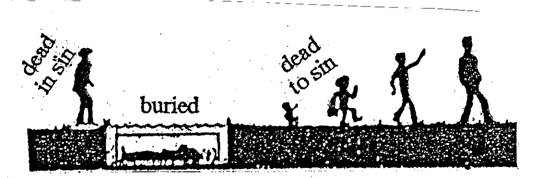
John 3:16 on the War Path
“For God so loved the world that He gave His only begotten Son, that whoever believes in Him should not perish but have eternal life” (Jn. 3:16). This verse has been called “the golden text of the Bible.” We hear it quoted often, but do we really look at what it teaches?
It begins with “For God…,” which contradicts atheism. If God loved the world and sent His Son, then He exists. “But without faith it is impossible to please Him, for he who comes to God must believe that He is, and that He is a rewarder of those who diligently seek Him” (Heb. 11:6).
The statement that He “so loved” denies deism, which says that “God created the world and its natural laws, but takes no further part in its functioning” (Webster).
The statement—”He gave His only begotten Son,” implies a sacrifice and undermines the entire premillennial system, which says that God sent His Son to be a king, but the Jews killed Him, so He postponed the kingdom. Isaiah clearly predicted that Jesus would be “despised and rejected by men,” and that He would “pour out His soul unto death” (Is. 53:3,12). God sent His Son as a sacrifice for sin, and He fulfilled that mission. He never intended to become an earthly king over an earthly kingdom.
The expression—”His only begotten Son,” contradicts Judaism, which denies that the Messiah has come. Paul said that God promised this “through His prophets in the Holy Scriptures,” and that He was “declared to be the Son of God with power, according to the Spirit of holiness, by the resurrection from the dead” (Rom. 1:3,4). The statement also contradicts modernism, which denies miracles. Jesus was “begotten” by the Holy Spirit (Mt. 1:20), but this miracle is not the whole story of His being begotten. Paul quoted the prophecy, in Psalm 2:7, and applied it to Christ’s exalted position after His resurrection (Acts 13:32,33). It does not refer to origin, but to His exalted position. Hebrews 11:17 says Abraham “offered up his only begotten son.” This referred to his position of preeminence. Isaac was not the first, nor only begotten son of Abraham. Jesus was born of a virgin, lived as a man, died, was raised from the dead and has the position of the “firstborn” – preeminence (Col. 1:15-18).
Next, the verse says “that whoever” believes should not perish. This denies the Calvinistic doctrine that God has predestinated who will be saved and who will be lost. At the house of Cornelius, Peter said, “In truth I perceive that God shows no partiality. But in every nation whoever fears Him and works righteousness is accepted by Him” (Acts 10:34,35). Paul wrote the Romans: “Whoever believes on Him will not be put to shame…For whoever calls upon the name of the Lord shall be saved” (Rom. 10:12,13). If God predetermined who would be saved and lost, He is a respecter of persons and it is not true that “whoever believes” can be saved.
Being saved is conditioned upon “believing in Him.” This denies universalism, which teaches that “all souls will eventually find salvation in the grace of God” (Webster). The last verse in chapter three says, “He who believes in the Son has everlasting life; and he who does not believe the Son shall not see life, but the wrath of God abides on him” (v. 36). The belief that saves is not the kind that some of the rulers had (Jn. 12:42), but is obedient belief. Other translations of verse 36 clearly show this. “Those who don’t believe and obey him shall never see heaven” (Living Bible), “he who does not obey the Son shall not see life” (Revised Standard Version), and “he who disobeys the Son shall not see that life” (New English Bible).
Finally, the verse says “should not perish but have everlasting life.” This denies materialism, which says “matter is the only reality and that everything in the world…can be explained only in terms of matter” (Webster). There is a part of man that is not matter and will not pass away. John said, “The world is passing away, and the lust of it; but he who does the will of God abides forever” (1 Jn. 2:17).
The truth of John 3:16 is at war with many false doctrines in the world. Many who quote it to justify their doctrine of faith only, do not carefully consider what it teaches. A person who does not have enough faith to obey Christ does not have enough faith to be saved by faith.
The Great Salvation
The profound statement about the superiority of the revelation spoken by Christ, in Hebrews two, is based upon the description of the Son in the first chapter. Notice first that Christ is superior to the prophets. They were spokesmen for God, He is God; they told about God’s creation, He is the Creator; they described the magnificence of God, He is the express image of God; they predicted the suffering Servant, He purged our sins by His own death; they foretold that the seed of David would sit on his throne, He sits on the throne of David (Heb. 1:1-3). Christ is then declared to be superior to angels because the Father called Him His Son, and commanded angels to worship Him. Also, the angels were simply ministering spirits, the Son is the King who will rule until His enemies become His footstool (1:4-14).
After showing Christ’s superiority over the prophets and the angels, the writer said, “Therefore we must give the more earnest heed to the things we have heard, lest we drift away. For if the word spoken through angels proved steadfast, and every transgression and disobedience received a just reward, how shall we escape if we neglect so great a salvation, which at the first began to be spoken by the Lord, and was confirmed to us by those who heard him” (2:1-3).
The Word Through Angels
Notice first that the word spoken through angels refers to the Old Covenant. Stephen said the Jews have “received the law by the direction of angels and have not kept it” (Acts 7:53). Paul said that the law was “appointed through angels by the hand of a mediator” (Gal. 3:19). The writer of Hebrews said that law was weak and unprofitable and made nothing perfect (Heb. 7:18,19). He further said “For if that first covenant had been faultless, then no place would have been sought for a second” (8:7). When God, through Jeremiah, predicted a new covenant, that implied the old covenant would grow old and pass away (8:13).
Although the word spoken through angels was the lesser revelation, under it “every transgression and disobedience received a just reward” (Heb. 2:2). The word transgression means stepping across a line, or going beyond what is authorized. The word disobedience first meant imperfect hearing, then careless hearing and finally unwillingness to hear. It refers to a deliberate closing of the ears toward God’s word which had been delivered through angels.
The Word Through Christ
Just as the Son is greater than the prophets and angels, the word spoken through Christ is
greater than the word spoken through angels. The writer says the “great salvation” was first spoken by the Lord and was confirmed by those who heard Him. Jesus “has become a surety of a better covenant” (Heb. 7:22), which was “established on better promises” (8:6) and was dedicated “with better sacrifices” than the old (9:23). When Jesus instituted the memorial supper, He said “this is My blood of the new covenant…” (Mt. 26:28). This covenant was given through Christ, who is superior to angels, and was dedicated with His blood, which is superior to the blood of animals.
Jesus lived under the law (Gal. 4:4), and taught people to obey it, but there were words “first spoken by the Lord” that were different from the words spoken through angels. He told Nicodemus that a person must be “born of the water and the Spirit” in order to enter the kingdom of God (Jn. 3:5). He told Pilate “My kingdom is not of this world” (Jn. 18:36), and gave instructions about how those in the kingdom were to treat one another (Mt. 18:15-18). These things spoken by the Lord, and other things He revealed through the Spirit (Jn. 16:12,13) are superior to the covenant given through angels.
The Greater Responsibility
The writer appeals to the history of God’s people under the Old Covenant as a warning to those who live under the New. The question, “How shall we escape if we neglect so great a salvation?”, should be a sobering warning. If they received a just reward for violating the lesser covenant, how dare we assume that we will be guiltless if we transgress the greater revelation? We must be wary not only of transgressing the things dedicated by the blood of Christ, but also of neglecting them. William Barclay commented on the expression “drift away,” “For most of us the threat of life is not so much that we should plunge into disaster, but that we should drift into sin. There are few people who deliberately and in a moment turn their backs on God; there are many who day by day drift farther and farther away from Him.”
The “great salvation” is superior to the message spoken through angels, because it came through a superior Messenger. The writer of Hebrews, reasoning from the lesser to the greater, implies that we have a greater responsibility because we have a greater revelation, “therefore we must give the more earnest heed to the things we have heard.”
Baptism, then what?
Some time ago, I read about a preacher who preached a funeral sermon and said over and over, “All I can say about the deceased is that he was baptized.” The preacher was accused of “preaching the man to torment.” Of course, what the preacher said had nothing to do with the man’s eternal destiny. Preachers are not judges and neither send people to torment nor to paradise! What the preacher did was emphasize for the living that simply being baptized does not stamp your ticket to heaven.
The sixth chapter of Romans shows that baptism is not only the end of something, but also the beginning of something. We “died to sin” when we were “buried with Him through baptism into death, that just as Christ was raised from the dead by the glory of the Father, even so we also should walk in newness of life” (v. 4). When we die to sin, we not only escape slavery to sin, we also become “slaves of righteousness” (v. 18), and must produce “fruit to holiness” (v. 22).
In baptism, we are “delivered from the power of darkness and translated into the kingdom of the Son of His love” (Col. 1:13). Baptism is the instrument of circumcision (it does not take the place of circumcision). Paul described it this way: “In Him you were also circumcised with the circumcision made without hands, by putting off the body of the sins of the flesh, by the circumcision of Christ, buried with Him in baptism, in which you also were raised with Him through faith in the working of God, who raised Him from the dead” (Col. 2:11,12).
Another way to describe baptism is a new birth. Jesus said one must be “born of water and the Spirit” in order to enter the kingdom of God (Jn. 3:5). Paul described the same process as being “sanctified with the washing of of water by the word” (Eph. 5:26). The person who is baptized in obedience to the word of God is in the kingdom (Jn. 3:5), or the church (Eph. 5:26). Another way the Bible describes it is “baptized into Christ” (Gal. 3:27). When a person is in Christ, he is a “new creation (creature), old things have passed away; behold, all things have become new” (2 Cor. 5:17).
Jesus said “Every branch in Me that does not bear fruit He takes away; and every branch that bears fruit He prunes, that it may bear more fruit” (Jn. 15:2). What will happen to the one who has simply been baptized and does not produce fruit? “If anyone does not abide in Me, he is cast out as a branch and is withered; and they gather them and throw them into the fire, and they are burned” (Jn. 15:6). We are “in the vine” (Christ) when we are baptized into Him, but branches in Christ are expected to bear fruit. We bear fruit in personal growth as well as in teaching others.
Peter said newborn babes should “desire the pure milk of the word, that you may grow thereby” (1 Pet. 2:2). How is your appetite? Simply being baptized does not make one grow up in Christ. Growing must follow the birth!
Does God Hear Prayers of Sinners?
The statement of the man who had been healed of his blindness: “Now we know that God does not hear sinners; but if anyone is a worshiper of God and does His will, He hears him” (Jn. 9:31), is often read without considering the context and other Bible teaching on the subject.
Notice the example of Saul of Tarsus(Acts 9). He was “breathing threats and murder against the disciples of the Lord” (v. 1), when the Lord appeared to him on the road to Damascus. When Jesus told him “I am Jesus, whom you are persecuting,” he was told to “Arise and go into the city, and you will be told what you must do” (v. 6). Three days later, the Lord told Ananias to go to Saul, “for he is praying” (v. 11). For what was he praying? The Bible does not say, but it does clearly reveal that Saul was not saved by prayer. He was not in Christ, and therefore could not pray for remission of sins. This is a spiritual blessing for those who have been baptized into Christ (Acts 8:13-22).
Saul was saved when he obeyed what he was told to do. Paul himself said Ananias told him to “Arise, and be baptized, and wash away your sins, calling on the name of the Lord” (Acts 22:16). “Calling on the name of the Lord” here is obviously not prayer, for Paul had been praying, but had not called on the Lord. Neither is believing “calling on the name of the Lord.” Paul wrote, “For whoever calls upon the name of the Lord shall be saved. How then shall they call on Him in whom they have not believed? And how shall they believe in Him of whom they have not heard? And how shall they hear without a preacher?” (Rom. 10:13,14). Preaching, hearing, believing and calling are four different things! Peter said that in baptism we “appeal (call) to God for a good conscience” (1 Pet. 3:21). Clearly, Saul of Tarsus prayed before he was saved, but salvation was not by “the sinner’s prayer,” as denominational preachers teach.
The first Gentile convert, Cornelius, was “a devout man and one who feared God with all his household, who gave alms generously to the people, and prayed to God always” (Acts 10:2). Again, we do not know what he prayed for, but we know that he was not saved by prayer. In describing this conversion, Peter said, “Then the Spirit told me to go with them, doubting nothing. Moreover these six brethren accompanied me, and we entered the man’s house. And he told us how he had seen an angel standing in his house, who said to him, Send men to Joppa, and call for Simon whose surname is Peter, who will tell you words by which you and all your household will be saved” (Acts 11:12-14). Cornelius prayed, and “his prayer was heard” before he was baptized, but he was saved by hearing and obeying words, not by praying. Peter told his family to “be baptized in the name of the Lord” (Acts 10:48). Baptism “in the name of the Lord” is “for the remission of sins” (Acts 2:38).
What kind of sinner was the man talking about in John 9? Jesus had healed the blind man on the Sabbath day and some said, “This Man is not from God, because He does not keep the Sabbath. Others said, How can a man who is a sinner do such signs?” (v. 16). The Jews who were finding fault said, “we know this man is a sinner” (v. 24). The man who had been healed said, “Now we know that God does not hear sinners; but if anyone is a worshipper of God and does His will, He hears him” (v. 31). These Jews were not accusing Jesus of being a Gentile, but of being a disobedient Jew. The man who had been healed knew the Old Testament taught “If I regard iniquity in my heart, the Lord will not hear” (Ps. 66:18), and “The Lord is far from the wicked, but He hears the prayer of the righteous” (Prov. 15:29).
The sinner that God will not hear is the person who professes to be a child of God, but lives a life of rebellion to God’s word. It is a sobering thought to realize that if I refuse to listen to God’s word, he will not listen to my prayers. God told His people of old, “Behold, the Lord’s hand is not shortened, that it cannot save; Nor His ear heavy, that it cannot hear. But your iniquities have separated you from your God; And your sins have hidden His face from you, so that He will not hear” (Is. 59:1,2).
If a non-Christian prays for forgiveness, God will not hear (answer) that prayer. If a Christian lives in sin and refuses to repent, God will not hear (answer) his prayer. Think about it—if I refuse to listen to God’s word, why should he listen to my words? The truth is He will not!
Great Faith
Jesus taught his disciples: “Take heed to yourselves. If your brother sins against you, rebuke him; and if he repents, forgive him. And if he sins against you seven times in a day, and seven times in a day returns to you, saying, ‘I repent,’ you shall forgive him” (Lk. 17:3,4). The next statement of the apostles was “Increase our faith” (v. 5). The Lord’s reply was not what we might expect. He did not go into a discussion of how faith should grow, but said: “If you have faith as a mustard seed, you can say to this mulberry tree, ‘Be pulled up by the roots and planted in the sea,’ and it would obey you” (v. 6).
The power of faith is not in a powerful faith, but in a powerful God. If the faith is in the right source, it will not take much. In fact, Jesus said “as a mustard seed,” and that is not very great!
When Elijah confronted the prophets of Baal on Mt. Carmel, he showed faith in a great God, “one who answers by fire” (1 Kgs. 6:11). Later, his faith in God was overcome by his fear of Jezebel and he asked to die (1 Kgs. 19:4). Elisha, who took the place of Elijah, showed a God-centered faith in dealing with the Syrians. When the Syrians would make a move, Elisha would tell the king of Israel where they were. The king of Syria asked, “Will you not show me which of us is for the king of Israel?” (2 Kgs. 6:11). One of the servants said, “None, my lord, O king, but Elisha, the prophet who is in Israel, tells the king of Israel the words that you speak in your bedroom” (v. 12). God is not only omnipotent, but also omniscient.
When the Syrian army surrounded Dothan, one of Elisha’s servants asked, “Alas, my master! What shall we do? So he answered, Do not fear, for those who are with us are more than those who are with them” (2 Kgs. 6:15,16). Who was with Elisha? The Lord! He simply asked the Lord to strike them with blindness and led them into Samaria, the capital of Israel and then asked for their sight to be restored. Imagine how they felt! But, Elisha fed them and sent them back to their master. “So the bands of Syrian raiders came no more into the land of Israel” (2 Kgs. 6:23). The great God had responded to a small faith.
We need to strengthen our faith, but more than that, we need to have our faith in the right place. Jesus said, “if you have faith as a mustard seed, you will say to this mountain, move from here to there, it will move; and nothing will be impossible for you” (Mt. 17:20). We do not have to wait until we have a great faith to overcome “mountains” that obstruct us, but we do need trust in the great God that we serve.
Salvation by Grace
There are two extremes on how the Christian is justified by grace. Some teach that God’s grace covers all our sins and that once a person is saved, he cannot fall from grace. The Bible clearly teaches that some fell from grace (Gal. 5:1-4). Paul gave twenty-three thousand examples of apostasy and said, “Therefore let him who thinks he stands take heed lest he fall” (1 Cor. 10:8-12).
The opposite extreme is that if a Christian does not keep law perfectly he will be lost. This is a legalistic view of Scripture and the book of Romans clearly teaches that justification is by grace, not by perfect works (Rom. 4:1-4). Does this mean that we have no law? No! The book of Romans also teaches that “where there is no law, there is no transgression” (v. 15), and “sin is not imputed when there is no law” (5:13). If the Christian has no law, he cannot commit sin and therefore would need no grace.
The book of Romans teaches that we are not justified by the law of Moses. “Therefore by the deeds of the law no flesh will be justified in His sight, for by the law is the knowledge of sin” (3:20). “Therefore we conclude that a man is justified by faith apart from the deeds of the law” (3:28). The Jews were made “dead to the law through the body of Christ” because when He died on the cross the Old Law was taken away (Rom. 7:4; Col. 2:14).
Justification is not by the law of Moses, nor by perfectly keeping Christ’s law, but it is conditional upon obedience to the “form of doctrine” that was delivered (Rom. 6:17,18). The form of doctrine is “the law of the Spirit of life” (8:2). It is the good news; the gospel of Christ! But those who do not “obey the gospel” will not be saved by it (Rom. 6:17,18; 10:16). No book emphasizes salvation by grace more than the book of Romans, and yet no book more clearly teaches the necessity of obedience in order to be saved by God’s grace.
In the sixth chapter, the apostle teaches that we reach the death (or the blood) of Jesus by being buried in baptism into His death. “Or do you not know that as many of us as were baptized into Christ Jesus were baptized into His death?” (v. 3). The old man, or the body of sin was crucified with Him when we were baptized into His death and raised to walk a new life. When those dead in sin are buried in baptism, they die to sin and arise to walk a new life because they have been saved by God’s grace through their obedient faith.
In the tenth chapter, Paul teaches that there is more to do than simply believe. He said “whoever calls upon the name of the Lord shall be saved” (v. 13). But before a person can call, he must believe, and before he can believe, he must hear. Before he can hear, there must be a preacher (referring to the original messengers of the gospel) (v. 14). Just as a person may hear and not believe, he may believe and not call. Calling, then, cannot be believing. Jesus said, “Not everyone who says to Me, Lord, Lord, shall enter the kingdom of heaven, but he who does the will of My Father in heaven” (Mt. 7:21). Notice carefully—those who call will be saved (Rom. 10:13); those who do the will of God will be saved (Mt. 7:21), therefore calling on the name of the Lord is obeying the will of God.
Salvation is a gift, but it is a conditional gift. If it were not, everyone would be saved (Tit. 2:11). God has given conditions in His word, the gospel of Christ. We cannot earn His favor, but we can, and must, obey Him in order to receive His grace.
Sanctification
A creed says: “They who are effectually called and regenerated, having a new heart and a new spirit created in them, are further sanctified, really and personally, through the virtue of Christ’s death and resurrection, by his Word and Spirit dwelling in them…Although sanctification (is) inseparably joined with justification, yet they differ, in that God in justification imputeth the righteousness of Christ; in sanctification his Spirit infuseth grace, and enableth to the exercise thereof; in the former, sin is pardoned; in the other it is subdued…” (Presbyterian Confession of Faith, 1956 edition, pg. 40,123). This doctrine is sometimes called “the second work of grace.” The first work is justification and the second is sanctification.
In order to understand the Bible teaching on this subject we must have a clear definition of the two words. Justification is defined as “the act of pronouncing righteous” (W.E. Vine). His basic definition of sanctification is “separation to God.” Obviously, the words describe two aspects of salvation, but they do not describe a first and second work of grace. Is a person pronounced righteous (justified) at one point and separated to God (sanctified) at a different point?
Notice some things the Bible says were sanctified, or made holy. Moses was “standing on holy ground” (Ex. 3:5), the temple was called “the holy place” (Mt. 24:15) and Jerusalem was “the holy city” (Mt. 27:53). There were various times that were called sanctified, or holy: the Sabbath (Dt. 5:12), and the fiftieth year (Lev. 25:10-12). People were called holy, or sanctified: the firstborn of men (also of animals, Ex. 13:2), the priests (Ex. 28:41), the nation of Israel (Dt. 7:6), and Christians in Corinth (1 Cor. 1:2).
When is a person sanctified or set apart? Jesus said the Corinthians were “washed…sanctified… justified in the name of the Lord Jesus and by the Spirit of our God” (1 Cor. 6:11). This did not mean that they could not commit sins (read 1 Cor. 1-3!), but they had been called by the gospel and “obtained the glory of our Lord Jesus Christ” (2 Thess. 2:12,13). He told the Ephesians that they had been sanctified and cleansed “by the washing of water by the word” (Eph. 5:26).
As a result of being justified (forgiven) and set apart from the world (sanctified) believers are to “grow in grace and knowledge” and “be holy in all your conduct” (1 Pet. 1:14,15; 2 Pet. 3:18), but that is not a “one…two” (or first and second) act. It is a continual process. The beloved apostle John said, “If we (that includes himself) say that we have no sin, we deceive ourselves, and the truth is not in us” (1 Jn. 1:8).
The doctrine that those who receive “the second work of grace” (which they call sanctification) lose all desire to sin is contrary to the truth. We are forgiven (justified) and set apart (sanctified) and should “walk in the light as He is in the light” and if we do that and “confess our sins, he is faithful and just to forgive us our sins and cleanse us from all unrighteousness” (1 Jn. 1:7-9).
Death Frees
Romans chapters six and seven mention two things from which death makes one free. “For he who has died has been freed from sin” (Rom. 6:6), and “if her husband dies, she is free from that law, so that she is no adulteress, though she has married another man” (Rom. 7:4).
Notice the sixth chapter first. Paul said we are baptized into the death of Christ and into (our) death (Rom. 7:3,4). Before we can be joined to Christ, we must die to sin. That takes place when we are buried into His death, or His blood (Rev. 1:5), and “raised to walk in newness of life.” The new life follows the burial. When a person is baptized into Christ’s death, the “old man was crucified with Him” (Rom. 7:6), he is “freed from sin” (Rom. 7:7), or he is “set free from sin” (Rom. 7:18). The man who was dead in sin (Eph. 2:1,5), has died to sin and been raised to a new relationship with Christ.
Adam Clarke, who believed in sprinkling, made this comment on Romans 6:4: “It is probable that the apostle here alludes to the mode of administering baptism by immersion, the whole body being put under the water, which seemed to say, the man is drowned, is dead; and when he came up out of the water, he seemed to have a resurrection to life; the man is risen again; he is alive!” I would disagree with his word “probable,” since that is exactly what the passage says, but he had the right idea about what happens when one is buried in baptism. The man who was dead in sin, is buried and dies to sin, because there he receives the benefits of Christ’s blood and he arises from his former state of spiritual separation to being united with Christ.
In the seventh chapter, Paul uses the marriage relationship to show the believer’s relationship to the Law. He said a woman is bound to her husband as long as he lives, “but if the husband dies, she is released from the law of her husband” (Rom. 7:2). If she marries another, while her husband lives, she is an adulteress. (This does not discuss the exception in Matthew 19. It is talking about the general rule.) The application of the example is that we must be “dead to the law” before we can be “married to another, even to Him who was raised from the dead” (Rom. 7:4). What we are dead to, we are separated from!
Just as dead to sin means separated from it, dead to the law means separated from it. We can no more be under two Testaments at the same time than we can be married to two people, or joined to sin and to Christ at the same time. Death to sin frees us to walk a new life, death to the Law frees us from the Old Testament, and a companion’s death frees us to marry another.
The Question of God
A book by the above title was written by Dr. Armand M. Nicholl, Jr., who is an associate clinical professor of psychiatry at Harvard Medical School and the Massachusetts General Hospital. The book, written in 2002, presents a contrast between the beliefs of C.S. Lewis and Sigmund Freud. Chapter two discusses their beliefs about the question, “Is there an intelligence beyond the universe?” Here are some interesting quotes about the two men.
“As an atheist, Lewis agreed with Freud that the universe is all that exists—simply an accident that just happened. But eventually Lewis wondered whether its incredible vastness, its precision and order, and its enormous complexity reflected some kind of Intelligence. Is there Someone beyond the universe who created it?” Freud refers to himself as “a materialist, an atheist, a godless medical man, an Infidel and an unbeliever.” He called his worldview “scientific, because of its premise that knowledge comes only from research. Of course, this basic premise cannot itself be based on scientific research. Rather, it is a philosophical assumption that cannot be proven. One can only assume that all knowledge comes from ‘research,’ and that ‘no knowledge,’ comes ‘from revelation.’ Freud appears to realize that logically one cannot prove a negative—one cannot prove that God does not exist. The only real defense of his worldview is to discredit its alternative.”
“For the first thirty years of his life, Lewis shared Freud’s atheism. His materialism took definitive form soon after he entered his teens…A decade later, as a faculty member at Oxford, Lewis experienced a radical change—a change from atheism to belief based on the Old and New Testaments. Through a series of discussions with faculty members whose intelligence he greatly respected, and through the reading of certain authors over a period of many years, Lewis came to a firm belief, not only in a Creator of the universe, but also a belief that that Creator stepped into human history.”
Freud explained man’s faith in God as an illusion. “We possess intense, deep-seated wishes that form the basis for our concept of and belief in God. God does not create us in His image; we created God in our parents’ image—or, more accurately, into the childhood image of our father. God exists only in our minds.” Lewis countered by saying that “the biblical worldview involves a great deal of despair and pain and is certainly not anything one would wish for.” He said “Freud’s argument stems from his clinical observations that a young child’s feelings toward the father are always characterized by a ‘particular ambivalence’ – i.e., strong positive and strong negative feelings. But if Freud’s observations hold true, these ambivalent wishes can work both ways. Would not the negative part of the ambivalence indicate the wish that God not exist would be as strong as the wish for his existence?
Lewis found this to be true in his own life. He notes in his autobiography that as an atheist his strongest wish was that God not exist. Lewis wanted no one to interfere with his life…Atheism appealed to Lewis because it satisfied his deep-seated wish to be left alone.”
“Both Freud and Lewis describe strong negative feelings toward their fathers when they were children—feelings that they wrote about often as adults—and, in addition, both associated their fathers with the spiritual worldview they rejected as young men…So perhaps these intense negative childhood feelings in Freud and Lewis toward the first authority in their lives caused resistance to the very notion of an Ultimate Authority.”
“Freud thought that the human race would someday outgrow the need for belief—especially as the masses became more educated. In fact, according to a recent Gallup poll, though more Americans are more educated today than ever before, more also believe God plays a direct role in their lives than ever before.”
Lewis said, “when Freud is talking about how to cure neurotics he is speaking as a specialist on his own subject, but when he goes on to talk general philosophy he is speaking as an amateur…I have found that when he is talking off his own subject and on a subject I do know something about…he is very ignorant.”
The Pursuit of Pleasure
This week, we are continuing to quote from “The Question of God,” written by Dr. Armand M. Nicholl, Jr., which contrasts the teachings of Sigmund Freud and C.S. Lewis. (If you did not read last week’s bulletin, be sure to read it.
In the chapter entitled “Sex – Is the Pursuit of Pleasure Our Only Purpose?”, the author said: “Freud and Lewis wrote extensively about sexuality. Freud said that when you look at people’s behavior, their one purpose in life is to be happy and that ‘sexual love…(is) the prototype of all happiness.’ Lewis strongly disagreed. He believed there are other, more lasting sources of happiness. Satisfaction of the desire for sex, like satisfaction of the desire for food, is only one of many God-given pleasures. He considered Freud much too preoccupied with sex.”
The author of this book said: “Half of all marriages end in divorce. From my clinical practice of many years and my research on young adults who come from divorced families, I can say unequivocally that a great deal of unhappiness in our society results from failure to understand the distinction between being in love (Eros) and loving in the deeper sense (Agape). The majority of couples that come to my office contemplating divorce come because one of them has fallen in love with someone else. That person claims they no longer are in love with their spouse. The husband (or the wife) met someone at work and came to feel those wonderful feelings that were once felt toward the spouse—of being in love. Mistaking the feeling of being in love as the only basis for a relationship and the only source of real happiness, the person sees no reason for staying in the marriage. He (or she) fails to realize that the feeling of being in love in the new relationship will also inevitably change, so that he may find himself once more in love with yet another person. A high percentage of second marriages end in divorce.”
The author said: “both Freud and Lewis agree that for the well-being of both the individual and society, sexual impulses need to be controlled. Their reasons, however, differ considerably. Freud argues that civilization imposes certain restrictions on the individual to maintain social order. This causes the individual to be discontent and less than happy. Lewis argues that the moral law comes from a Creator who loves us and desires our happiness. Following that law will help us to love more effectively and, therefore, to be more happy.”
The author said that when Lewis entered Oxford University, “whatever restraints he imposed on his sexual life did not arise from his conscience.” Lewis wrote of his early college years, “I was as nearly without a moral conscience as a boy could be.” As a soldier, Lewis wrote, that he did not “waste money on prostitutes, restaurants and tailors, as the gentiles do…You will be surprised and, I expect, not a little amused to hear that my views at present are getting almost monastic about all the lusts of the flesh. But he made it clear that his reasons for refraining from such behavior were not on moral or spiritual grounds…He feared that he might become ill physically or emotionally.”
Some of Lewis’ fellow students, who also became believers, said that before their conversion their sexual experiences were a desperate attempt to overcome their loneliness. “After their conversion experience, they attempted, like Lewis, to live the strict biblical standard of chastity or marriage with complete fidelity. Though this severe restriction conflicted strong with their past behavior, and with current mores, they found these clear-cut boundaries less confusing than no boundaries at all and helpful in relating to members of the opposite sex ‘as persons rather than sexual objects.’”
That sounds a whole lot like first Corinthians 6:13-20, doesn’t it!
Is Death Our Destiny
The above title is the last chapter in the book “The Question of God,” by Dr. Armand M. Nicholi, Jr. This book contrasts the teachings of Sigmund Freud and C.S. Lewis.
The author first discussed Freud’s attitude toward death. He quoted “Thoughts for the Times on War and Death” in which Freud said “death does not exist in our unconscious mind. Our minds appear to be so constructed that we expect permanence…Our unconscious then does not believe in its own death; it believes as if it were immortal.” Freud became obsessed with death and was certain that “he would die at forty-one; then at fifty-one, then at sixty-one and sixty-two, and when he was seventy he was certain he would die at eighty.” He died at 83, an unbeliever, having taught that men invented God because they were afraid of death, but did not attend his own mother’s funeral when she died at ninety-five years of age. The author asked “What could possibly have been the reason he missed the funeral? Was he so terrified of death he could not bring himself to attend?”
C.S. Lewis, at one time said that atheism was an attraction to him “because it gratified my wishes.” He said that he had a strong “need to be free of any Authority interfering with his life” but this became intolerable. “Unlike Freud, who hated growing old and who referred to the process continually in negative, pessimistic terms, Lewis appeared to enjoy the process. Writing to a friend a month before his death, he exclaims, ‘Yes, autumn is the best of the seasons; and I’m not sure that old age isn’t the best part of life.’”
The author asked “how could Lewis or anyone else be prepared for death, to face this ‘penal obscenity’ with not only cheerfulness, calmness, and inner peace, but with actual anticipation? Did his worldview provide him with the resources that made this possible? Perhaps, again, we find the answer in his own words: ‘If we really believe what we say we believe—if we really think that home is elsewhere and that this life is a ‘wandering to find home,’ why should we not look forward to the arrival?”`
“What accounts for the profound impact the writings of C.S. Lewis and Sigmund Freud continue to have on our culture a half century after their deaths? One reason for their impact may be that, whether we realize it or not, we all embrace some form of either the materialist worldview advocated by Freud or the spiritual worldview advocated by Lewis. But there may be more subtle reasons. Perhaps Freud and Lewis represent conflicting parts of ourselves. One part raises its voice in defiance of authority, and says with Freud, ‘I will not surrender’; another part, like Lewis, recognizes within ourselves a deep-seated yearning for a relationship with the Creator.”
The author concluded: “Our tendency to distort and create our own God, sometimes a God not of love but of hate, may explain why, over the centuries, people have committed, and continue to commit, ungodly acts—even acts of terrorism—in the name of God. This tendency to create our own God gives us insight into why the first commandment is: ‘You shall have no other gods before me.’”
Is All Service Worship?
Several years ago a preacher in the Christian Church made the argument to me that if we cannot play an instrument in worship, we cannot play one anywhere, because “everything we do is worship.” Though it may be difficult to distinguish the difference between worship and service in some passages, the fact that not all service to God is worship is obvious from the words and from the way they are used in Scripture.
Some have used: “Therefore, whether you eat or drink, or whatever you do, do all to the glory of God” (1 Cor. 10:31), to argue that if you cannot use instrumental music to praise God, you cannot use it at all. That is the result of ignoring the context and twisting the Scripture. The context begins in verse 14, when Paul warns against participating in idolatry. He said when Israel ate sacrifices to idols, they were having fellowship with idols, and Paul urged believers in Corinth not to participate in the fellowship of demons (v. 20). Yet, they could “eat whatever is sold in the meat market” (v. 25), if they understood that such action was not worship to an idol. If the action were done as worship to an idol, it was wrong, but if done for a different purpose there was nothing wrong with it.
The same principle is true of eating bread and drinking grape juice. Those foods may be eaten for food, or for worship to God. If we are worshiping God and eating those foods as a social meal, we are not “discerning the Lord’s body” (1 Cor. 11:29); if we eat other foods as a social meal, we are not worshiping God.
Jesus cleansed the temple twice because men had failed to distinguish between service and worship (Jn. 2:14-16; Mt. 21:12,13). The services of selling doves and making change were good works, but Jesus said they were being done in the wrong place. The “house of prayer” had become “a den of thieves.” Maybe they thought that if they could sell doves and exchange money anywhere, they could do it in the temple. Jesus did not agree with their reasoning!
Worship is defined as: “broadly it may be regarded as the direct acknowledgement to God, of His nature, attributes, ways and claims, whether by the outgoing of the heart in praise and thanksgiving or by deed done in such acknowledgement” (W.E. Vine). Thayer commented: “Among the Orientals, especially the Persians, to fall upon the knees and touch the ground with the forehead as an expression of profound reverence…hence in the New Testament by kneeling or prostration, to do homage (to one) or make obeisance, whether in order to express respect or to make supplication.” Regardless of how obedient subjects were, they had not worshiped until they had performed acts of reverence that were required by the kings.
The Bible confirms this definition of worship. Shadrach, Meshach and Abed-nego were faithful servants of Nebuchadnezzar, when the order was given that all must “fall down and worship the gold image” that King Nebuchadnezzar has set up (Dan. 3:5). These Jews knew the difference between serving the king and worshiping his image. If all service is worship, they had already worshiped the king and should have avoided the fiery furnace.!
In the first century those who refused to worship the Roman Emperor were not permitted to buy or sell (Rev. 13:17; 14:9,10). Those Christians knew the difference between serving the Emperor and worshiping him, and it cost them dearly.
Service is a more general word and may be used to describe worship, but not all service is worship. Abraham told the young men with him that “the lad and I will go yonder and worship” (Gen. 22:5). After David’s son died, he “went into the house of the Lord and worshiped,” then he went to his own house and ate food (2 Sam. 12:20). The Ethiopian had gone to Jerusalem to worship (Acts 8:27). The trip was not worship, but he went to worship. True worship has both an inward and outward dimension. It involves the attitude and the acts performed. If the worship was to the Emperor, it involved reverence expressed in whatever actions he required. If the worship is to God, it must be “in spirit and in truth” (Jn. 4:24).
It is not true that if you can serve the Emperor, you can worship him. Neither is it true that if you can play an instrument anywhere, you can play it in worship to God. Nor is it true that if you wash feet anywhere, you are worshiping God, or if you can eat meat anywhere, you can add it to the Lord’s supper and do it in worship.
Contemporary Worship
The Times Daily, February 11, 2008, had an article on churches “wrestling with the idea of new worship styles.” The preacher at St. Mark Missionary Baptist Church said they had “an old organ and piano,” but he wanted drums also. He said “it nearly split the church,” over adding another kind of instrumental music! The fact is that when they chose to add one kind of instrument, there was no reason not to add others. That is the way error works. “If we can do that, then we can do this” becomes the standard of action—not whether God’s word authorizes that, or this!
The article said “Contemporary worship services are nothing new. They grew out of the charismatic movement of the 1960s when some church-goers were seeking a style of worship different from their parents.” Their “feel good” religion led them to look for ways to feel better. They cannot know how God feels simply by how they feel. That comes only from His revelation (1 Cor. 2:11,12). He didn’t say anything The Times Daily, February 11, had an article on churches “wrestling with the idea of new worship styles.” The preacher at St. Mark Missionary Baptist Church said they had “an old organ and piano,” but he wanted drums also. He said “it nearly split the church,” over adding another kind of instrumental music! The fact is that when they chose to add one kind of instrument, there was no reason not to add others. That is the way error works. “If we can do that, then we can do this” becomes the standard of action—not whether God’s word authorizes that, or this!
The article said “Contemporary worship services are nothing new. They grew out of the charismatic movement of the 1960s when some church-goers were seeking a style of worship different from their parents.” Their “feel good” religion led them to look for ways to feel better. They cannot know how God feels simply by how they feel. That comes only from His revelation (1 Cor. 2:11,12). He didn’t say anything authority, there is no stopping place for apostasy.
The Times Daily article on churches in business (Feb. 13), said “Mars Hill Church of Christ…(is) among the churches that operate schools.” They see no difference between good works of individuals and the church. Secular education is a good work, therefore the church may provide secular schools. Certainly, they would not want to be anti-education!
A member of Tuscumbia Church of Christ who attends a Baptist Church that has “pool tables, table tennis and snacks” said she would “like to see us have pool tables or Friday Bible studies” but she attends Tuscumbia Church of Christ because of all her friends. She said that she sees no Scriptural difference.
Recently, a member of the church said he would answer a question about church kitchens when those in line to use the rest room would explain where they got the authority for the rest room! He didn’t try to find a passage of Scripture to authorize churches building kitchens, but found all the authority he needed in the rest rooms. That shows a total lack of understanding authority. When God told Noah to build an ark of gopher wood, there were things that were expedient and necessary to accomplish that job—such as tools for cutting and ways of transporting the wood. Suppose Noah had decided that since he used a saw to cut the lumber, he would build another boat, or use another kind of wood to build the ark! He may get tired of staying in that ark and need a contemporary way of recreation or fishing, so since he used tools to build the ark, he could reasonably build another boat!
There is a difference between using expedients to accomplish what God authorized and doing something different. The authority to sing authorizes whatever is expedient to accomplish that—such as song books, projecting words on a screen or using a pitch pipe. When we sing words from a book, or a screen and sing on pitch, we have not added another kind of music. We have done what God authorized.
But what about the rest room, and we could add pews, air-conditioning and heating? The authority to assemble implies a place of assembly. And if we assemble for a very long period of time there are things that expedite that assembly. The things mentioned above help in doing what God authorized—assembling for worship. Building a gymnasium, which would include running water, seats of some sort and rest rooms, expedite recreation. Building a kitchen, with electricity, running water, tables and a rest room accommodates the work of providing social meals. Recreation and social meals are not a part of worship, and do not expedite it. They are different works, just as surely as playing a piano, drums, an electric guitar, etc. is another kind of music. Those who defend churches building kitchens and gymnasiums cannot consistently object to instrumental music in worship, and the young people know that. A young boy at Cross Point Church of Christ said he likes the “praise band” at the Baptist Church, and “he sees little difference between what he hears coming from the pulpits.” The reason he sees little difference is that there is little difference to see! Paul said “sing and make melody in your heart” (Eph. 5:19), and “if any man is hungry, let him eat at home” (1 Cor. 11:34). He is not likely to hear either of these truths taught at Cross Point.
A young girl in Lakeland had been attending Bible classes with us for several weeks when her mother wanted her to go to their church for a special entertainment program. She told her mother that she didn’t want to go there, she liked to go to the church of Christ “because we get to study the Bible there.” What a novel idea for a church to be involved in the work God authorized!
Worship Versus Showtime
(Note: This article was written March 21, 1999, in Lakeland, Florida. It sounds like the things we have been hearing that many churches want in worship today—even in some churches of Christ)
The nation of Israel desired a king because the nations around them had kings (1 Sam. 8:5). Human nature has not changed, and it would be foolish not to learn from history that God’s people are influenced by their environment.
We see the influences of denominationalism among our more liberal brethren, and then we can expect to see some conservative brethren being influenced by the same activities.
In the April-June, 1997 issue of “Gospel Gleaner,” Wayne Jackson wrote an article entitled, “The Growing Trend Toward Jazzed-Up Worship.” His conclusion was that “this surge toward false emotionalism is due in part to the shallowness of our people in Scripture knowledge. Many have become so spiritually/intellectually lazy that they are looking for a quick-fix to alleviate their boredom. It is almost like some are searching for a sort of ‘Spirit’ drug on which to get a fast ‘high.’”
The thing interesting about this is that some (including Wayne Jackson) who have taught brethren that the church can do what the individual can do, and that there is no pattern for the work of the church, are now reaping the consequences of that lack of respect for Biblical authority.
In the October, 1998 issue of “The Spiritual Sword,” David Sain reviewed a book entitled “SHOW TIME! Worship in the Age of Show Business.” He, too, is lamenting the disrespect for the Bible pattern on worship, and agreed with the author of that book, who said there is a “shift in the focus of of our worship—away from God and toward one’s own interests. The worshipper has been placed at the center of worship!” He said that some defend entertainment on the basis that it “attracts the un-churched to Christianity.” But, he pointed out that “such a strategy is contrary to that which Jesus gave to his disciples, to whom he never suggested that they try to win the world by making Christianity attractive. Instead, Jesus basically said ‘tell it,’ not ‘sell it.’” We need to tell the message of salvation, not sell people on a superior entertainment program.
Evidently, some of the more liberal congregations are getting into drama, contemporary music, lifting hands and special music in worship. In response to the argument that “drama helps people remember the lesson,” David Sain said, “the end result of drama is supplanting of preaching (cf. Matt. 28:19), rather than the supporting of preaching, which, by contrast is what appropriate illustrations and visual aids do.” He sees clearly that there is a difference between an aid to accomplish what God authorized and the addition of another kind of action. To the argument that drama “awakens people spiritually,” he said this “implies that the gospel is lacking power (Rom. 1:16).” Then, he said, “Drama in the worship assembly is a practice for which there is no authority in the New Testament. God wants his word presented in simplicity through preaching (1 Cor. 1:18-21; 2:1-5). In the judgment of this reviewer, drama only feeds the desire for entertainment, and trivializes the teaching of God’s Word, reducing it to a ‘performer’ and ‘spectator’ level.”
Concerning the use of special music—solos, quartets and choirs in the public worship, he said, “A careful study of Ephesians 5:19; Colossians 3:16, et.al., will lead to the inescapable conclusion that vocal music is the only kind of music divinely authorized for Christian worship, and in the worship assembly of the church the singing that is authorized is congregational in nature.” Then, he correctly concluded that “special music produces an inescapable entertainment atmosphere.”
The battle over “traditional” and “contemporary” worship has been raging in the denominational world, and now it is beginning among our brethren. Those who have compromised Bible authority to justify the unscriptural things they want to practice (such as church kitchens and ball teams), are at a disadvantage in opposing these trends. We can certainly improve the spirit of our worship, but unscriptural gimmicks must not supplant spiritual worship as authorized by Christ.
Notes on Sunday Night Communion
1. Christians are authorized to partake of the Lord’s supper on the first day of the week (Acts 20:7). It is to be observed when Christians come together (1 Cor. 11:18,20,33).
2. It is an assumption to say that every member of a congregation must partake at the same time – in the same assembly on the first day of the week.
3. Communion is an individual act in an assembly of Christians. “But let a man examine himself and so let him eat of that bread and drink of that cup” (1 Cor. 11:28).
A. Guilt for partaking in an unworthy manner is individual – not congregational (1 Cor. 11:27).
B. Examination is individual (v. 28). There is no congregational examination.
C. Judgment is individual (v. 29). Accountability for observing is not congregational. If one partakes unworthily, the whole congregation is not responsible. (If there are three members of a congregation and two of them partake unworthily, it does not condemn the third one if he partakes worthily.)
4. The Bible teaches that some in an assembly may have come together for a different purpose than others.
A. Unbelievers may come into the assembly (1 Cor. 14:23), but they have not assembled to observe the Lord’s supper.
B. This shows that some may come for one purpose and others for a different purpose.
C. Many preachers speak at different congregations on Sunday. If they observe the Lord’s supper at the first place they speak, must they leave the other congregations before those present commune, or must they commune at every assembly because others came together for that purpose?
D. Just as unworthy participation of some in an assembly does not nullify the acceptable worship of an individual, the non-participation of some (whether they have already partaken, or whether they erroneously “feel unworthy to partake,”) has nothing to do with the individual doing what God told him to do in an assembly on the first day of the week.
5. If five families cannot assemble on Sunday morning, because of shift work, or other causes, may they assemble in the evening to observe the Lord’s supper together? Would it be scriptural for them to meet with another congregation that is partaking of the Lord’s supper in the afternoon? Remember that Paul and those with him in Troas were not members of that congregation (Acts 20). If those five families agree to meet in the afternoon to commune with Christ, would it be scriptural for others who have communed earlier to sing, pray and study but not commune? If one person who has communed in an earlier assembly may meet with a group that has come together to observe the Lord’s supper and not commune with them, any number could do the same.
6. Does “wait for one another” (1 Cor. 11:33) mean that all must wait until the last member is present before partaking of the Lord’s supper?
A. If this is the meaning, then we could argue that it is wrong to commune on Sunday morning, if some members cannot arrive until after noon.
B. The word “wait” means “to take or receive from, hence denotes to await, expect…it suggests a reaching out in readiness to receive something” (Vine). “Paul is correcting the party spirit at Corinth, the practice of parties which excluded those not members of it. He is saying, ‘Do not exclude one another, but receive each and all cordially.’ Everyone may have partaken of the supper at the same time, but that is not Paul’s point in this context, and there is nothing in the scriptures to indicate that it is obligatory. Furthermore, everyone partakes of the supper in our services today, that is, everyone who is supposed to partake of it does so at both the morning and evening services” (James Needham, in Palm Springs Bulletin, 7/16/73).
7. Does 1 Cor. 10:16,17 mean that the communion is congregational, therefore that all must partake at the same time?
A. Paul was in Ephesus when he wrote this letter to the Corinthians (1 Cor. 16:8). He included himself, and the believers in Ephesus and Corinth, (and all other believers doing the same) in the “we bless…we break…we all partake.”
B. The “one bread” refers to one bread in kind (unleavened bread), and the “one body” refers to the universal body, not to the local church. Brethren in Ephesus and Corinth partook of the one bread, which indicated their unity in the one body. It was common to all because they were observing it on the same day (first day of the week) and using the same elements (unleavened bread and fruit of the vine). The cup is not a congregational cup, and the bread is not a congregational loaf. There is one cup and one bread in kind, that is, every Christian partakes of the unleavened bread and fruit of the vine (1 Cor. 10:16.17). Those who argue for one cup (container) are really defending many cups – because they make “the cup” congregational vessels instead of the common fruit of the vine.
8. Some say that there is no example of the second serving, therefore it is not authorized.
A. Nor is there an example of individual communion cups, separate Bible classes nor a second assembly on the Lord’s day. Does this prove that these things are not authorized?
B. The point is not whether they are mentioned in examples, but are they authorized? When a Christian partakes of the fruit of the vine from an individual container, has he done what God authorized? When a Christian assembles on the first day of the week, examines himself and partakes of the Lord’s supper, has he done what God authorized him to do on the first day of the week?
C. Is it not strange that you never hear anything about a “second song service,” or the “second preaching service,” or the “second giving service”? We have no example of these things being done in two assemblies on the Lord’s day, but we have authority to do them. Likewise with providing the Lord’s supper. (The same is true of giving – we provide an opportunity for those who have not given at an earlier service, but not to those who have already given.)
D. The fact is that their mode of transportation (as in this country in years past) probably did not permit two or three assemblies in one day. They probably stayed longer at their one assembly, but it has nothing to do with whether it is scriptural to meet more than once.
9. Some object that Sunday evening communion encourages some to lay out Sunday morning because they know they can come Sunday evening and commune.
A. The same objection could be raised against Sunday night preaching. Some may say they can go fishing Sunday morning and go hear preaching Sunday evening! That person’s problem is not the Sunday evening preaching, or communion, but an unfaithful heart.
B. We make no defense for those who willfully miss Sunday morning because they can worship Sunday evening, nor for those who miss Sunday evening because they worshiped Sunday morning. They both have the same problem!
Conclusion
God authorized Christians to observe the Lord’s supper on the first day of the week in an assembly. There is no proof that every Christian in an assembly must partake at the same time, nor that every member must partake acceptably, for others to commune with Christ. (Communion is with Christ, Mt. 26:29; 1 Cor. 10:16.) If one who has communed in an earlier assembly (such as a preacher who has preached at another congregation) can sit while others do what they came together to do – commune with Christ, any number may do the same thing. The Bible does not teach a “second communing,” but it does teach that a Christian has the right, and the responsibility, to partake of the Lord’s supper in an assembly on the first day of the week. If I were a member of a congregation that would not allow me to do what God authorized me to do on the first day of the week, unless I could be present when most of them partook of it, I would try to find an assembly where I could do what God taught me to do on the first day of the week.
If a person conscientiously feels that he cannot commune on Sunday evening, he should not be pressured to participate in that when he does not believe to be scriptural, but no Christian has the authority to forbid others doing what they believe God authorizes them to do.
The One Cup Doctrine
The Bible teaches there is ONE CUP (in kind), ONE VINE (in kind) and ONE BREAD (in kind) for ALL believers. This has nothing to do with the number of containers for the cup, nor how many vines were involved, nor how many pieces of bread were used.
1 Cor. 10:16,17 – “The cup of blessing which we bless, is it not the communion of the blood of Christ? The bread which we break, is it not the communion of the body of Christ? For we, being many, are one bread and one body; for we all partake of that one bread.”
Notes:
- Paul was in Ephesus when he wrote this letter (1 Cor. 16:8). He included himself in the “we,” along with the brethren in Corinth. Brethren in at least two churches blessed the same “cup” and partook of the “one bread.”
- One container advocates say Paul meant to say: “we, the assembled in Ephesus” bless the cup and eat the bread. The only reason to so conclude is to uphold a preconceived theory that is violated by the obvious meaning of the passage.
- Such an interpretation is contrary to the text, the context and other Bible teaching. There is no basis in the text for saying “we the assembled.” That is an addition to God’s word.
- The “one bread” and “one body” does not refer to the church in Ephesus. The “one body” is entered through baptism (1 Cor. 12:13). The “one body” is the universal church – all the saved of the entire world – and all believers partake of the one cup and one bread. (The “one container” advocates are many cuppers. They have a cup in every congregation.)
- Paul’s illustration (1 Cor. 10:18-21) is that all Israel were “partakers of the altar” when they ate of the sacrifices offered on altars (Num. 3:31; 23:1,14,29,30). Likewise, those who participated in idolatry, regardless of the number of idols, were partaking of “the table of demons.” Believers who partake of the Lord’s Table are all partaking of the same table, regardless of how many containers are used.
- Paul, in Ephesus, blessed the same “cup” that the Christians in Corinth blessed. There is no denying it. That’s what he said. Was it the container, or the contents that were blessed?
Are there two elements in the Lord’s Supper, or three?
- One container advocates contend that the bread represents the body, the fruit of the vine represents the blood and the cup represents the New Testament. The Bible teaches the bread represents the body and the cup, or fruit of the vine, represents the blood of the New Testament.
- Mt. 26:26-29 – “And as they were eating, Jesus took bread, blessed it and broke it, and gave it to the disciples and said, Take, eat; this is My body. Then He took the cup, and gave thanks, and gave it to them, saying, Drink from it, all of you. For this is My blood of the new covenant, which is shed for many for the remission of sins.”
- Mk. 14:22-25 – “And as they were eating, Jesus took bread, blessed it and broke it, and gave it to them and said, Take eat; this is My body. Then He took the cup, and when He had given thanks He gave it to them, and they all drank from it. And He said to them, This is My blood of the new covenant, which is shed for many.” (To make the container refer to the New Testament is a denial of what Jesus said.)
- Lk. 22:20 – “Likewise He also took the cup after supper, saying, This cup is the new covenant in My blood, which is shed for you.” (The container did not represent what was shed for our sins – but the contents represented the blood of the new covenant.)
- 1 Cor. 11:25,27 – “In the same manner He also took the cup after supper, saying, This cup is the new covenant in My blood. This do, as often as you drink it, in remembrance of Me…Therefore whoever eats this bread or drinks this cup of the Lord in an unworthy manner will be guilty of the body and blood of the Lord.” (Neither the container of the bread, nor of the fruit of the vine have any significance. The one who eats the bread or drinks the fruit of the vine “unworthily” is guilty of the body and blood of the Lord.)
Notes:
- Two writers (Matthew and Mark) say “blood of the new covenant,” and two (Luke and Paul) say the “new covenant in My blood.” Are these talking about two different things? No! Both are saying the same thing – the fruit of the vine (the cup) represented the blood that was shed that the new covenant might be effective (Heb. 9:17-20).
- The two things memorialized in the Lord ’s Supper are – His body and His blood. Paul said those who eat the bread unworthily are guilty of the body of Christ, and those who drink the cup unworthily are guilty of the blood of Christ (1 Cor. 11:27). The cup is a communion of the blood of Christ (1 Cor. 10:16). The containers of neither represent His body nor His blood.
The cups in the Passover
Lk. 22:17-20 – “Then He took the cup, and gave thanks and said, Take this and divide it among yourselves; for I say to you, I will not drink of the fruit of the vine until the kingdom of God comes. And He took bread, gave thanks and broke it, and gave it to them, saying, This is My body which is given for you; do this in remembrance of Me. Likewise He also took the cup after supper, saying, This cup is the new covenant in My blood, which is shed for you.”
Notes:
- “One container” advocates are divided in their interpretation of this passage. George A. Hogland says the cup in verse 17 is different from the cup in verse 20. “The Lord’s supper was instituted at the Passover Supper. In that Supper four cups of the fruit of the vine were passed around at different intervals. The cup of Luke 22:17 is thought to be the second cup of the series. The cup of Luke 22:20 is the third of the series” (Did Jesus Use Individual Cups?, p. 25). Ronnie Wade says the cup in verse 17 is the Lord ’s Supper. “They seemingly forget that when Jesus said ‘divide it’ he has reference to the contents of the cup. And that the language involves a metonymy. How did they actually divide the cup? Let the Bible answer it. ‘They all drank of it’ Mk. 14:23” (This Do In Remembrance of Me, pg. 14,15).
- The Treasury of Jewish Holidays, by Hyman E. Goldin, p. 138 says: “One goblet or wineglass is placed on the table for each and every one who is to participate in the Seder service. Every participant, drank exactly four cups of wine, mead, or grape juice…The third time it was filled, it was called ‘the cup of blessing.’” A Jewish Rabbi in Dothan, Alabama told me that this is “common knowledge among the Jews” and gave Encyclopedia Judaica, by Keter Publishing Co., p. 173, as another source indicating the same.
- The context indicates that the “cup” of verse 17 is the same as verse 20. Note that in verse 16, Jesus said “I will no longer eat of it until it is fulfilled in the kingdom of God,” but in verse 18 He said “I will not drink of the fruit of the vine until the kingdom of God comes.” What they were to “divide among yourselves” (v. 17) is what Jesus said He would not drink until the kingdom came.
- But, some argue “if they drank from four cups, that is not a cup.” If each had his own container and drank the contents of the “cup of blessing” would they not have drunk the same cup? (If we “drink a pot of coffee” from our own containers, have we not drunk the pot of coffee?)
- The most natural explanation of Luke 22:17-20 is that the “cup” was “divided” into their individual containers, and then Jesus gave thanks for the bread and afterwards they drank of the “cup” which had already been “divided.”
What does “drink of it” mean?
“One container” advocates contend that the only way you can “drink of the cup” is for everyone to put his mouth to the same container. Study these parallels.
- 1 Cor. 9:7 – “Who ever goes to war at his own expense? Who plants a vineyard and does not eat of its fruit? Or who tends a flock and does not drink of the milk of the flock?” Would everyone who “drank of the milk” have to put his mouth to the same container?
- Mt. 26:29 – “But I say to you, I will not drink of this fruit of the vine from now on until that day when I drink it new with you in My Father’s kingdom.” Must everyone put his mouth to the same container to “drink of this fruit of the vine” with Jesus? The believers in Corinth and Ephesus ate the same bread and drank the same cup – but not from the same container (1 Cor. 10:16,17; 16:18).
- Jn. 4:12 – “Are You greater than our father Jacob, who gave us the well, and drank from it himself, as well as his sons and his livestock?” Obviously, they all drank the contents of the well – they did not put their mouths to the same container. (It is not being honest to quibble – “there was just one well.” The point is that Jacob, his sons and his cattle did not put their lips to the same container to “drink from it.”)
- 1 Cor. 10:4 – “And all drank the same spiritual drink. For they drank of that spiritual Rock that followed them, and that Rock was Christ.” When the Israelites drank of “that Rock” – did they all put their mouths to the same container? Yes, there was one source – but there were many containers.
Argument on the singular
One container advocates contend that “the cup” means one container for each congregation.
Notes:
- “The fruit of the vine” is “the cup.” It is one in kind – fruit of the vine (regardless of the number of vines). If each congregation must have one container, why not juice of one vine?
- The vine refers to the kind of vine and the cup refers to the contents which we drink. Paul, writing from Ephesus, told the Corinthians “the cup of blessing” is a communion of the blood of Christ, and “the bread” is a communion of the body of Christ. Furthermore, all believers are “one bread and one body” (1 Cor. 10:16,17). This has nothing to do with the number of pieces of bread, nor the number of people! There is one bread, just as believers are one body who partake of the one bread (in kind).
- The “cup” that was “divided among” them (Lk. 22:17) was not the container, but the contents.
- I believe in one cup (the fruit of the vine) and one bread (unleavened bread) for every Christian. “One container” advocates really believe in many cups and many breads – one container for the fruit of the vine and one piece of bread for each congregation.
Communion is individual
“One container” advocates contend that the unit of communion is the local church and that the whole church must use the same vessel for the fruit of the vine and the same piece of bread.
Notes:
- The Lord ’s Table was placed in the kingdom (Lk. 22:29,30). There are as many tables as there are kingdoms. There is one kingdom (the universal church), and there is one table (1 Cor. 10:21).
- Did all the apostles have to be in the same assembly in order to partake of the same table? Jesus told them they would “eat and drink at My table in My kingdom, and sit on thrones judging the twelve tribes of Israel” (Lk. 22:30). If the singular “table” means one location, then all the apostles had to be in the same assembly every time they communed with Christ.
- The Lord ’s Supper is to be eaten when disciples come together (1 Cor. 11:33), but the emphasis in Scripture is on each individual communing with Jesus. Guilt for unworthy observance was individual (1 Cor. 11:27). Examination is individual (v. 28). Judgment is individual (v. 29). Judging is to be of oneself (v. 31). There is no congregational guilt, examination, or judgment in observing the Lord ’s Supper.
- The communion (fellowship) is between the partaker and the Lord (1 Cor. 10:16,20). The cup is the “communion of the blood of Christ,” and the bread is “the communion of the body of Christ.” It is not “communion with those sitting beside you,” but with Christ. Yes, there is a sense in which we do it together (1 Cor. 11:33), but my acceptable communion does not depend upon the actions of others. If everyone else partakes unworthily, it does not affect my communion with Christ. If all the others partake worthily, it does not mean that I have partaken worthily.
Which is it? Container or contents?
Mt. 26:27-29 – The cup…this is My blood…I will not drink it until
Mk. 14:23-25 – The cup…this is My blood…the fruit of the vine
Lk. 22:17-20 – The cup…fruit of the vine…the new covenant
1 Cor. 10:16,21 – The cup a communion…drink the cup of the Lord
1 Cor. 11:25-28 – The cup…the new covenant …drink this cup
There is no Scriptural significance to the containers of the bread or the fruit of the vine. There is one bread (unleavened bread) and one cup (the fruit of the vine) in the Lord’s kingdom.
Is The Book of Mormon another Testament of Christ?
Introduction
- The Book of Mormon was published by Joseph Smith in 1830. The introduction of the book says: “the Book of Mormon was the most correct of any book on earth, and the keystone of our religion, and a man would get nearer to God by abiding by its precepts, than by any other book.”
- Jerald and Sandra Tanner have reproduced the original copy of the Book of Mormon and documented 3,913 changes. Many of the changes were in grammar or spelling, but some were in names.
- In 1982 the name was changed to “The Book of Mormon – Another Testament of Jesus Christ.”
- Bible students know that just as a woman cannot be married to two men at once, a person cannot be joined to two Laws at once (Rom. 7:1-4). A person had to die to the law before he could be “married to Christ.” Paul’s illustration was to show that Jews could not be “married to” the Old Covenant and another Covenant (the New) at the same time.
- The writer of Hebrews said: “For the priesthood (the Levitical priesthood) being changed, of necessity there is also a change of the law” (Heb. 7:11,12), and “He takes away the first that He may establish the second” (Heb. 10:9).
- The assertion that the Book of Mormon is “another Testament” means that Christ has two Testaments in effect at the same time.
- There are several books that claim to be “revelations from God,” but none can be accepted without rejecting the Bible as God’s word. Those who teach other revelations charge the Bible with being inadequate, corrupted or incomplete. If these charges are true, the Bible is not the truth and God did not keep His word (1 Pet. 22-25)
Why the Bible is Adequate
- The Bible claims to be God’s word. Jesus promised the apostles that the Spirit would guide them “into all truth” (Jn. 16:13). If He did, there are no new truths being revealed after the death of the apostles. If the Spirit did not guide the apostles of Christ into all truth, Jesus did not tell the truth.
- Paul said the Scripture furnishes (thoroughly equips) the man of God “for every good work” (2 Tim. 3:16,17).
- Peter wrote, “His divine power has given to us all things that pertain to life and godliness, through the knowledge of Him who called us by glory and virtue” (2 Pet. 1:3).
- Paul wrote, even if an angel from heaven “preach any other gospel to you than what we have preached to you, let him be accursed” (Gal. 1:8,9).
- Jude wrote, “exhorting you to contend earnestly for the faith which was once for all delivered to the saints” (Jude 3). We die once (Heb. 9:27), and “the faith” was once delivered!
- F.F. Bruce accurately stated: “The New Testament books did not become authoritative for the Church because they were finally included in a canonical list; on the contrary, the Church included them in her canon because she already regarded them as divinely inspired, recognizing their innate worth and generally apostolic authority, direct or indirect. The first ecclesiastical councils to classify the canonical books were both held in North Africa – at Hippo Regius in 393 and at Carthage in 397 – but what these councils did was not to impose something new upon the Christian communities but to codify what was already the general practice of these communities” (“The New Testament Documents – Are They Reliable?,” p. 27).
- Neil Lightfoot said, “The books of the Bible possess their own authority and indeed had this authority long before there were any councils of the church” (“How We Got The Bible,” p. 82).
How Did The Bible Come To Us?
1. Manuscripts (copies of the Bible in the original languages):
a. The Vatican manuscript (or Codex B) – a fourth century manuscript, housed in the Vatican Library since 1481. It contains 759 pages of the finest vellum on which most of the Old and New Testaments are written.
b. The Sinaitic manuscript – discovered at Mt. Sinai. It dates to the fourth century and contains most of the Old Testament and all twenty-seven books of the New Testament. It was discovered by a German named Tischendorf, in 1844-1859, and then put in the Imperial Library, St. Petersburg, Russia. In 1933, it was sold to the British Museum for half a million dollars. (Note: We could as reasonably say “the Russians gave us the Bible,” as we could “the Roman Catholics gave us the Bible”! Neither is true.)
c. The Alexandrian manuscript – dates to the fifth century. It was taken from Alexandria, Egypt to the British museum in 1627. Ten leaves are missing from the Old Testament, 25 from the beginning of the New, two from John and three from Second Corinthians.
d. The Dead Sea Scrolls – were discovered in 1947 and date back to the second century B.C. Scrolls were found of every Old Testament book, except Esther, and a complete manuscript of the book of Isaiah. These manuscripts simply confirmed the accuracy of what we already had.
e. Summary: There are over 5,000 manuscripts, or partial manuscripts of the New Testament (the number keeps growing), and some of them date back to 130 A.D.
Consider these facts about these ancient writings:
| When Written | Earliest Copy | Number of Copies Exist |
| Plato 427-347 B.C. | 900 A.D. | 7 |
| Tacitus c. 120 A.D. | 1100 A.D. | 20 |
| Herodotus 488-425 B.C. | 900 A.D. | 8 |
| Aristotle 384-322 B.C. | 1100 A.D. | 5 |
| New Testament 45-96 A.D. | 130 A.D. | 5,000 + |
2. Ancient Versions (translations from the original languages):
a. The gospel was preached on Pentecost in different languages (Acts 2:4,6), and that same gospel needed to be translated into different languages after it was written by Spirit-guided men (Eph. 3:3-5). Note: Translating a manuscript cannot corrupt the manuscript! The translation may be wrong in some point, but scholars can check the manuscripts which are genuine!
b. The Old Syriac – a language spoken in regions of Syria and Mesopotamia, was found in 1892. It contains the gospel accounts and is dated to the second century.
c. The Old Latin – thirty-eight fragments contain almost every book of the N.T.
d. The Latin Vulgate – revision of the Old Latin, from Greek manuscripts, made in 382-385. “Perhaps 10,000 copies of the New Testament in the Latin Vulgate exist” (Lightfoot, p. 43).
3. What about the Apocryphal Books?
a. The Catholic Church added Apocryphal (doubtful authenticity) books to the Old Testament. They have not removed any books; they have added books! But they have not added any to the New Testament – under which we live.
b. Why we reject the apocryphal books:
1. They were never included in the Hebrew canon of the O.T. Neither Jesus, the apostles, nor other Jews to whom the Law was given accepted them.
2. They were not accepted by such Jewish writers as Philo and Josephus (first century), the Jewish council of Jamnai (c. 90 A.D.), or by Origin and Jerome.
3. They do not show qualities of inspiration. Great portions are fictitious and contain historical and geographical errors.
4. Various books were read then, as today, in religious meetings but that does not prove they were regarded as inspired.
4. Mormon Testimony:
a. The Book of Mormon says: “…For behold, they have taken away from the gospel of the Lamb many parts which are plain and most precious; and also many covenants of the Lord have they taken away…Wherefore, thou seest that after the book hath gone forth through the hands of the great and abominable church, that there are many plain and precious things taken away out of the gospel of the Lamb, and exceeding great many do stumble, yea, inasmuch that Satan hath great power over them” (1 Nephi 13:26,28,29).
b. The Articles of Faith contradict this claim:
1. “It is evident, then, that from a time nearly three hundred years before Christ, the Old Testament has been current in both Hebrew and Greek; and this duplication has been an effective means of protection against alterations” (p. 242).
2. “Since the latter part of the fourth century of our current era, there has arisen scarcely a question of importance regarding the authenticity of the New Testament as at present constituted. During these centuries the New Testament has been accepted as a canon of scripture by professed Christians” (p. 245).
3. After presenting these historical facts, it speculates – “perhaps, many precious parts have been suppressed or lost, while some corruptions of the texts may have crept in, and errors have been inadvertently introduced through the incapacity of translators, the volume as a whole must be admitted as authentic and credible” (p. 248).
Conclusions:
- The “great and abominable church” could not have removed books or doctrines from the original manuscripts, because it did not exist in the fourth century, and never had all the manuscripts! (This accusation is only to cast doubt on the authenticity of the Bible – because they have another book they want to promote.)
- Translations cannot corrupt manuscripts. Even if the translation is inaccurate in some point, that does not change the manuscript from which it was translated.
- The Articles of Faith lists eighteen books that are supposedly lost from the Bible (p. 501). The Book of Mormon claims it was given to “establish the truth of the first” (the Bible), and “make known the plain and precious things which have been taken away from them” (1 Nephi 13:40). The truth? – Not one of the books mentioned as missing from the Bible is found in the Book of Mormon! Furthermore, there is no doctrine peculiar to the Book of Mormon that is consistent with what the Bible teaches.
- The fact that a book is mentioned in the Bible does not prove that it was inspired of God. It is pure assumption to say that inspired books, or doctrines, have been lost, but it is necessary in order to cast doubt on the Bible, so people will accept the Book of Mormon.
- Paul said, “I marvel that you are turning away so soon from Him who called you in the grace of Christ, to another (heteros – a different kind) gospel, which is not another (allos – the same kind)…But even if we, or an angel from heaven, preach any other gospel to you than what we have preached to you, let him be accursed” (Gal. 1:6-8). Angels are not going to bring “another gospel,” but some who claim angel visits have revealed different gospels from what the Holy Spirit revealed.
Note: I have presented this material to several Mormons and the only reaction I have received is that they would not trade their feelings for anything in the Bible. Their whole defense for the necessity of the Book of Mormon is flawed, but they chose to follow the “burning of the bosom” (their feelings) over what the word of God plainly teaches. If their feeling is the final source of authority – so is the feeling of everyone else! We can follow the word of God, or our feelings – but not both as the final standard of truth. Paul said “when you read, you may understand my knowledge in the mystery…” (Eph. 3:3,4), and he commended the Bereans because they “searched the Scriptures daily to find out whether these things were so” (Acts 17:11). Mormons misuse James’ statement – “if any of you lacks wisdom, let him ask of God…” (Jas. 1:5), to teach that we should read the Book of Mormon and pray for a feeling from God about whether it is true. James was writing to “brethren” (those who had obeyed the truth) and telling them to pray for wisdom in understanding how to apply his teaching. We believe because of evidence – not emotion. True emotion should be the product of the evidence – not the evidence!
A Crucial Test:
The Articles of Faith suggests “a crucial test, whereby the validity of falsity of any claim to divine authority may be determined” is whether the church organization is ever the same (p. 199). Note: It does not say to pray and ask God to give you a feeling about it, but to compare it with the Divine revelation to see if it is ever the same. So, let’s look at their organization and compare it with the Bible.
1. The Priesthoods:
a. “The Church of Jesus Christ of Latter-Day Saints recognizes two orders of Priesthood, the lesser called the Aaronic, the greater known as the Melchizedek order” (p. 204).
b. The Bible teaches:
1) The Aaronic priests were from the tribe of Levi (Num. 18:1,2).
2) Jesus was from the tribe of Judah (Heb. 7:13,14), therefore He could not have been an Aaronic priest (Heb. 8:4). But non-Jews (Mormons) claim to hold this priesthood.
3) The priesthood and the Law changed when Jesus died on the cross (Heb. 7:12; 8:7-13; 10:9-14). If the Levitical priesthood still exists, we are still under the Law of Moses.
4) There was only one man in the Old Testament to hold the priesthood of Melchizedek (Gen. 14:17-20). There is only one person in the New Testament who holds the priesthood of Melchizedek – Jesus (Heb. 7:1-10). David prophesied: “You are a priest forever according to the order of Melchizedek” (Psalm 110:4; Heb. 6:20; 7:17).
5) The fact that neither the birth, death nor ancestry of Melchizedek is known made him typical of the One who truly had no beginning or end. Any man whose parents, or birth is known cannot be a priest after the order of Melchizedek!
2. Deacons:
a. This is called “the first or lowest (office) in the Aaronic Priesthood” (p. 206). Boys may be appointed to this office at the age of twelve.
b. The Bible teaches, among other qualifications, deacons must “be the husbands of one wife, ruling their children and their own houses well” (1 Tim. 3:8-13). Nothing is said about holding the Aaronic priesthood – because the priesthood had changed (Heb. 7:12).
3. Elders:
a. Elders is another office of the Aaronic priesthood. They may be appointed at seventeen years of age, and ninety-six elders form a quorum, three of these constitute the presidency of the body” (p. 207).
b. The Bible teaches that elders, and bishops refer to the same work (Acts 20:17,28; Tit. 1:5,7). They must meet the qualifications (1 Tim. 3:1-7; Tit. 1:5-9), and be appointed in local churches. An unmarried young man cannot meet the qualifications of husband of one wife and have believing children.
4. Seventies:
a. The seventies “are primarily traveling elders” and are to preach “unto the Gentiles first, and also unto the Jews” (p. 207).
b. The seventy sent by Jesus taught “the kingdom of God has come near you” (Lk. 10:11). They were not in the church, or kingdom, because it had not been established. There was never an office of “seventies” in the New Testament church.
5. High Priests:
a. High Priests “are ordained with power to officiate, when set apart or otherwise authoritatively directed, in all the ordinances and blessings of the Church” (p. 207).
b. In the Old Testament, the High Priest (one at a time) was from the tribe of Levi and had to meet specific qualifications (Ex. 29:29,30; Lev. 21:10-15). In the New Testament, Christ is our only High Priest (Heb. 4:14; 7:26-28). All who have been purchased by the blood of Christ are “a holy priesthood” (1 Pet. 2:5; Rev. 5:9,10), and are to offer themselves as living sacrifices (Rom. 12:1,2).
6. Apostles:
a. Apostles “act under the direction of the First Presidency of the Church. Twelve Apostles, duly set apart, constitute the Quorum, or Council, of the Twelve” (p. 209).
b. The Bible teaches that an apostle must be one who accompanied Jesus from His baptism and have been an eye-witness of the resurrection (Acts 1:21,22). There were only two who were found who met the qualifications and only one of them was chosen. Paul was an exception, and said “last of all He (Christ) was seen of me also, as one born out of due time” (1 Cor. 15:8). The apostles and prophets were part of the foundation of the church, with Jesus as the chief cornerstone (Eph. 2:20). Neither the apostles, nor Christ must be on earth for the church to exist – and none of them are
7. The First Presidency:
a. The First Presidency is chosen by members of the High Priesthood and is “to be a seer, a revelator, a translator, and a prophet, having all the gifts of God which he bestows upon the head of the Church” (p. 210).
b. The Bible says Christ is “head over all things to the church, which is His body…” (Eph. 1:22,23). The Bible does not authorize a First Presidency, nor an earthly head of the church. The one body (Eph. 4:4) has one head
(Eph. 1:22,23).
Conclusion:
If you took a “crucial test” and missed every question, what would be your grade? The Church of Jesus Christ of Latter Day Saints does not have one office that is identical with the organization of the New Testament church. It is a human organization, set up by the wisdom of men, not by the Testament dedicated with the blood of Christ.
The First (or Old) Testament was dedicated by the blood of animals (Ex. 24:7,8). The Second (or New) Testament was dedicated by the blood of Christ (Mt. 26:28; Heb. 9:15-17). Any addition to that Testament is a reflection on the blood of Christ and has not been dedicated with His blood.
The Book of Mormon is NOT another Testament of Jesus Christ. It was not dedicated by His blood and is not in harmony with the Testament that WAS dedicated by that blood.
Other Contradictions
| Mormonism | The Bible |
| The stick of Judah is the Bible and the stick of Ephraim is the Book of Mormon (D. & C. 27:5). | Ezekiel wrote on both sticks and God gave him the meaning – Judah and Israel will be “one nation in the land” (Ezek. 37:22 |
| Mosiah 18:17 says “they were called the church of God, or the church of Christ, From that time forward.” (Dated: 147 B.C.) | Jesus said (in about 30 A.D.) “I will build My church” (Mt. 16:18). It was established in Jerusalem (Acts 2). |
| Alma 46:15 says they “took upon them, gladly, the name of Christ, or Christians as they were called, because of their belief in Christ who should come.” (Dated:73 B.C.!) | Acts 11:26 says “And the disciples were first called Christians in Antioch.” (This was about 41 A.D.) |
| Alma 7:10 says “And behold, he shall be born of Mary, at Jerusalem, which is the land of our forefathers.” | Micah 5:2 says He would be born in Bethlehem Ephrathah. Mt. 2:1 says He “was born in Bethlehem of Judah.” |
Note: Whoever wrote the Book of Mormon probably confused Zion (the city of David, 1 Chron. 11:5), with Bethlehem (the city of David, Lk. 2:11). Jerusalem was a walled city and never included Bethlehem.
Change in the Book of Mormon
The “Times Daily” (Nov. 9, 07), carried an article entitled: One-word change in Book of Mormon speaks volumes. The change is in the introduction to the Book of Mormon that says: “After thousands of years, all (the Jaredites) were destroyed except the Lamanites, and they are the principal ancestors of the American Indians.” The new version says “they are among the ancestors…” Mormonism has taught that the American Indians were descendants of people from Jerusalem. The article said: “After testing the DNA of more than 12,000 Indians, though, most researchers have concluded that the continent’s early inhabitants came from Asia across the Bering Strait.”
With no archaeological evidence for claims of the Book of Mormon, they continue to assert that evidence does not “eliminate the possibility” that the American Indians came from Jerusalem. But the truth is that there is more than one change in the Book of Mormon. It claims to be “the most correct book on earth, and the keystone of our religion, and a man would get nearer to God by abiding by its precepts, than by any other book” (Introduction in Book of Mormon). David Whitmer described the manner claimed for God’s deliverance of the B. of M.: “I will now give you a description of the manner in which the Book of Mormon was translated. Joseph Smith would put his face in the hat, drawing it closely around his face to exclude the light; and in the darkness the spiritual light would shine. A piece of something resembling parchment would appear, and on that appeared the writing. One character at a time would appear, and under it was the interpretation in English” (“An Address to Believers,” 1887, p. 12). This is copied from Jerald and Sandra Tanner’s reproduction of the original Book of Mormon—entitled “3,913 Changes in the Book of Mormon.”
Although Joseph Smith professed his translation to be inspired of God, it was filled with grammatical errors! Some of the changes, however, are changes of words since the 1830 edition. Here are some examples: 1 Nephi 11:18 changed from (Mary) “the mother of God” to “the mother of the Son of God.” Mosiah 21:28 and Ether 4:1 changed from king “Benjamin” to king “Mosiah.” 1 Nephi 13:32 “state of awful woundedness” changed to “awful state of blindness.” 2 Nephi 30:6 “white and delightsome people” changed to “pure and delightsome people.” These are just a few of the changes in words that supposedly were given by God. Some Mormons claim that the witnesses of the Book of Mormon made up the story about it being given “word for word,” but David Whitmer said “it was Joseph Smith himself who taught that the Book of Mormon was dictated word-for-word” (“3,913 Changes in the Book of Mormon,” p. 14).
One of the greatest flaws in the Mormon story is their teaching about the Priesthood. 1 Nephi 5:14 says Lehi was a descendant of Joseph, not of Levi. Nephi consecrated Joseph and Jacob (not the ones in the Bible), sons of Lehi to be priests. 2 Nephi 5:10 says they “keep the judgments, and the statutes, and the commandments of the Lord in all things, according to the law of Moses.” Then verse 26 says Nephi “did consecrate Jacob and Joseph, that they should be priests and teachers over the land of my people.” The Bible says: “So you shall appoint Aaron and his sons, and they shall attend to their priesthood; but the outsider who comes near shall be put to death” (Num. 3:10). Nephi said they observed “the commandments of the Lord in all things, according to the law of Moses” (2 Nephi 5:10). The Law plainly says priests were to be from the tribe of Levi (Num. 3:6-9), and any outsider who assumed that office should be killed. So they lied about keeping “the commandments of the Lord in all things.”
The Bible teaches the priesthood changed. “Therefore, if perfection were through the Levitical priesthood (for under it the people received the law), what further need was there that another priest should rise according to the order of Melchizedek, and not be called according to the order of Aaron? For the priesthood being changed, of necessity there is also a change of the law” (Heb. 7:11,12). Just as surely as we are not under the Old Covenant, we do not have Levitical priests! Christ Himself (being from the tribe of Judah) could not serve as a Levitical priest (Heb. 8:4), but Gentile boys in the L.D.S. Church claim to be Levitical priests. Jesus was “without father…mother…genealogy, having neither beginning of days nor end of life” is the only one who qualifies for the priesthood of Melchizedek (Heb. 7)!
Celestial Marriage
While visiting in Phoenix, Arizona, Joyce and I saw the Mormon temple there. We collected some material and saw several couples outside the temple who had just participated in celestial marriage (marriage for heaven). Of course, we could not go into the temple, but an impressive building in front of it gave propaganda about Joseph Smith’s religion.
A leaflet explaining the purposes of temples said: “In the temple, families can be united in the most sacred of all human relationships—as husband and wife and as children and parents—in a way that time cannot limit and death cannot end.”
“The Articles of Faith” of the Mormon church explains that celestial marriage is essential to eternal progression. That is the reason angels cannot progress in heaven. “They cannot be enlarged, but remain separately and singly, without exaltation, in their saved condition, to all eternity; and from henceforth are not gods, but are angels of God forever and ever” (p. 445). Devout Mormons believe that they can be sealed in the temple to their wives and children for eternity and this enables them to progress to becoming “gods.”
What does the Bible say about marriage? Paul wrote, “For the woman who has a husband is bound by the law to her husband as long as he lives. But if the husband dies, she is released from the law of her husband” (Rom. 7:2).
When the Sadducees asked about which of seven brothers the woman would have in the resurrection, Jesus said “For in the resurrection they neither marry nor are given in marriage, but are like angels of God in heaven” (Mt. 22:31). Mormons try to get around this by saying that she had to be married before the resurrection, but Jesus did not tell them about “celestial marriage.”
Luke’s account is more explicit than Matthew’s on this subject. “And Jesus answered and said to them, The sons of this age marry and are given in marriage. But those who are counted worthyto attain that age, and the resurrection of the dead, neither marry nor are given in marriage; nor can they die anymore, for they are equal to the angels and are sons of God, being sons of the resurrection” (Lk. 20.34-36). If angels in heaven are not married, neither will the sons of “that age” be married! Writers of the Pulpit Commentary summarized it well: “Marriage is, according to our Lord’s teaching, but a temporary expedient to preserve the human race, to which death would soon put an end. But in the world to come there will be no death and no marriage…The complicated earthly relations shall give place to the simplicity of sonship” (Vol. 16, pg. 169, 18). All will be “sons of God” and “equal to the angels,” in heaven—not husbands and wives!
Baptism for the Dead
Whether you have talked with a Mormon or not, the statement in 1 Corinthians 15:29 is difficult. After discussing the importance of the resurrection of the body, Paul said, “Otherwise, what will they do who are baptized for the dead, if the dead do not rise at all? Why then are they baptized for the dead?”
Sometimes it is easier to say what a passage does not teach than to explain what it does teach. We will first notice what it does not teach and then present a probable explanation of the true meaning of the passage.
Mormonism teaches that the living are to be baptized for those who are dead, so they can accept the vicarious baptism in the spirit world. The Book of Mormon does not teach this doctrine; in fact, it teaches against it. “For behold, this life is the time for men to prepare to meet God; yea, behold the day of this life is the day for men to perform their labors…therefore I beseech you that ye do not procrastinate the day of your repentance until the end; for after this day of life, which is given us to prepare for eternity, behold, if we do not improve our time while in this life, then cometh the night of darkness wherein there can be no labor performed” (Alma 34:32,33). In Doctrine and Covenants, Joseph Smith claimed to have received a revelation that they should be baptized for the dead. “And again, I give unto you a work in relation to the baptism for your dead. Verily, thus saith the Lord unto concerning your dead: When any of you are baptized for your dead, let there be a recorder, and let him be eyewitness of your baptisms…” (D. & C. 127:5,6). Mormons will use the Bible, but to them baptism for the dead is a revelation from God through Joseph Smith, who gave instructions about where and how it was to be done (D. & C. 124:29-32; 128:1-5).
There are a number of reasons that the passage cannot mean that the dead are to be baptized by proxy. (1) The Bible teaches that we will give account individually for the deeds we have done in the flesh (Rom. 14:12; 2 Cor. 5:10). (2) Abraham told the rich man that “those who want to pass from here to you cannot, nor can those from there pass to us.” When he asked that Lazarus go back to teach his brothers, he was told that they could hear “Moses and the prophets, let them hear them” (Lk. 16:26,31). The rich man was not going to receive another chance, and no one on earth could do anything to change his destiny. (3) Jesus said a person must “believe and be baptized” in order to be saved (Mk. 16:16). Mormonism teaches that one person can believe and another be baptized for him. Peter said “repent and be baptized” (Acts 2:38). Mormonism says one can be baptized and another (who is dead) can repent and accept proxy baptism. So, both faith and repentance may follow baptism! That contradicts Bible teaching.
What does the passage teach? There are many interpretations that I do not believe fit the context, but space will not permit an examination of those. I will present an interpretation that I believe fits the context and does not conflict with other Bible teaching.
Paul was defending the resurrection of the body, and after using the resurrection of Christ as evidence, he used baptism and his own “standing in jeopardy every hour” (1 Cor. 15:30) to argue his point. Baptism portrayed the very thing some of them were denying – the resurrection of the body. Paul was saying, “Why then are you baptized for (with reference to) the dead,” who never rise again – according to your belief? Their own practice of baptism is used as an argument against their denial of the resurrection. E.G. Sewell summarized it this way: “All who are buried with Christ in baptism declare by that act that they believe that he was buried and rose again; and in believing that he rose, we at the same time believe and by our action declare our faith in a resurrection of all the dead, of Christ first and through him all others. If Christ did not rise from the dead, burial with him in baptism would be meaningless; and if he rose not, then no others will rise, and the religion of Jesus is a failure at last” (Questions Answered, Lipscomb and Sewell, p. 165).
The same point is emphasized in the next verse. Paul said, “And why do we stand in jeopardy every hour?” If the dead are not raised, why were the Corinthians being baptized, and why were Paul and others jeopardizing their lives by preaching Christ? If there is no resurrection of the dead, neither baptism nor jeopardizing your life for the message of Christ makes any sense. These verses do not teach that we can be baptized for someone else, nor jeopardize our lives for someone else, but they teach that our baptism and faithfulness demonstrate a faith in being united with all others who have lived and died in the faith.
The Priesthood & Mormonism
The Articles of Faith published by the LDS church says, “The Church of Jesus Christ of Latter-Day Saints recognizes two orders of Priesthood, the lesser called the Aaronic, the greater known as the Melchizedek order” (p. 204). Since several Mormons have called and one wrote two ten inch square ads trying to defend the doctrine of the LDS church, I am going to print the articles that we have put in the Courier Journal and a letter that I sent responding to the two ads.
Their doctrine on Priesthoods is not taught in the Bible and contradicts what the Bible says about the two priesthoods. The Levitical (or Aaronic) priesthood was held by Jews who were from the tribe of Levi (Num. 18:1,2; Dt. 10:8). When Jeroboam appointed priests not from the tribe of Levi, he sinned 1 Kgs. 12:29-31). Jesus Himself could not have been an Aaronic priest because He was not from the right tribe (Heb. 7:14; 8:4), but Mormons who are not even Jews claim this priesthood.
There was only one man who held the priesthood of Melchizedek, and he was “without father, without mother, without genealogy, having neither beginning of days nor end of life, but made like the Son of God, remains a priest continually” (Heb. 7:3). The fact that God did not reveal his father, mother, birth nor death made him typical of Him who is truly without beginning or end—Jesus Christ. He is like Melchizedek “who has come, not according to the law of a fleshly commandment, but according to the power of an endless life. For He testifies: You are a priest forever according to the order of Melchizedek” (Heb. 7:16,17). Christ has no assistants and no successors in this priesthood!
In a sense, every Christian is a priest (not after the order of Aaron or Melchizedek), because each has been washed from his sins and offers himself as a living sacrifice (Rev. 1:5,6; 1 Pet. 2:2-5; Rom. 12:1,2). Everyone in the kingdom of Christ is a priest.
Here are three are ads that have been published in the Courier Journal (a weekly newspaper).
Is The Book of Mormon from God?
Mormons attack the Bible by saying “the great and abominable church” removed precious truths. Their “Articles of Faith” lists 18 books missing from the Bible ( p. 501). The Book of Mormon claims its purpose was to make known things removed from the Bible (1 Nephi 13:26,40). None of the 18 books in their list is included in the B. of M., so it was a complete failure in this mission. Jesus promised the apostles the Holy Spirit would guide them into all truth (Jn. 16:13). If Jesus kept His word and the Holy Spirit accomplished His mission, all truth was revealed before the death of the apostles. That message was once delivered (Jude 3) and abides forever (1 Pet. 1:25). The only reason to attack the Bible is they have a different “revelation” they want you to accept.
Did the Bible Predict the Book of Mormon?
Mormons teach that Ezekiel prophesied the coming of the Book of Mormon. They claim “the stick of Judah” is the Bible and “the stick of Ephraim” is the Book of Mormon (Ezek. 37:16). Notice the context. Ezekiel was to write on both sticks and God gave him the meaning. He was to join them in his hand and this would show that Israel and Judah would become one nation and one king would rule them (Ezek. 37:19-22). God would make a “covenant of peace” under the rule of David (Ezek. 37:24). This refers to the Covenant of Shepherd-King Jesus (Heb. 13:20,21). Jesus was raised to sit on David’s throne (Acts 2:29-36), and His blood dedicated the New Testament (Mt. 26:28). Ezekiel’s prophecy has nothing to do with the Book of Mormon.
Does the Book of Mormon contradict the Bible?
Yes! The book of Alma (claiming to describe events in 73 B.C.) says: “And those who were faithful; yea, all those who were true believers in Christ took upon them, gladly, the name of Christ, or Christians as they were called, because of their belief in Christ who should come.” The Bible, describing events in about 41 A.D., says “and the disciples were called Christians first in Antioch” (Acts 11:26). Paul wrote the Corinthians that to be “of Paul” two things would have been necessary – Paul crucified and baptism in his name. To be “of Christ” two things are also essential – Christ crucified and baptism in His name (1 Cor. 1:13-16). Neither of these things could have happened in 73 B.C., therefore they could not have been Christians.
Does emotion establish truth?
While I was working in Romania, there were calls and two large articles affirming that we should follow James 1:5 and ask God to confirm the Book of Mormon. First, this is a misuse of the passage. It was written to believers (Jas. 1:2) and they were to pray for wisdom in applying the truth they had received. Second, Scripture is our guide (2 Tim. 3:16,17), not our emotion. Muslims feel the Koran is God’s word. Christian Scientists feel Mrs. Eddy’s writings are from God. If emotion is the final authority, then everyone who feels right is right! The Bereans “searched the Scriptures” to determine the truth (Acts 17:11). Jesus told His apostles the Holy Spirit would guide them into “all truth” (Jn. 16:13). If that is true, the gospel they preached is for all nations (Mt. 28:18-20) and there are no new revelations.
(The following letter was sent to the Courier-Journal to answer the two ads and letter by Mr. Rodocker.)
The Editor:
A letter and two large ads were published by Mr. Rodocker while I was out of the country (working in Romania), so I would like to briefly reply to some of his statements.
He said that my teaching against doctrines that are contrary to God’s word is not following the example of Jesus. Matthew quoted Jesus as saying, “And in vain they worship Me, teaching as doctrines the commandments of men” (Mt. 15:9). That is the example I am following. Matthew 23 contains some of the sharpest rebukes against religious leaders that you will read anywhere.
Mr. Rodocker was responding to three short articles: (1) Jesus promised the apostles all truth would be revealed to them (Jn. 16:13), therefore no new truth could be given after the death of the apostles, which would exclude the Book of Mormon; (2) Their use of Ezek. 37. God told Ezekiel that the two sticks (representing Judah and Israel) would become “one nation,” not one Book; (3) I showed followers of Christ were called Christians first in Antioch (Acts 11:26), not in 73 B.C., as the Book of Mormon teaches. In his letter and two large ads, Mr. Rodocker did not answer either message I presented, he just attacked the messenger and gave his personal testimony. That does not change the facts I set forth in the articles.
He also misused James 1:5 to prove that we should pray for God to give us the feeling that the Book of Mormon is true. That passage was written to brethren, encouraging them to ask for wisdom in applying what God had revealed. He believes the LDS church is right, and all others wrong, because it has apostles and priesthoods. First, Jesus promised His apostles they would sit on thrones and judge His people (Lk. 22:30). They judge through the word they revealed (Lk. 10:16). There was only one successor to an apostle – Matthias, who took the place of Judas. The qualifications were: (1) accompany Jesus since His baptism and (2) be an eye-witness of the resurrection (Acts 1:22-26). There are no qualifiers today; only false apostles (2 Cor. 11:13). Second, the Levitical priesthood has been changed (Heb. 7:11,12). Jesus could not have been a Levitical priest, because He was not from the tribe of Levi (Heb. 7:14; 8:4). There was only one Melchizedek in the Old Testament and he was a priest and a king (Gen. 14:18-20). There is only one Melchizedek priest and king today – Jesus Christ, who had no beginning and no end; He has an endless life (Heb. 7:1-3,14-17). There are no qualifiers on earth today!
I have not criticized the good works nor the moral lives of Mormons. That is not the issue, but living a good life and being moral did not save Cornelius (Acts 10:1-3; 11:14), and it does not make a person’s doctrine right. Mr. Rodocker said the book of Mormon was given for the American continent. I wonder if God gave another book for South America and the other continents? The truth is that the Gospel of Christ (revealed through the New Testament writers) was given to “all the world” (Mk. 16:15,16).
The Christian and the Sabbath
The word Sabbath means “to cease, desist…cessation from activity” (W.E. Vine). Sabbatarians today contend that Christians should keep the Sabbath day holy because they believe the ten commandments are still in effect. What does the Bible teach about the subject?
The Law Was Given to Israel
Moses wrote: The Lord our God made a covenant with us in Horeb. The Lord did not make this covenant with our fathers, but with us, those who are here today, all of us who are alive” (Dt. 5:2,3). The covenant he described includes the ten commandments, and he stated that since the Lord brought them out of Egypt, therefore the Lord your God commanded you to keep the Sabbath day (Dt. 5:15). The preamble to the Ten Commandments says they were given to those brought out of the land of Egypt, out of the house of bondage (Ex. 20:2).
This is repeated several times in the Old Testament. Solomon said he built a house for the Lord: And there I have made a place for the ark, in which is the covenant of the Lord which He made with our fathers when he brought them out of the land of Egypt (1 Kgs. 8:21). 2 Chronicles 5:10 says: There was nothing in the ark except the two tablets which Moses put there at Horeb, when the Lord made a covenant with the children of Israel, when they had come up out of Egypt. Nehemiah said: You came down also on Mount Sinai, and spoke with them from heaven, and gave them just ordinances and true laws, good statutes and commandments. You made known to them Your holy Sabbath, and commanded them precepts, statutes and laws, by the hand of Moses Your servant (9:13,14).
The prophet Ezekiel taught the same about the origin of the Ten Commandments. Therefore I made them go out of the land of Egypt and brought them into the wilderness. And I gave them My judgments, which, if a man does, he shall live by them. Moreover I also gave them My Sabbaths to be a sign between them and Me, that they might know that I am the Lord who sanctifies them (Ezek. 20:10-12).
The New Testament teaches that the law was given to Israel and not to the Gentiles. For the Gentiles, who do not have the law, by nature do the things contained in the law, these, although not having the law, are a law to themselves (Rom. 2:14). “What advantage then has the Jew, or what is the profit of circumcision? Much in every way! Chiefly because to them were committed the oracles of God” (Rom. 3:1,2). So, the law, which included the ten commandments, was given to the Israelites after they came out of Egypt and not to the Gentiles.
Note: Sabbatarians try to contradict these passages by using Genesis 2:3: Then God blessed the seventh day and sanctified it, because in it He rested from all His work. It is assumption to say that God sanctified the seventh day the day after His creative week. When Moses wrote the book of Genesis, God had sanctified the seventh day, but this verse does not say when He did it. Compare the statement about Judas immediately after the apostles were chosen and given miraculous power. Matthew says: and Judas Iscariot, who also betrayed Him (Mt. 10:4). You may conclude that Judas betrayed Jesus as soon as he was chosen to be an apostle, but that is not true. When Matthew wrote this account, Judas had betrayed Jesus, but it was not until near the end of Jesus’ work, not at the beginning. Furthermore, when Israel was in the wilderness, a man violated the Sabbath by “gathering sticks” (Num. 15:32). They did not know the penalty for violation, so: They put him under guard, because it had not been explained what should be done to him (v. 34). Is it reasonable to believe that the Sabbath had been in effect since creation and no one had violated it until Israel came out of Egypt? God said the Sabbath was given to Israel as a sign between Me and you throughout your generations, that you may know that I am the Lord who sanctifies you” (Ex. 31:13). If the Sabbath was given to all nations, how could it have been a special sign between God and Israel?
How Long Was That Covenant To Last?
Paul told the Galatians that the law which was given four hundred and thirty years after the promise to Abraham, was to last till the Seed should come (Gal. 3:17-19). That law acted as a tutor (guardian) until the faith (the system revealed through Christ) came and after faith has come, we are no longer under a tutor (Gal. 3:25).
The contrast between the Old and New Covenants is clearly manifest in 2 Corinthians 3:6-18. The background to Paul’s argument here can be read in Exodus 34:29-35. The giving of the Old Covenant was a glorious occasion, but the giving of the New Covenant is more glorious.
Contrasts in 2 Cor. 3
| The Old Testament 2Cor. 3:14 | The New Covenant 2 Cor 3:6 |
| The Letter 2 Cor 3:6 | The Spirit 2 Cor 3:6 |
| The Letter Kills 2 Cor 3:6 | The Spirit gives life 2 Cor 3:6 |
| Ministry of death written and engraved on stones 2 Cor 3:7 | Ministry of the Spirit 2 Cor 3:8 |
| Ministry of condemnation 2 Cor 3:9 | Ministry of righteousness 2 Cor 3:9 |
| Was glorious 2 Cor 3:7,10 | Was more glorious 2 Cor 3:8,9 |
| Passing Away 2 Cor 3:11 | Remains 2 Cor 3:11 |
| Reading Moses 2 Cor 3:15 | Turning to the Lord 2 Cor 3:16 |
The fading of the glory on Moses’ face was typical of the passing of the Covenant revealed through him and that covenant specifically included what was written and engraved on stones!
The Two Covenants
In Galatians 4:21-31 Paul used another illustration of the two Covenants. Abraham’s wife (Sarah) and handmaid (Hagar) represented two covenants. For these are two covenants: the one from Mount Sinai which gives birth to bondage, which is Hagar (v. 24). The covenant given at Mount Sinai included the Ten Commandments (2 Chron. 5:10). The free woman (Sarah) represented the Jerusalem above (v. 26). Spiritual Jerusalem is the church of the Lord (Heb. 12:22,23). The handmaid Hagar, (who represented the Old Covenant) and her son Ishmael (who represented Jewish persecution, v. 29) were both cast out (v. 30). Paul’s conclusion: So then, brethren, we are not children of the bondwoman (representing the covenant) but of the free (v. 31).
Prophecy of The Coming of The New Covenant
Jeremiah prophesied: Behold, the days are coming, says the Lord, when I will make a new covenant with the house of Israel and with the house of Judah – not according to the covenant that I made with their fathers in the day that I took them by the hand to bring them out of the land of Egypt, My covenant which they broke, though I was a husband to them, says the Lord… (Jer. 31:31-34). The writer of Hebrews quotes this prophecy and concludes: In that He says, a new covenant, He has made the first obsolete. Now what is becoming obsolete and growing old is ready to vanish away (Heb. 8:13). When God, through Jeremiah said that a new covenant would be given, that meant the old covenant was going to become obsolete and vanish away.
When the book of Hebrews was written, the Old Covenant had passed away and the New Covenant had been established. The priesthood had changed, and of necessity there is also a change of the law (Heb. 7:12; 8:1). The writer said that Christ is the Mediator of the new covenant, which was dedicated by His death (Heb. 9:15,16), or by His blood (Mt. 26:28). The Old Covenant had been dedicated with the blood of animals (Heb. 9:18-20). After showing the superiority of Christ’s blood over the blood of bulls and goats (Heb. 9:1-4), he said: He takes away the first that He may establish the second. By that will we have been sanctified through the offering of the body of Jesus Christ once for all (Heb. 10:9,10).
The ten commandments are not part of the covenant dedicated by the blood of Christ. They were dedicated with the blood of bulls and goats!
We Are Dead To The Law
Paul used the illustration of marriage to show that men had to die to the Old Covenant before they could be joined to the New Covenant (Rom. 7:1-7). After saying a woman is free from the law of her husband after he dies, Paul said: Therefore, my brethren, you also have become dead to the law through the body of Christ, that you may be married to another, even to Him who was raised from the dead, that we should bear fruit to God (Rom. 7:4). To be dead to the law means the same as being dead to sin (Rom. 6:1,2). If you are dead to sin, you do not live in it, and if you are dead to the law, you do not live in it!
What law is Paul talking about? He identified it as the one that includes You shall not covet (Rom. 7:7; see Ex. 20:17).
Paul taught the same truth to the Ephesians. Having abolished in His flesh the enmity, that is, the law of commandments contained in ordinances, so as to create in Himself one new man from the two, thus making peace, and that He might reconcile them both to God in one body through the cross, thereby putting to death the enmity (Eph. 2:15,16). (Notice the underlined expressions in Rom. 7 and Eph. 2). It was through His body, His flesh or the cross that men died to the law!
Note: Adventists put the word “ten” in front of every occurrence of the word commandments – except in Ephesians 2:15, and here the context is talking about the commandments that were given to the nation of Israel (Dt. 4:13,14; 5:1-15), and not to the Gentiles who were strangers from the covenants of promise (Eph. 2:12).
Sabbatarian Two Law Theory
Adventists reject the two covenants of Gal. 4:24; 2 Cor. 3:6,14 and Heb. 8:13, and divide the Old Covenant into two covenants. They call part of the Old Covenant the law of Moses (or the ceremonial law) and part of it the law of God (or the moral law).
Here is their evidence: The law of Moses – was written by Moses in a book (Dt. 31:24), it was put by the side of the ark (Dt. 31:26), it contained seven Sabbath days and many offerings and feast days (Lev. 23:13-38), it contained the law of circumcision (Dt. 10:16), and these laws pointed to the death of Jesus and were temporary (Heb. 9:10,12,14). The law of God – was written by God (Dt. 4:12,13), it was written on stone (Ex. 31:18), it contains ten commandments (Dt. 4:13), it contained only one Sabbath day (Ex. 20:8-11), it was not nailed to the cross (Mt. 5:17-19) and we keep it by God’s grace (Phil. 4:13).
What is wrong with that picture?
The Bible does not make such a distinction. God gave the Law of Moses (Ezra 7:6), and Moses gave the Law of God (Neh. 10:29). Furthermore, Moses wrote the ten commandments twice (Ex. 20 and Dt. 5), because he wrote both Exodus and Deuteronomy!
Nehemiah called what Moses wrote: the Book of the Law of Moses ( 8:1), the Law of God (8:8), the Book of the Law of God (8:18) and the Book of the Law of the Lord their God (9:3).
The Bible says: the burnt offerings for the Sabbaths and the New Moons and the set feasts, as it is written in the Law of the Lord (2 Chron. 31:3). The days of Mary’s purification: according to the law of Moses was performed in Jerusalem as it is written in the law of the Lord (Lk. 2:22-24). Those things are not in the ten commandments, but are in the Law of the Lord! The Adventist doctrine on this is clearly unscriptural.
Other Scriptures Misused
Mt. 5:17,18 – Do not think that I came to destroy the Law or the Prophets. I did not come to destroy but to fulfill. For assuredly, I say to you, till heaven and earth pass away, one jot or one tittle will by no means pass from the law till all is fulfilled.
They use this passage to argue that the law under which Jesus lived (Gal. 4:4) did not pass away. First, the law and the prophets referred to the whole of Old Testament (see Mt. 7:12; 11:13; 22:40). Second, Christ came to fulfill the Law and the Prophets, and after His resurrection, He said: These are the things which I spoke to you while I was still with you, that all things must be fulfilled which were written in the Law of Moses and the Prophets concerning Me (Lk 24:44). If Jesus fulfilled His mission, every jot and tittle of the Law passed away, and if He did not fulfill it, not one jot or tittle of the Law or Prophets has passed away! (That includes much more than the Ten Commandments!)
When a man makes an agreement to buy a $100,000 house and fulfills that contract, he did not destroy it, but it ceased to be in effect. He may keep a copy and use parts of the same contract when he buys another house, but the terms from the first contract are only valid if they are included in the second. The Book of the Law of God was dedicated by the blood of animals (Neh. 8:18; Heb. 9:18-20). The New Covenant was dedicated by the blood of Christ (Mt. 26:28). There are lessons learned from the Old Covenant (Rom. 15:4), and many teachings are the same, but unless the instruction in the First Covenant is included in the Second Covenant, it has not been dedicated by the blood of Christ and is not to be bound on God’s people today.
Mt. 24:20 – And pray that your flight may not be in winter or on the Sabbath.
Adventists use this passage to argue that the Sabbath was being observed by Christians in 70 A.D., when the city of Jerusalem was destroyed. First, they ignore the word winter and focus on the word Sabbath. If Christians were observing the Sabbath, they were also observing winter as holy. Why would it have been more difficult to flee on the Sabbath or in the winter? The gates of the city would have been closed by the Jews on the Sabbath (Neh. 13:19), and travel would have also been made more difficult if it were winter. Neither has anything to do with Christians keeping the Sabbath or the winter as holy.
Isaiah 66:23 – And it shall come to pass that from one New Moon to another, and from one Sabbath to another, All flesh shall come to worship before Me, says the Lord.
Adventists use this verse to argue that Christians should keep the Sabbath “in the new earth.” Notice again they choose the part of the verse that suits their opinion and ignore the other part. If the verse teaches that we are to keep the Sabbath, it also teaches that we should keep the New Moon! Do they teach that we should be keeping New Moons? No.
Isaiah is describing the new heavens and new earth (v. 22); the time when the wolf and the lamb shall feed together, the lion shall eat straw like the ox, and dust shall be the serpent’s food. They shall not hurt nor destroy in all My holy mountain, says the Lord (65:25). This is the time when the root of Jesse (Christ, Rom. 15:12), would rule over his holy mountain (the church, 1 Tim. 3:15; Isaiah 11:6-10). Isaiah was describing our worship under Christ in words that his readers would understand. The New Testament says: Therefore let no one judge you in food or in drink (dietary laws of Moses), or regarding a festival (annual holy days), new moon (monthly holy days) or Sabbaths (weekly holy days), which are a shadow of things to come, but the substance is of Christ (Col. 2:16,17). The shadow is the Old Law; the substance (very image) is the New Covenant (Heb. 10:1,8,9). The New Covenant does not teach that certain foods are unclean, or that we should keep annual festivals (Passover, Pentecost, and Tabernacles), monthly new moons or weekly Sabbaths.
Acts 18:4 – And he (Paul in Corinth) reasoned in the synagogue every Sabbath, and persuaded both Jews and Greeks.
Adventists use this, and other passages where Paul went into the Jewish synagogue on the Sabbath to argue that he was observing the law in order to please God.
The context shows that Paul was using the occasion to teach his Jewish brethren about the Christ. Paul testified to the Jews that Jesus is the Christ. But when they opposed him and blasphemed, he shook his garments and said to them, Your blood be upon your own heads; I am clean. From now on I will go to the Gentiles (Acts 18:5,6).
At Antioch, Paul did the same thing (Acts 13:14), with a similar result. But when the Jews saw the multitudes, they were filled with envy; and contradicting and blaspheming, they opposed the things spoken by Paul (v. 45). Paul used the occasion of Jews being together to teach them the gospel of Christ, and I would be happy to go to a Synagogue or a Sabbatarian church on Saturday if given the opportunity to teach. That does not mean that I would be keeping the Sabbath holy, but would be doing as Paul did. He taught that the Old Covenant (the tutor) had served its purpose and that we are no longer under it (Gal. 3:24,25). When Paul met with Christians, he met on the first day of the week (Acts 20:7).
What About the First Day of The Week?
Mk. 16:1,2 –Very early in the morning, on the first day of the week, they came to the tomb when the sun had risen. Also, Jesus was declared to be the Son of God with power, according to the Spirit of holiness, by the resurrection from the dead (Rom. 1:4), which happened on the first day of the week.
Acts 20:7 – Now on the first day of the week, when the disciples came together to break bread, Paul, ready to depart the next day, spoke to them and continued his message until midnight.
Sabbatarians try to avoid the plain teaching of this verse by arguing that it was a common meal, or that the disciples did not observe the Lord’s supper on the first day of the week.
Was this a common meal? The expression “breaking bread” can be used of a common meal (Mt. 14:19; Acts 2:46; 20:11; 27:35), or the Lord’s supper (Mt. 26:26; 1 Cor. 10:16; 11:24). How is it used in Acts 20:7? First, notice that in the context of instructing the Corinthians about the proper observance of the Lord’s supper, Paul told them: when you come together to eat, wait for one another (1 Cor. 11:33). The next verse says, But if anyone is hungry, let him eat at home, lest you come together for judgment… (v. 34). He had told them they had houses to eat and drink in (11:22). They were not to come together as the church in Corinth to eat a common meal. So, the question is – did Paul do in Troas what he condemned in Corinth? Not likely!
Next, what does the context of Acts 20:7 indicate? Paul sailed away from Philippi after the Days of Unleavened Bread. He evidently met with Jews there on the Passover, and wanted to be in Jerusalem before Pentecost (20:16). (If we should keep the Sabbath because Paul met with Jews on that day, why not also Passover and Pentecost?) Paul and Luke sailed five days and joined others, who were on the same trip, at Troas, where we stayed seven days (v. 6). Did Paul and those with him wait seven days for the Christians in Troas to come together for a common meal? Verse 7 says Now on the first day of the week, when the disciples came together to break bread…Paul preached to them. If Paul waited seven days to assemble with the church to eat a common meal, he violated what he wrote to the Corinthians!
There is no reason to doubt that the disciples did what they came together to do on the first day of the week. Paul intended to depart the next day (v. 7) and after midnight his sermon was interrupted by Eutychus falling out of a window. Paul raised him from the dead, went back into the house, ate a common meal, (nothing is said about the other disciples in this eating), and left the next morning, after daybreak (v. 11). According to Roman time (as would have been used in Troas), Paul left on Monday morning. To deny that the disciples broke bread on the first day of the week is to deny they did what they came together to do!
1 Cor. 16:1,2 – Now concerning the collection for the saints, as I have given orders to the churches of Galatia, so you must do also: On the first day of the week let each of you lay something aside, storing up as he may prosper, that there be no collections when I come.
These verses tell us the Christians in Corinth came together every week. The Living Bible says on every Lord’s day, The New English, Jerusalem Bible and N.T. in Contemporary Language say every Sunday, and the N.I.V. says on the first day of every week. This would be implied in the expression the first day of the week, even if the word “every” were not there. When God said remember the Sabbath day to keep it holy (Ex. 20:8), did He mean quarterly, or weekly?
Adventists argue that the contribution was to be stored at home. If that is true, why did Paul specify the first day of the week and how would that avoid having collections when Paul arrived? Charles Hodge commented: “The words do not mean to lay by at home but to lay by himself. The direction is nothing more definite than, let him place by himself, i.e. let him take to himself what he means to give…The word thesaurizon means putting into the treasury, or hoarding up, and is perfectly consistent with the assumption that the place of deposit was some common treasury, and not every man’s own house…The only reason that can be assigned for requiring the thing to be done on the first day of the week is that on that day the Christians were accustomed to meet, and what each one had laid aside from his weekly gains could be treasured up, i.e. put into the common treasury of the church …The end which the apostle desired to accomplish could not otherwise have been effected. He wished that there might be no collections when he came. But if every man had his money laid by at home, the collection would be still to be made” (Commentary on First Corinthians by William B. Eerdmans Publishing Co., pg. 363,364).
Each Christian is to purpose in his heart what he will give (2 Cor.9:7), and that should be done at home, before he assembles with the church but he contributes it when he assembles.
Sabbatarians contend that the Law of Moses was done away but not the Law of God, then they go back to what they call the Law of Moses and teach tithing, which is not in the ten commandments, nor in the Covenant dedicated by the blood of Christ!
Did the Pope Change the Sabbath?
A charge often made by Sabbatarians is that the Pope changed the Sabbath to Sunday. When Roman Catholic authors claim their church changed the law, they are contending that the Roman Church is the one established on Pentecost, and that Peter was the first Pope. The apostles did teach that disciples were to observe the Lord’s supper and give as they had been prospered on the first day of the week. When Roman Catholics read Acts 20:7, they conclude this was the action of the Roman Catholic Church and therefore that church changed the day of worship. (The Orthodox Church makes the same claim.) Neither claim is true. The apostles were not Roman Catholic, nor Greek Orthodox!
Some historical quotes from “The Lord’s Day,” by D.M. Canright (published by Restoration Reprint Library):
Barnabas (A.D. 120) said: “Wherefore, also, we keep the eighth day with joyfulness, the day, also, on which Jesus rose again from the dead” (p. 131).
Justin Martyr (A.D. 140): “But Sunday is the day on which we all hold our common assembly, because it is the first day on which God, having wrought a change in the darkness and matter, made the world; and Jesus Christ, our Saviour, on the same day rose from the dead” (p. 137).
Clement (A.D. 194) – “He, in fulfillment of the precept, keeps the Lord’s Day when he abandons an evil disposition …glorifying the Lord’s resurrection in himself… The Lord’s Day, it will be seen here, and all along, is the resurrection day. Clement lived, not at Rome, but in Egypt. So Sunday-keeping was not simply a Roman usage” (p. 142). Adventists argue that the Romans authorized “the sun’s day” (Sunday) to take the place of the Sabbath, therefore it originated in heathenism. They neglect to notice that “Saturn’s day” (Saturday) was named for the Roman mythological “god of agriculture.” The names of the days of the week have nothing to do with when we should observe the Lord’s supper and give as we have been prospered. Those who worship God on Sunday are not honoring the Sun, neither are those who worship on Saturday honoring Saturn.
Tertullian (A.D. 200) – “We solemnize the day after Saturday… We neither accord with the Jews in their peculiarities in regard to food, nor in their sacred days” (p. 144).
Did Constantine Change the Day?
Constantine (A.D. 321) is the founder “in part at least, of the civil observance of Sunday. Before this law all Christians had voluntarily kept the Lord’s Day as a religious duty. Now the civil law required pagans to respect the Christian rest day…The pagans had to conform to the Christian day, not Christians to the pagan day” (Canright, pg. 189,190).
The Pope Did Not Change it
Some claim the Roman Pope changed the Sabbath to Sunday at the Council of Laodicea (A.D. 364). Quoting again from Mr. Canright: “Laodicea is not Rome…It was an Eastern, not a Western town… The Pope did not attend (In fact, there was no such office as Pope at that time. FJ), nor did he send a legate or a delegate or any one to represent him. In fact, neither the Roman Church nor the Pope had anything to do with the council in any way, shape or manner…McClintock and Strong’s Cyclopedia says of this council: ‘Thirty-two bishops were present from different provinces in Asia.’ All bishops of the Eastern Church, not one from the Roman Church!” (Canright, pg. 212-214).
Conclusion
There is no New Testament authority for observing the Lord’s supper on Saturday, for observing it quarterly, nor for the church taking a collection on Saturday.
The testimony of Scripture is that disciples in Troas came together to break bread on the first day of the week (Acts 20:7), and disciples in Corinth assembled every Sunday to worship and one of the things they did was give as they had been prospered (1 Cor. 16:1,2). These acts of worship were approved by the apostles of Christ and were practiced long before Constantine lived or a Roman Pope existed!
Rightly Dividing The Word
2 Tim. 2:15
| Old Covenant/Testament | New Covenant/Testament |
| First Covenant, Heb. 8:7 | Second Covenant, Heb. 8:7 |
| Old Testament, 2 Cor 3:14 | New Covenant, 2 Cor 3:6 |
| The Law, Jn 1:17 | Grace and truth, Jn 1:17 |
| Written on stone, 2 Cor 3:7 | Written in heart, 2 Cor 3:3 |
| Given at Sinai, DT 5:1-5 | Given at Jerusalem, Is 2:3 |
| To One Nation, 2 Chron 5:10 | To All Nations, Mk 16:15 |
| Not to Gentiles, Rom 2:24 | No Distinctions, Eph 2:15 |
| Dedicated with blood of animals,Heb 9:17-20 | Dedicated with blood of Christ, Mt. 26:28 |
| Priests temporary, Heb. 7:23 | Priest permanent, Heb. 7:24 |
| Physical circumcision, Gal. 5:2-4 | Spiritual circumcision, Rom. 2:28,29 |
| On Sabbath: No work, Ex. 20:10; Ex. 35:3 | On the first day of the week: worship, Acts 20:7; 1 Cor. 16:1,2 |
Click here for a Word document of this article that you can download print in booklet form.
Letter – Answering an Adventist
(This is a copy of the letter I wrote the Courier Journal Editor in response to Adventist, Buddy Mauldin’s letter trying to answer one of our ads.)
I would like to respond to some of the things Mr. Mauldin asserted in his criticism of my article on the gifts of the Spirit.
He said the baptism of fire (Mt. 3:11) refers to the tongues of fire on the apostles (Acts 2:3). First, Acts 2 says nothing about the tongues of fire being a baptism. The apostles were “baptized with the Holy Spirit” (Acts 1:5), not with fire. Notice the context of Mt. 3:7-12. Some of John’s audience were a “Brood of vipers” and he warned them to change (v. 7). He said he could baptize with water, but Jesus had greater power and would baptize “with the Holy Spirit and fire” (v. 11). Then, Matthew explained that Jesus would “gather His wheat into the barn; but He will burn the chaff with unquenchable fire” (v. 12). In describing the judgment, Jesus said the wheat and tares would be separated and the tares will be burned (Mt. 13:30). That’s what happens to the chaff, not the wheat! The parallel account in Luke is even plainer (Lk. 3:7-9,16,17). Luke said the tree that does not produce good fruit “is cut down and thrown into the fire” (v. 9), and Christ “will gather the wheat into His barn; but the chaff He will burn with unquenchable fire” (v. 17). To say the Apostles received the baptism of fire is to call them chaff or unfruitful trees!
Mr. Mauldin claims there is a contradiction between being washed in baptism and being washed in the blood of Christ. Revelation 1:5 does say we are “washed from our sins in His own blood.” When does that happen? When a person simply believes, or when he obeys Christ? Saul of Tarsus was told to “arise and be baptized and wash away your sins” (Acts 22:16). Is that two contradictory ways of having sins washed away? Certainly not! Paul explained that he had been “baptized into His death,” or “buried with Him through baptism into death” (Rom. 6:3,4). Christ shed His blood in His death, and we are baptized into His death and “raised to walk in newness of life.” Mr. Mauldin has a person walking in newness of life before he was buried into the death of Christ.
Then, he tries to nullify the promise of Christ: “He who believes and is baptized will be saved” (Mk. 16:16), by the dilemma of a person in the desert with no water to be baptized. By the same reasoning, I will deny the other requirement Christ gave. Another man, who was an atheist, is in the desert but someone convinces him that God exists. He does not believe Jesus was raised from the dead, but is on the way to study with someone about Jesus. He was too far away, had no water to survive and perished in the desert, therefore belief in Christ is not essential! Neither of these approaches is an effort to understand what Jesus taught. It is not my responsibility to judge the eternal destiny of either man. The Judge was crucified and raised from the dead (Acts 17:30,31). It is just as much a judgment to consign a person to heaven as it is to consign him to hell. Neither Mr. Mauldin nor I, have the responsibility to try to act in this capacity. It is my responsibility to teach what Jesus said, and leave the judging to the true Judge.
The Seventh Day Theory
(Note: The following material was written by J.C. Estes and published in a booklet entitled “Around the Lord’s Table,” in 1917. I made a few revisions for space purposes, but it is an excellent article.)
The Seventh-Day Adventists tell us that the first day of the week, as a day to meet and worship God, is an institution of the Roman Catholics. But they have never disproved its being an institution of the New Testament…Jesus came forth from the dead on the first day of the week (Matt. 28:1-6; Mark 16:1-16; Luke 24:1-8). The commandment “Remember the Sabbath day to keep it holy,” was given to the Jews and no one else (Deut. 5:15). No people except the Jews were ever brought out of Egyptian bondage by the Lord God. (See: 1Kgs. 8:21; 2 Chron. 5:10; Ezek. 20:10-12; Neh. 9:13,14. fj) The keeping of the Sabbath was a memorial of the Jews’ delivery from bondage. Therefore remember the Sabbath day to keep it holy; or, therefore the Lord thy God commanded thee to keep the Sabbath day. Because you were delivered from bondage by the mighty hand and the outstretched arm of the almighty God, he has commanded you (Jews) to remember the Sabbath day, to keep it holy. Because Jesus Christ came forth from the bondage of the grave on the first day of the week and thus broke the binding power of death death which the devil had, delivering us from such a bondage, he has given us examples of commemorating his resurrection on the first day of the week in the disciples meeting upon that day to break bread (Acts 20:7)…
“But,” says one, “did not Paul go into the synagogues of the Jews on the Sabbath day and teach?” Yes; but we have no example of Paul breaking bread (commemorating the Lord’s death and resurrection in partaking of the Lord’s Supper) on any day except the first day of the week…If we neglect the assembling of ourselves together on the first day of the week, we neglect the Lord’s Supper; and in all this neglect we have no promise of salvation should we die in our neglect of this duty. We do not have to be a thief, a murderer, a robber, a drunkard, nor a fornicator to be lost. If we neglect to do what we are taught to do as children of God, we shall not escape the punishment that awaits the unfaithful.
The Day of Resurrection
1. Jesus said that He would be raised on the third day after His death.
A. “From that time Jesus began to show to His disciples that He must go to Jerusalem, and suffer many things from the elders and chief priests and scribes, and be killed, and be raised again the third day” (Mt. 16:21; see also Mt. 17:23; 20:19).
B. Luke says that Jesus died on the day of Preparation “and the Sabbath drew near” (Lk. 23:54). The women watched where Jesus was laid, and then “they returned and prepared spices and fragrant oils. And they rested on the Sabbath according to the commandment” (Luke 23:56). “Now on the first day of the week, very early in the morning” they went to the tomb to anoint the body (24:1). That same day two men were traveling to Emmaus (v. 13) (that was the first day of the week, v. 1), and they told Jesus “today is the third day since these things happened” (v. 21). (“These things” referred to the crucifixion, v. 20). Jesus said, “Thus it is written, and thus it was necessary for the Christ to suffer and to rise from the dead the third day” (v. 46). Luke’s description is clear that Jesus arose on the first day of the week.
2. How the Jews reckoned time.
A. Esther gave instructions to “neither eat nor drink for three days, night or day” and then she would go before the king (Esther 4:16), but “on the third day” she went before him (Esther 5:1).
B. Rehoboam gave instructions to “come back to me after three days” (2 Chron. 10:5), but they came “on the third day” (v. 12). Obviously, part of a day was reckoned as a day. If Jesus was crucified on the day before the Sabbath (Friday), the third day thereafter would be Sunday. He was in the tomb a part of two days and a whole day (the Sabbath), which harmonizes with what Luke said about the events.
3. Events on the first day of the week:
A. Jesus arose from the dead on the first day of the week, thus was “declared to be the Son of God with power” on that day (Rom. 1:4). He appeared to Mary on that day (Jn. 20:11-16), also to a group of disciples on that evening (Jn. 20:19,20). The next Sunday (“after eight days” would be on the eighth day, or the next Sunday), He appeared to the disciples with Thomas (Jn. 20:26-29).
B. The gospel of Christ began to be preached and the church was established on the first day of the week (Lev. 23:15,16; Acts 2:1-4,47).
C. Disciples met to “break bread” on the first day of the week. In Acts 2:42 “the breaking of bread” is placed with other acts of worship. In Acts 20:7 the disciples came together on the first day of the week to break bread. Paul told the Corinthians that disciples are to come together for the Lord’s supper – not for common meals (1 Cor. 11:22-34).
D. Paul gave orders to the churches of Galatia and the Corinthian church to give on the first day of the week (1 Cor. 16:1,2). This clearly indicates that they would be together on the first day of the week – or they could not have collected the contributions on that day.
4. There is no New Testament evidence that the church observed the Lord’s supper or “laid by in store” (gave) on the Sabbath day. If we are to keep the Sabbath today – what does the Covenant dedicated by the blood of Christ teach us to do on that day?
Response to 70 A.D. Doctrine
This material was prepared about ten years ago, when a young man who had become a disciple of Max King’s doctrine of “realized eschatology,” “the 70 A.D. doctrine,” or “Max King-ism” moved to Lakeland and was looking for a church that would sympathize with his new doctrine. We discussed it in a preachers’ meeting, and the next month, Max King came from Ohio to help his disciple. The preachers had four hours of discussion that day.
It took me a while to understand what he meant by “already, but not yet,” but I finally understood that he was saying the same thing he had written – the Old “overlaped” the New. The New Covenant was established at Pentecost, but not fully until 70 A.D., the kingdom was established on Pentecost, but not fully until 70 A.D., and he didn’t say this, but logically Christ was not fully a priest after the order of Melchizedek until 70 A.D. (Heb. 7:10-12). The writer of Hebrews said, “Now this is the main point of the things we are saying: We have such a High Priest, who is seated at the right hand of the throne of the Majesty in heaven” (Heb. 8:1). But according to King-ism, He was not fully seated until 70 A.D. The priesthood and the Law did not fully change until 70 A.D. (It is granted that the Temple and genealogical records were destroyed in 70 A.D., but are we to assume that the Jews gave up circumcision as a sign of their relationship with God, as well as all the other teachings of the Old Law and fully submitted only to the New Covanant which “fully went into effect in 70 A.D.”?) Daniel said when Jesus “came to the Ancient of Days…Then to Him was given dominion and glory and a kingdom…” (Dan. 7:13,14). Peter said David did not ascend to heaven, but he wrote that one would ascend and be told “Sit at My right hand, Till I make Your enemies Your footstool” (Acts 2:35,35). But according to Max King, Jesus didn’t fully get that kingdom until 70 A.D.
This doctrine makes Matthew 24, instead of Acts 2, the “Hub” of the Bible. The O.T. looked forward to that day, and the N.T. looks back to it. The “coming of Jesus” in judgment against Jerusalem is the center of Bible teaching. When Jesus judged the city of Jerusalem, that was the end – the resurrection of the dead, and the final judgment! Max said he did not know what would happen to those who died after 70 A.D. According to him, the N.T. says nothing about anything to happen after that date, so any explanation he would make would be speculation. He surmises that the saved will go to heaven, and the lost to hell the day they die and there will be no general resurrection, but there is no Scripture that suggests such an idea, therefore it is purely his presumption.
Reply to Letter Defending 70 A.D. Doctrine
(Note: The following letter was written, in response to a long hand-written letter from a young man who had accepted the Max King doctrine on 70 A.D. I will not reproduce his letter, but those familiar with the doctrine will be able to follow my response to his arguments.)
Dear ____:
You suggested that it was my responsibility to help you “see the error of my way,” and though I believe that the material I gave you should have been adequate, I am going to make another effort by replying to the involved letter that you wrote.
I will say in the beginning, that it amazes me when brethren dogmatically know what difficult, and figurative passages mean, but cannot understand plain passages, and begin to interpret the simple passages to harmonize with their opinion established from the difficult passages. This, I believe, is the basic error of the “King” doctrine, as I will try to show you in this letter.
Argument I: You contend that the “resurrection” of Dan. 12:2,3 is the same as the “end of the age” in Mt. 13:39-41 and John 5:28,29.
1. The passage in Dan. 12 is much debated, and I certainly will not be dogmatic about what it means, but I will dogmatically deny that it contradicts the plain statement of John 5:28,29, which says “the hour is coming in which ALL who are in the graves will hear his voice and come forth – those who have done good, to the resurrection of life, and those who have done evil, to the resurrection of condemnation.” This did not happen in 70 A.D.!
2. Daniel said, “Many of those who sleep in the dust shall awake…” “Many” is not “all.” So, we begin with the simple acknowledgement of the meaning of words. Whatever Dan. 12 means, it does not mean the same thing as John 5:28,29. Speaking of the same “many,” (of Dan. 12:2), Daniel said “Many shall be purified, made white, and refined, but the wicked shall do wickedly…” (Dan. 12:10). It seems to me that Daniel is using “resurrection” here, as did Ezekiel in Ezek. 37, in a figurative sense. Ezekiel referred to the resurrection of the nation and here it seems that Daniel is talking about the “resurrection” of John 5:25,26 – those who hear the word of God “shall live.” Among those converted by the word of Christ, some would be faithful, and some would become wicked. John 5:28,29 say: “Do not marvel at this; for the hour is coming in which all who are in the graves will hear His voice and come forth – those who have done good, to the resurrection of life, and those who have done evil, to the resurrection of condemnation.” Some who were converted gave up the faith and went back into Judaism or the world. They had been “raised to walk a new life” (Rom. 6:3,4), but they went back into shameful living. That harmonizes with the plain teaching of the N.T. – both the righteous and wicked will be raised on the “last day” (Jn. 6:40,44; 12:48).
3. You assumed that the “end of the age” in Mt. 24 is the same as “the end of this age” in Mt. 13:39-43. In the parable in Mt. 13, Jesus says the field is the world, the good seed is the children of the kingdom, the tares are the children of the wicked one, the sower of the good seed is Christ, the sower of the tares is the devil, the harvest is the end of the world and the reapers are the angels. It is pure assumption to say that “the world” here is Jerusalem. The “end of the age” must be determined by context, and it is a perversion of the context to equate Mt. 13 with the destruction of Jerusalem. Jesus did not say “Jerusalem will be reaped” – He said “the world would be reaped at the end – nothing about 70 A.D.
4. You used Joel 2:28-32; 3:1,13-17 as though they prove that “the end of the age” referred to the second coming. Joel may refer to the destruction in Joel 2:31, but that does not mean the passage is talking about the second coming. He goes on to describe the second remnant (Joel 2:31; Is. 11:11; Rom. 11:5), not the second coming. This is also referred to in Amos 9:11-15 and applied to the church of the Lord in Acts 15:15-19. The description of “that day” in Joel 3:16-18 is parallel to Amos 9:11-15, and refers to the day when spiritually the redeemed will dwell with God in Zion or Jerusalem (see Heb. 12:22-24,28). It has no reference to the second coming and is perverted when so applied.
Argument II: Your second argument is based on the assumption that “at hand, shortly” etc., always mean the same thing.
1. I agree that brother____ misused Obadiah 15, when he applied it to “all nations,” (seemingly nations today), but that does not change the main point of his argument. Historically, Edom, and the surrounding nations were not destroyed until centuries after the time of Obadiah, yet he said it was “near.”
2. You said that Jeremiah’s prophecy, quoted in Heb. 8:7-13 has to mean that it was growing old when the writer of Hebrews penned those words. Why? Because you have a theory that this passage has to fit! The plain truth is that the Old Law had passed away, just as the Levitical priesthood had, before the writer of Hebrews wrote those words. The writer had just said that “the priesthood being changed, of necessity there is also a change of the law” (Heb. 7:11,12). Did Jesus become a priest in 70 A.D.? Zachariah had prophesied that “the Branch” would build a temple and “sit and rule on His throne (as King); So He shall be a priest (of Melchizedek) on His throne, and the counsel of peace shall be between them both” (Zech. 6:12,13). The Bible plainly says that Jesus was raised from the dead “to sit on David’s throne” and that when He ascended to heaven, He “sat on the throne of His Father” (Eph. 1:20; Rev. 3:21). Eph. 2:19-22 shows that the Ephesians were a part of the “temple” which was built upon Christ. Hebrews 8:1 (which you believe was written before 70 A.D.) plainly says “We HAVE such a High Priest, who IS SEATED at the right hand of the throne of the Majesty in the heavens.” A doctrine that teaches that the temple of God was not fully built and Christ was not fully a priest or a king until 70 A.D. is not an innocent theory! But there is much more evidence on this subject. The writer of Hebrews said, “But now He HAS OBTAINED a more excellent ministry, inasmuch as He is also Mediator of a better covenant, which WAS ESTABLISHED on better promises” (Heb. 8:6). If the law was changed when the priesthood was changed (Heb. 7:12), and the “better covenant” WAS ESTABLISHED when the writer of Hebrews wrote this, it could not refer to 70 A.D.! In Hebrews 10:10, the writer said “we have been sanctified” through the sacrifice of Christ. When was that fully in effect? It began on Pentecost (Lk. 24:47; Acts 2:36-38), not in 70 A.D.! Your interpretation of Heb. 8:13 puts you in contradiction to these plain passages.
3. What does Heb. 8:13 mean? It certainly does not mean that the establishment of the New Covenant and the remission of sins were future from the time the book was written. When God, through Jeremiah, said that a New Covenant would be established, that implied the one then in existence was going to grow old and vanish away. To put this “considerable time after the cross” (as you said) is to contradict everything the Bible says on the subject. No passage, that I am aware of, teaches that the New Covenant would go into effect when Jerusalem was destroyed. That is totally a human doctrine.
Argument III: You tied Rom. 11:25,26 “so shall all Israel be saved,” with Zech. 14:1-9, which you say is the destruction of Jerusalem in 70 A.D.
1. Both of these are assumptions. First, “so shall all Israel be saved,” has nothing to do with the destruction of Jerusalem. “So” is an adverb of manner; saying “in this manner all Israel will be saved.” “All” is used of all who will be saved. The context is that Jews would be converted because of the conversion of Gentiles. They would be “provoked to jealousy” (Rom. 11:14) and be saved in the same manner as Gentiles. Then, he said the Jews “were broken off” because of unbelief (Rom. 11:20), and God would “graft them in again” (Rom. 11:23), if they believe. The passage does not even hint that this would fully begin in 70 A.D.
2. Your use of Zech. 14:1-9 is also an assumption that “the day of the Lord” is His final coming – which you say was 70 A.D.. Brother Hailey commented: “Some have concluded that he speaks of physical Jerusalem and its destruction by the Romans, A.D. 70. But this interpretation is made untenable by the assurance, ‘and the residue of the people shall not be cut off from the city.’ Of Jerusalem’s destruction by the Romans, Josephus says, ‘Now as soon as the army had no more people to slay or to plunder, because there remained none to be the objects of their fury…Caesar gave orders that they should demolish the entire city and temple’ (Wars, Book VII, 1:1)…The more probable explanation is that the Lord is here pointing to the spiritual Jerusalem as the capital of His spiritual kingdom (cf. Heb. 12:22; Gal. 4:26) and of the assault upon it by the world” (Commentary on Minor Prophets, p.395).
3. The passage is difficult, but when verses 8,9 are compared with 9:9,10 (and Jn. 7:37,38; Ps. 2:6-9; Micah 4:1-3) it is obvious that it is Messianic, referring to the blessings in Christ, not to the destruction of physical Jerusalem.
4. Your use of Acts 3:21 also ignores the context. You make “all things spoken by the mouth of all his holy prophets” refer to the destruction of Jerusalem. The “time of restitution of all things” has nothing to do with the destruction of Jerusalem. The next verse says, “For Moses truly said to the fathers, the Lord your God will raise up for you a Prophet like me from your brethren. Him you shall hear in all things, whatever He says to you” (v. 22). Verse 24 says the prophets “foretold these days,” then verse 26 says Jesus was sent to “turn away every one of you from your iniquities.” The turning away from iniquities did not begin in 70 A.D., but on Pentecost (Lk. 24:46,47).
5. You tied the prophecy of Isaiah 65:17-19 with 2 Peter 3:8-11, as though both of them are talking about the same time. This involves too much to discuss in detail, but I will make a few observations to show your misuse of the passages.
a. Isaiah identified the time of the “new heavens and new earth” as the time when “the wolf and the lamb shall feed together, the lion shall eat straw like the ox, and dust shall be the serpent’s food. They shall not hurt nor destroy in all My holy mountain, says the Lord” (65:24,25). The time of these events is clearly understood by comparing this passage with Isaiah 11:6-10, which is applied to Christ’s rule over Jews and Gentiles (see Rom. 15:8-12). This passage has nothing to do with the destruction of Jerusalem, but to the new order under Christ, when He ascended to heaven and was given a kingdom (Dan. 7:13,14).
b. Peter used the same figure “new heavens and new earth” to refer to the future arrangement in heaven (2 Pet. 3:7-14). He said that just as the “world” (kosmos) was destroyed with water, the “earth” (ge) and the works that are in it “will be burned up.” Since these things will be dissolved, he admonishes believers to be holy “looking for and hastening the coming of the day of God, because of which the heavens will be dissolved being on fire, and the elements will melt with fervent heat” (v. 12). Was Peter telling Christians to “hasten” the destruction of Jerusalem? John used the same expression to refer to the heavenly city (for which Abraham waited, Heb. 11:10; Abraham was never in the church!), after the present system passes away (Rev. 21:1-7.
6. You argument on Acts 24:14,15 (“there will be a resurrection of the dead”) is very interesting. You claim that this has been fulfilled because Green and Berry’s Interlinear says, “there is about to be a resurrection of the dead.” You didn’t say so, but I understand that the “Realized Eschatology” theory contends that this is the resurrection of Christianity out of Judaism.
a. This is Paul’s defense before Ananias against the accusation of the Jews that he was “a ringleader of the sect of the Nazarenes.”
b. He said he had the same hope as the Jews – “a resurrection of dead, both of the just and the unjust.” Did the Jews who were opposing Paul hope that Christianity would be resurrected out of Judaism? Not likely!
c. Paul’s meaning here is clear; because the next verse says in view of the resurrection “I myself always strive to have a conscience without offense toward God and men” (v. 16). Paul wanted to have a good conscience and be in the resurrection of “the just,” – which the Jews did not have while in rebellion to Christ. This has nothing to do with 70 A.D.
There are other things that could be said, but I think these should be sufficient to answer the arguments you made and I hope they help you to see that the plain passages in the Bible should be accepted in context rather than twisted to try to fit some preconceived theory.
Response to a Letter
Note: This letter was written to a preacher who seemed to be making some of the 70 A.D. arguments. It was in reply to his criticism of a lesson I did on the “New heavens and New earth.” I showed that the “new heavens and new earth” of Isaiah 65:17 refers to the time when the wolf and lamb shall feed together in God’s holy mountain (v. 25). That is fulfilled in the church (Rom. 15:8-12). The “new heavens and earth” of Peter (2 Pet. 3:13) and John (Rev. 21:1,2) refer to the new abiding place after the first heaven and earth are burned up, or pass away. That refers to heaven.
Dear brother ____:
(1) You pointed out that Isaiah’s “new heaven and new earth” follows a discussion of a judgment, just as does Peter and John’s. That is true, but is Isaiah’s prophecy of judgment against Israel referring to 70 A.D., or to 586 B.C.? It seems that Isaiah was predicting the desolation of Jerusalem by Babylon, not by the Romans (Is. 64:11; 39:6). The problem with making Isaiah’s prophecy refer to 70 A.D. is that the new heavens and earth of Is. 65:17-25 is described as the kingdom of peace being established; also discussed in Is. 11:6-11. The “Root of Jesse” did not begin His reign, nor was the holy mountain established and Gentiles admitted into that mountain after the destruction of Jerusalem in 70 A.D. The fulfillment of Isaiah’s prophecy was with the ascension of Christ and the establishment of the kingdom in Acts 2, not with the destruction of Jerusalem 40 years later.
Your statement about Peter not using the words of Isaiah to refer to a different “coming” I do not believe with stand. Isaiah talked about the coming of the Lord in judgment through the Babylonians (Is. 39:6), but that does not mean that the coming Peter was talking about was the same “coming.” Again, if the “coming” that Peter is talking about is Christ’s coming in judgment against Jerusalem in 70 A.D., then all the things mentioned above that Isaiah prophesied did not come until after 70 A.D.
(2) It sounds like you are denying that the world was destroyed with water in 2 Pet. 3:6. The point Peter made is that just as the world (kosmos – orderly arrangement; not the planet itself) perished by water (literal or figurative?), the heavens and earth (ge – the planet earth) will “melt with fervent heat,…be burned up…be dissolved.” I do not believe that describes the events of 70 A.D., and if we can make that some figurative destruction of Judaism, we will have to make the water of the flood some kind of figurative judgment.
(3) I do not vouch for the accuracy of Scientists (who say the world will end) – except when they agree with God’s revelation. We both know that the world had a beginning, and I believe the same word that tells me about the destruction of the orderly arrangement (kosmos) with a flood also tells me that the earth (ge) is going to be destroyed with fire. Jesus said “heaven and earth shall pass away” (Mt. 24:35). Science agrees with this.
(4) I do not believe that premillennialists force me to interpret every passage in the N.T. to be fulfilled before 70 A.D. The destruction of Jerusalem is not the center of the Bible message. The Colossians had been translated into the kingdom before 70 A.D. (Col. 1:13). To make everything in Revelation refer to events before 70 A.D. forces some impossible conclusions: The Ephesians were to “eat from the tree of life, which is in the midst of the Paradise of God” (2:7, Those who eat the tree of life will live forever, Gen. 3:22); Smyrna believers who overcame would not “be hurt of the second death” before 70 A.D. (2:11); those in Pergamos would receive the white stone, if they overcame before 70 A.D. (2:18); those in Sardis who overcame would have their names confessed by Christ before the Father and the angels before 70 A.D. (3:5), and death and Hades would be “cast into the lake of fire” before 70 A.D. (Rev. 19:14,15). 70 A.D. was an important date, but those things did not happen in 70 A.D.!
You asked if Revelation was written in 96 A.D., to what judgment could he refer as coming shortly. Well, the book is primarily describing the persecuting power of the Roman Empire and the ultimate victory of Christ and those with Him over that persecuting power. The Roman Empire did not end in 70 A.D., but it fell apart in a relatively short time (but not before 70 A.D.), as Daniel prophesied (Dan. 2:40-43).
(5) The passage in, Rev. 22:6,7, may refer to the main things discussed in the book – the victory of Christ and the saints over the persecuting Roman Empire, but that does not mean that everything in the book had to be fulfilled before that date. The ultimate victory is heaven – not victory on earth, and those disciples needed to know that there was something better than this world awaiting the faithful – just as we need that assurance.
(6) I agree that the theme of Hebrews is the better system, but that does not prove that those who lived and died under the Law received that better system. In fact, we know that John the Baptist did not receive it (Mt. 11:11). Furthermore, the writer of Hebrews said that those who lived and died before Christ received a good testimony but “did not receive the promise” (Heb. 11:39).
I hope these things make sense. They are the best I can do right now. I simply do not believe that Mt. 24 is the center of the Bible message. The prophets generally looked to the events of Acts 2, when the New Covenant went into effect and the Kingdom of Christ was established, not to Titus burning the city of Jerusalem.
Thanks for your review. It made me study some more!
A Study of the 70 A.D. Doctrine
Note: This material was prepared for a study with a young man in Lakeland, Fl., who had been influenced to accept the doctrine of Max King, called “realized eschatology,” or the “70 A.D. doctrine,” which says that the hub of the Bible is the destruction of the temple in Jerusalem in 70 A.D.. A group of preachers were meeting to study the subject and Max King came from Ohio to support his disciple, so we had about five hours of discussion that day. The doctrine says that the second coming, the resurrection of the dead and the final judgment happened in 70 A.D., and the Bible says nothing about what will happen to those who die afterward. (He said they evidently go directly to heaven or hell, but he had no Scripture that indicates such a theory.)
Galatians 4:21-31 and the overlapping of Laws.
Position:
1. “The Spirit of Prophecy,” written by Max King in 1971 says “Abraham had two sons, and there was no gap between them. They overlapped a little, but Isaac ‘came on’ when Ishmael ‘went out.’ The son born of the spirit was given the place and inheritance of the son born of the flesh” (p. 239).
2. Max called it “the already, but not yet” meaning that the Old Covenant was replaced on Pentecost, but not yet completely until 70 A.D., and the church was established on Pentecost, but not yet completely unto 70 A.D.
Response:
- The key to the allegory is in verse 21: “Tell me, you who desire to be under the law, do you not hear the law?”
- Hagar and Ishmael were no part of God’s promise to bless all nations through the “seed” of Abraham (Gen. 12:1-3; 15:1-6; 17:18-21 21:12,13).
- The two mothers (are two covenants) and two sons (are two products):
- Hagar – the Old Covenant; Sarah – the New Covenant
- Ishmael – Jews under the Law; Isaac – Christians in the New Covenant.
- The Old Covenant did not contain the inheritance promised through Abraham’s seed (Gal. 3:17-19).
- The only “heirs” of the promise are Christians (Gal. 3:28,29). (Christians were not given the inheritance of Ishmael, because he never had it.)
- Paul did not tell the Galatians to “hang on until 70 A.D. when you will really inherit something.” He said, “the Jerusalem above is free, which is the mother of us all” (Gal. 4:26). (Cp. Heb. 12:22 – “but you have come to Mount Zion…” This is perfect tense, referring to past action with present consequences.)
- The allegory taught the Jewish believers that to go back under the First Covenant would be to go back to bondage (Gal. 4:31-5:4). They were not waiting to experience true freedom. They had it! They were already “sons of God” (Gal. 3:26,27), and children of the free woman (Gal. 4:31). There is nothing in this passage that even hints about an overlapping of the Old and New Covenants.
Hebrews 8:13 and the overlapping of Covenants
Position: The writer of Hebrews said “now what is becoming obsolete and growing old is ready to vanish away,” therefore it had not vanished away at that time. This was “years after the cross,” and though it began to wax old at the cross, it did not pass away until 70 A.D. Out of the decay of Judaism arose the spiritual body of Christianity.
Response:
- The passage does not teach the law remained in force for years after the cross. Such an interpretation contradicts the whole teaching of the book of Hebrews.
- There is no “decaying process” in the verse. The word “decayeth” (KJV) means “to declare a thing to be old and so about to be abrogated” (Thayer). Berry says: “that which grows old and ages…”
- It says “whatever is becoming obsolete” – which is a general statement of the passing of the law when it became old. It refers to the time when God, through Jeremiah, said “I will make a new covenant” (Jer. 31:31-34). The promise of a New implies that the Old was vanishing away. There is nothing in Jeremiah’s prophecy nor the book of Hebrews that implies the process began at the cross.
- Hebrews says – when the priesthood changed, the law changed (Heb. 7:11,12). The Levitical priesthood was never a part of the church. Heb. 8:1 says: “Now this is the main point of the things we are saying: We have such a High Priest…” He did not say you will soon have Him!
- Heb. 9:15 – “He is the Mediator of the new covenant.” He did not say He is in the process of becoming the Mediator.
- Heb. 10:9,10 – By the second covenant “we have been sanctified…” not you will be sanctified in 70 A.D. The second covenant did not begin at the destruction of the Temple in Jerusalem. It was “abolished in His flesh…” – the crucifixion (Eph. 2:15; Col. 2:14).
- We are “dead to the law through the body of Christ” (Rom. 7:1-4).
- The quibble that “it does not say the law is dead,” ignores the argument of the passage. If those people were “dead to the law” (v. 4), they were free from it, just as being “dead to sin” means free from it (Rom. 6:7).
- They had “become dead to the law through the body of Christ,” not through the destruction of Jerusalem.
- The illustration is that a woman is bound to her husband “as long as he lives,” not until he becomes terminally ill.
- The Jews, who had been bound to the law, could not be joined to a new law, while the old was passing away any more than a woman could be joined to another man while the old man was dying.
Position:
Hebrews 12:28 – “since we are receiving a kingdom which cannot be shaken…” is interpreted to mean they had not completely received it, but were in to process of receiving in, which was fully realized in 70 A.D.
Response:
- What did the prophets say about the establishment of the kingdom?
- Daniel said it would be given when Christ ascended to the Ancient of Days (Dan. 7:13,14). This was not in 70 A.D., any more than it will be at the second coming.
- Zechariah said the Branch would “build his temple” and “sit and rule on His throne…and be a priest on His throne” (Zech. 6:12,13). The temple is the church (1 Cor. 3:16), the throne of the kingdom is in heaven (Rev. 3:21). The priesthood serves the same time as the kingship (Heb. 8:1,2). The “temple” was not built, nor did Jesus become King and Priest in 70 A.D.
- Jesus said the disciples would “eat and drink at My table in My kingdom” (Lk. 22:29,30). That did not begin in 70 A.D.; nor was it completed in 70 A.D.
- In the Lord’s supper we “proclaim the Lord’s death till He comes” (1 Cor. 11:26). If 70 A.D. was the Lord’s second coming, then disciples should have ceased partaking of the Lord’s supper in 70 A.D.
- What is the meaning of Heb. 12:28?
- “Receiving” is present tense, just as “speaks” (v. 25) is present tense. It is a continuous process – not something that began or ended in 70 A.D.
- The contrast is between things that were temporary (the Old Law) and that which is permanent (the kingdom).
- 70 A.D. did not end Jewish efforts to keep the Old Law. Some are continuing to try to keep parts of it.
- What about Luke 21:31 – “the kingdom of God is at hand”? The word “kingdom” may refer to “sovereignty, royal power, dominion” (Vine), so it may refer to the rule of God through Jesus, or in our hearts. Jesus said to a scribe, “you are not far from the kingdom of God” (Mk. 12:34). He was not talking about a time, but an attitude. Heb. 10:22 says “let us draw near with a true heart.” Mt. 12:28 – “the kingdom of God has come upon you” refers to the sovereign rule of God. (How could the “kingdom” have come upon them, and at the same time be future? Obviously, it is using the word in a different sense than in Mt. 16:18,19 and Mk. 9:1, where Jesus was talking about the future establishment of the church/kingdom.)
Position:
1 Cor. 15 is talking about the church being “raised” out of Judaism into the “eternal life” in 70 A.D. “The last enemy” to be destroyed is the Jewish system (King, p. 144).
Response:
- Verse 12 says, “Now if Christ is preached that He has been raised from the dead, how do some among you say that there is no resurrection of the dead?” Question: Was Christ’s “resurrection” a spiritual resurrection or a bodily resurrection? Is the passage talking about some “spiritual” resurrection, or one like Christ experienced?
- Christ is the “firstfruits of those who have fallen asleep” (v. 20). The next verse says “For since by man came death, by Man also came the resurrection of the dead” (v. 21). Did Christ just spiritually arise?
- After the resurrection – “Then comes the end, when He delivers the kingdom to God the Father” (v. 24). Was the kingdom to be “delivered up,” at “the end,” or was it to be fully established? (70 A.D. advocates say it was to be fully established at “the end.”)
- Furthermore, the Father “puts an end to all rule and all authority and power” (v. 24), so if that happened in 70 A.D., the rule of Christ ended in 70 A.D.
- The “last enemy that will be destroyed is death” (v. 26). After the resurrection, there will be no more death, so if that happened in 70 A.D., why do we keep dying?
- The resurrected body will not look like the natural body (vs. 35-38). If that is talking about the resurrection of the church out of Judaism, did the church look differently after 70 A.D.?
- “We shall not all sleep, but we shall all be changed” (v. 51). If this was talking about the church being resurrected out of Judaism (because it was dead), what about those who had not died, were they changed?
- It is pure, and exaggerated, imagination to get Christianity being resurrected out of Judaism in 1 Cor. 15.
Position:
The A.D. 70 doctrine says the body that groaned “earnestly desiring to be clothed with our habitation which is from heaven” (2 Cor. 5:1-10), also refers to the body of Christ (the church) being resurrected out of Judaism.
Response:
- Paul contrasts being “present in the body” and being “home with God,” then said “whether we be present or absent, to be well pleasing to Him” (2 Cor. 5:8,9). Then, he concludes that each of us must appear before “the judgment seat of Christ, and that each one may receive the things done in the body, according to what he has done, whether good or bad” (v. 10).
- The fact that “the body” is singular does not prove that he is talking about the church. In 1 Cor. 6:19, Paul referred to “your body” as a temple, but it has no reference to the church. Read the context (verses 13-20).
- Paul said “for the hope of the resurrection of the dead I am being judged…bound with this chain” (Acts 23:6; 28:20). He said the Pharisees had the same hope (Acts 24:15). If the final resurrection happened in 70 A.D., and the only other resurrection is the church being raised out of Judaism, was Paul saying the Pharisees hoped for Christianity to arise triumphantly over Judaism?
Other Passages Misused
2 Peter 3 – 70 A.D. advocates make “the heavens and earth” refer to the Jewish economy, and they say the Lord has revealed nothing about what will happen to the present heavens and earth.
- Verse 5 – the “earth” (Greek: ge – “earth as arable land…the earth as a whole” Vine) was “standing out of water and in the water.” How was the Jewish system standing out of and in the water? That takes a lot of imagination, and twisting of Scripture.
- Verse 6 – the “world” (kosmos – “primarily order, arrangement, ornament, adornment” Vine) “being flooded with water perished.” How did the Jewish system perish with water?
- Verse 7 – the “earth” (ge) is “reserved for fire until the day of judgment and perdition of ungodly men.” Was that fulfilled in 70 A.D.? If so, were all “ungodly men” also judged on that day?
- Verse 10 – the “earth (ge) and the works that are in it will be burned up.” Was that the Jewish system? Did it all stop in 70 A.D.?
- Peter said nothing about the Jewish system in this chapter, and to read that into it is to pervert plain Bible teaching.
Some other passages misused by A.D. 70 advocates:
- The seventy weeks of Daniel 9. They have a 30 year gap between the 69th and 70th weeks, then the six items are fulfilled in the 70th week (63-70 A.D.).
- I have no problem with the passage ending with the destruction of Jerusalem, but that does not prove that it was the second coming of Christ.
- The primary purpose of the O.T. was to bring the Jew “to Christ,” therefore we should not be surprised that basically its prophecies were fulfilled in the first century.
- Daniel did discuss the destruction of the Roman Empire (Dan. 2:32-35), which did not happen in 70 A.D. (It was not the fourth kingdom (Roman empire) that was being destroyed in 70 A.D. – it was the city of Jerusalem.
- Matthew 5:17,18 – “till heaven and earth pass away, one jot or one tittle will by no means pass away…”
- They make “heaven and earth” the Jewish system and therefore the law passed when the temple was destroyed.
- Jesus did not say that heaven and earth would pass away before nor when the law passed away. The only thing necessary before the law passed away was that “every jot and tittle” be fulfilled.
- The passage does not fit a “progressive passing” of the law. None of it would pass away until it was all fulfilled, and when it was fulfilled it would all pass away.
- Matthew 10:23 – “…I say to you, you will not have gone through the cities of Israel before the Son of Man comes.”
- The “coming” here is probably the judgment against Jerusalem, but that does not mean it was the final coming (second coming) of Christ.
- There are several “comings” of Jesus in the New Testament: (1) Jn. 14:23 – Jesus and the Father would “come to” those who keep His word. (2) Rev. 2:5 – Jesus threatened to “come” in judgment against the church at Ephesus and “remove your lampstand.” (3) Mt. 16:28 – some who heard Jesus speaking would not die “till they see the Son of Man coming in His kingdom.” That happened on Pentecost, when people were “born of water and the Spirit” (Jn. 3:5), not in 70 A.D. (4) Mt. 24:27 – referring to the judgment of Jerusalem, Jesus said “as the lightening comes from the east and flashes to the west, so also will the coming of the Son of Man be.” This is no more the second coming than the other three “comings” are the final coming of Christ. (5) Heb. 9:28 – When Jesus comes the “second time,” it will be “apart from sin.” He came the first time to deal with sin, but the second coming will not be to deal with sin, but to save those who are waiting for Him. All the saved “eagerly wait for the Savior” (Phil. 3:20). At His “appearing and His kingdom” (the eternal phase of the kingdom), He will “judge the living and the dead” (2 Tim. 4:1; 1 Cor. 15:23-26). That did not happen at His coming in 70 A.D.!
- Acts 17:31 – “because He has appointed a day on which He will judge (Greek: mello – He is going to, or about to, judge) the world in righteousness…” 70 A.D. advocates conclude that had to be near – therefore it must have been the destruction of Jerusalem.
- Thayer says of “mello” – “of those things which will come to pass by fixed necessity or divine appointment.”
- Paul said “Adam was a type of Him who was to come” (Greek: mellontos – coming, Rom. 5:14). It was a long time from Adam to Christ!
- Galatians 3:23 says those under the law were “kept for the faith which would afterward (root word – mello) be revealed.” The Jews were kept under the Law for about 1500 years.
- James said “the coming of the Lord is at hand” (Jas. 5:8). First, the “coming” here may be His judgment on the rich (read the context), furthermore God does not reckon time as we do (2 Pet. 3:8). No one can put a “time lock” on God. We should be aware that the Lord can come at any time, and we should be watching and ready. There is no Biblical evidence that He came to raise the dead (righteous and wicked) and change the living (righteous and wicked) in 70 A.D.
Conclusion: This theory requires a re-interpretation of many plain passages and undermines basic Bible teaching about our worship and hope. If we are to partake of the Lord’s supper “till He comes” and He has already come, there is no purpose in partaking of the Lord’s supper today to remind us of the crucifixion of Christ and look forward to the resurrection on the last day (Jn. 6:39,40,44,54; 12:48).
Note: Clinton Hamilton did a scholarly study on this human theory in his commentary on 2 Peter and Jude (in the Truth Commentary series).
Date Setters
The following article was written by John L. Bray who is a Baptist preacher and lives in Lakeland, Fl. He travels widely and teaches against the Premillennial theory. I have several tracts written by him and have talked with and corresponded with him. I disagree with him on many subjects, but he is right in teaching against the whole Premillennial system. In a tract “Morgan Edwards and the Pre-Tribulation Rapture Teaching (1788)” he said that he published the tract to expose “this ERRONEOUS teaching about a pretribulation rapture. And it is mighty embarrassing to me as a Baptist to learn that now I cannot trace the teaching of anyone further back than a BAPTIST leader, and here in America at that!
Little did we know until now who sowed the seeds of this false teaching among Baptist people in their early years in America. We had previously thought J.N. Darby…But now we know differently, for it was Morgan Edwards who first came to America in 1761 who brought this teaching…his book was published in 1788.” (Following are quotations from Mr. Bray’s article.)
The Jehovah’s Witnesses leadership has seemingly abandoned their previously-held 1914 “thing.” They used to have on the masthead of their Awake publication these words: “Most important, this magazine builds confidence in the Creator’s promise of a peaceful and secure new world before the generation that saw the events of 1914 pass away.” That masthead now says: “Most important, this magazine builds confidence in the Creator’s promise of a peaceful and secure new world that is about to replace the present wicked, lawless system of things.”
We might wonder about whether this was intended to be a significant change or not, if it were not that in November 1 issue of The Watchtower, it said that, “Jehovah’s people have at times speculated about the time when the great tribulation would break out, even tying this to calcalculations of what is the life-time of a generation since 1914.
The youngest people living in 1914 would now be in their 80’s. (This was written in 1997, fj). When things don’t come to pass as predicted by these “date-setters,” then it is necessary that they change their teaching. Jehovah’s Witnesses are noted for having to do that. Some of our evangelical friends who set dates for the Rapture don’t seem to be really disturbed when the Rapture doesn’t take place on schedule. Would you believe that one who predicted the Rapture in 1988, then 1989, then possibly 1995, is now gearing up for 1997? While some of these folks use actual dates, too many of our friends are not actually mentioning dates, but they use the word, “SOON.” They do not define their use of the word “soon.” They are just as wrong as the date-setters. When I was a little boy (millenniums ago), signs everywhere were saying, “Jesus is Coming Soon.” They are still saying it, without one iota of evidence whatsoever.” (From paper by John L. Bray Ministry, Inc., May 19, 1997).
Is the Kingdom Composed of Animals?
Isaiah said: “The wolf also shall dwell with the lamb, The leopard shall lie down with the young goat, The calf and the young lion and the fatling together; And a little child shall lead them. The cow and the bear shall eat straw like the ox. The nursing child shall play by the cobra’s hole, And the weaned child shall put his hand in the viper’s den” (Is. 11:6-8). Hal Lindsey, writing about the theory of a thousand years reign of Christ on earth, said “Even the animals and reptiles will lose their ferocity and no longer be carnivorous” (The Late Great Planet Earth).
Look at the context of Isaiah’s prophecy. First, the thing he described was to be when the Root of Jesse would stand as a banner for the people (Jews) and the Gentiles would seek Him (Is. 11:10). This is quoted in Romans 15:12 and used to show that Gentiles can be saved. If that has not been fulfilled, none of us are in the Lord’s kingdom. Look at another statement Isaiah made concerning the highway of holiness: “No lion shall be there. Nor shall any ravenous beast go up on it; It shall not be found there. But the redeemed shall walk there” (Is. 35:8). How can it literally be true that wild beasts will be tamed and that there will be none there?
Ezekiel, speaking about the same subject, said the son of David (Christ) would be a prince, and “I will make a covenant of peace with them, and cause wild beasts to cease from the land; and they will dwell safely in the wilderness and sleep in the woods” (Ezek. 34:23-25). Furthermore, he said, “David My servant shall be king over them, and they shall all have one shepherd; they shall also walk in My judgments and observe My statutes and do them…Moreover I will make a covenant of peace with them, and it shall be an everlasting covenant with them…” (Ezek. 37:24-26). Christ said “I am the good shepherd” (Jn. 10:11), Paul taught “there is another king—Jesus” (Acts 17:7), and that Christ removed the enmity by “breaking down the middle wall of partition” (the Old Covenant) and making peace through the preaching of the gospel to both Jew and Gentile (Eph. 2:11-17). The gospel was never intended to influence wild animals and vipers, but to tame the wildness and viciousness in men. That’s how both statements of Isaiah—lions will be tamed and there will be no lions there, are true.
The kingdom of Christ was never intended to be a worldly kingdom. The Jews of the first century rejected Christ because He was not the worldly deliverer they expected. Premillennialists make the same mistake. Jesus said to Pilate: “My kingdom is not of this world. If My kingdom were of this world, My servants would fight, so that I should not be delivered to the Jews; but now My kingdom is not from here” (Jn. 18:36). Pilate understood that Jesus was no rival to his rule, but the Jews had Him killed because they were looking for an earthly King and earthly Kingdom.
Jesus said, “Most assuredly, I say to you, unless one is born of water and the Spirit, he cannot enter the kingdom of God” (Jn. 3:5). Paul said, “He has delivered us from the power of darkness and translated us into the kingdom of the Son of His love” (Col. 1:13). It exists!
The Lamb and the Lion
In describing the One who had power to loose the seals and open the scroll, John said, “And one of the elders said to me, Do not weep. Behold, the Lionof the tribe of Judah, the Root of David, has prevailed to open the scroll and to loose its seven seals” (Rev. 5:5).
Later in the same chapter, he is described as “Worthy is the Lamb who was slain to receive power and riches and wisdom, and strength and honor and glory and blessings” (Rev. 5:12).
About seven hundred years before Christ came, Isaiah said, “He was led as a lamb to the slaughter, and as a sheep before its shearers is silent, so He opened not his mouth” (Isa. 53:7). When John the Baptist saw Jesus coming to him, he said “Behold! The Lamb of God who takes away the sin of the world” (Jn. 1:29). Peter said we are redeemed “with the precious blood of Christ, as of a lamb without blemish and without spot” (1 Pet. 1:19). John said that Jesus “washed us from our sins in His own blood” (Rev. 1:5). Paul said that when we are buried in baptism, we are “baptized into His death” and arise to walk a new life (Rom. 6:3,4).
In Jacob’s blessing of Judah, he said, “Judah is a lion’s whelp; From the prey, my son, you have gone up. He bows down, he lies down as a lion; And as a lion, who shall rouse him? The scepter shall not depart from Judah, Nor the lawgiver from between his feet…” (Gen. 49:9,10).
The first verse of the New Testament says, “The book of the genealogy of Jesus Christ, the Son of David, the Son of Abraham” (Mt. 1:1). Jesus was from the tribe of Judah (Heb. 7:14), as was David (Mt. 1:6). The last book in the New Testament presents Jesus as riding on a white horse, and “a crown was given to him, and he went forth conquering and to conquer” (Rev. 6:2). Later the rider on the white horse is described as, “Faithful and True, and in righteousness He judges and makes war…and His name is called The Word of God” (Rev. 19:11,13).
The rule of Christ may be compared to a Lion or a Lamb. Both are figures of speech, but picture the dual roles of the Son of God. The book of Revelation describes heaven as a place where the Lord God Almighty and the Lamb will be. “And the city had no need of the sun or of the moon to shine in it, for the glory of God illuminated it, and the Lamb is its light” (Rev. 21:22,23). Only those who obey the Lamb will be permitted. “But there shall by no means enter it anything that defiles, or causes an abomination or a lie, but only those who are written in the Lamb’s Book of Life” (Rev. 21:27). Is your name in the book?
Except for Fornication
Recently, I was given an article from a brother who has taken the position that there is no Scriptural reason for divorcing and remarrying today. He said divorcing for fornication is right, but not remarrying because only Matthew 19:8,9 gives, or may seem to give, permission for remarriage. Jesus said: “Moses, because of the hardness of your hearts, permitted you to divorce your wives, but from the beginning it was not so. And I say to you, whoever divorcees his wife, except for sexual immorality (fornication), and marries another, commits adultery; and whoever marries her who is divorced commits adultery.”
Notice some other uses of “except,” or “unless” in the gospel of Matthew. Jesus said “unless (except) your righteousness exceeds the righteousness of the scribes and Pharisees, you will by no means enter the kingdom of heaven” (Mt. 5:21). What if their righteousness did exceed? Doesn’t that imply they would inherit the kingdom? He said a man cannot plunder a strong man’s house, “unless (except) he first binds the strong man” (Mt. 12:29). Doesn’t that imply that if he does bind the strong man, he can plunder his house? Jesus also said, “unless (except) you are converted and become as little children, you will by no means enter the kingdom of heaven” (Mt. 18:8). Does that not imply that if you are converted and become as little children, you will inherit the kingdom?
Now, when Jesus said, “whoever divorces his wife, except for sexual immorality, and marries another, commits adultery” (Mt. 19:9), does that not imply that if he puts her away for that cause, and marries another he has not committed adultery? The writer argued that fornication refers to sexual immorality before marriage, and “nowhere in the New Testament is porneia used of adultery.” This is not true. Twice in 1 Corinthians 5:1, the man who had his father’s wife is said to be guilty of fornication (porneia). The church was told not to have company with “sexually immoral people” (fornicators) (verse 9). The word porneia clearly applies to married people who are sexually immoral. Furthermore, it is pure assumption to argue that the actions of the “wife” in this context (Mt. 19) refers to what she did before marriage. In fact, the context is talking about the action of those “God has joined together” (vs. 5,6). Jesus was talking about actions of people who were married.
The writer used the Law of Moses (Dt. 24:1-4) to argue that the divorced woman was “defiled” if she remarried. This is a difficult passage, but Law of Moses taught that an adulteress was to be put to death, not given a divorce so she could remarry (Dt. 22:22). Furthermore, the woman put away for “some uncleanness,” could marry another man. That would not fit the teaching of Jesus in Mt. 19:9. He said the man who marries the put away woman commits adultery. Furthermore, if the second husband “detests her” (no reason given), she was not forbidden to marry another – except the first husband who put her away. She was “defiled,” so far as the first husband was concerned, even if her second husband died (Dt. 24:3,4). That is not what Jesus taught in Matthew 19. What Moses “permitted” was “because of the hardness of your hearts, but from the beginning it was not so” (v. 8), and it is not so under the New Covenant. There is only one reason for putting away and remarrying – adultery. Putting away an adulterer/adulteress was not, and is not, evidence of a hard heart. God Himself, spiritually, did that (Jer. 3:8).
Granted only Matthew records the exception for divorce, but the entirety of God’s word is truth (Ps. 119:160). Matthew does not mention faith or repentance in his account of the great commission (Mt. 28:18-20). Mark did not mention repentance (Mk. 16:16). Luke did not mention faith or baptism (Lk. 24:46,47). We accept all it says, not just when it appears in every account.
When Matthew mentions a man’s wife (Mt. 19:9), he was not talking about one who is engaged, but one who is married. The brother contended that fornication never refers to adultery. If that were true, a married person could never divorce an unfaithful spouse, because a married person cannot commit fornication (according to his argument). Jesus said the man who puts away his wife for fornication may marry another and not be guilty of adultery, but the one who marries the put away fornicator commits adultery. There is one situation in which a married person may (not has to) put his/her companion and marry another without committing adultery – that is putting him/her away for fornication.
Divorce and Remarriage
(Notes from Jerry Moffitt’s review of James Bales’ Position)
1. Dt. 24: 1-4 is an example of contingency legislation. The first three verses set forth a contingency situation while verse four entails the necessary legislation to deal with that contingency. Cp. Ex. 21: 18,19 – This does not give permission for strife or for one to smite another with a stone. It merely regulated a situation if it occurred. Jesus said Dt. 24 was “suffered by God” (Mt. 19:8). You do not suffer a command of God; you suffer violations of the rules. Gen. 2:24 was always in effect and Dt. 24 was never intended to replace it. God suffered the Gentiles to “walk in their own ways” (Acts 14:16). That does not mean that this was His desire, but for a period of time He “overlooked” it (Acts 17:30).
2. In Mt. 19:8 Jesus showed that Gen. 2:24 was always in effect. “It hath not been so” is in the perfect tense. “The perfect tense denotes the present state resultant upon a past action” (N.T. Greek, Machen, p. 187). So the perfect tense denotes action that started in the past, continued in the past, and came to a completed state, and remained in that state at the present. He literally
said, “From the beginning it hath not been so; it continued not so; and at the moment it stands not so.” What is not so? The Jews’ interpretation ofDt. 24, that one could divorce and remarry as he pleased. (Their reaction to Jesus’ one exception showed that they agree with the Hillel school.) If their interpretation was not the situation, what was the present situation? The
original marriage law. How do we know? Because Jesus had already answered the Jews’ question with it, by quoting Gen. 2:24.
3. Vincent’s Word Studies: “The A.V. is commonly understood to mean, it was not so in the beginning. But that is not Christ’s meaning. The verb is in the perfect tense (denoting the continuance of past action or its results down to the present). He means: notwithstanding Moses’ permission, the case has not been so from the beginning until now. The original ordinance has never been abrogated nor superseded, the case has not been so from the beginning until now. The original ordinance has never been abrogated nor superseded, but
continues in force” (Vol. 1, p. 108).
4. A.T. Robertson’s Word Pictures in the N.T.: “But from the beginning it hath not been so … The present perfect active of ginomai to emphasize the permanence of the divine ideal.” (Thenhe quotes Vincent’s statement above.)
5. Interlinear (translated by Alfred Litt) – ap (but from) arches de (the beginning) ou (not) genonen (it has been) ountos (so). Notice “it” refers to their interpretation that Moses granted divorce for every cause. But Jesus says that such an interpretation “not it has been so.” He does not say it as the A.V. has it, “from the beginning it was not so.” He rather says that it has not been so from the beginning. This helps to bring out the perfect better, which says literally that from the beginning on it has not been.
6. Mt. 19:9 does not restore the original marriage law, for that law was always on the books as the perfect tense shows. Christ applied the law to a world of death and adultery, making a concession in the case of adultery. Mt. 19 is Christ’s application of Gen. 2:24. He does not lower the standard, He merely reaffirmed it. That law provided for divorce due to fornication.
That is the divine interpretation Jesus placed on Gen. 2:24 in Mt. 19:9. So we see that Gen.2:24 embraced divorce for fornication in the mind of God. In Rom. 7, we see how the law should be applied in the case of death. In Mt. 19, we see how the law should be applied in the case of fornication.
7. The ideal is what is bound on us. We learn from the Bible that God tolerated many things He did not approve. He tolerated Balaam going to see Balak, but He did not approve of it (Num. 22:20,22). He even told Balaam to go, but when he went God was angry with him. God did not want Israel to have a king, but because of their hard hearts He gave them one and brought good
out of it.
8. The Levirate marriage law (a dead man’s brother was obligated to marry the widow if there were no sons, Dt. 25:5-10) is an exception to the rule of Gen. 2:24. Exceptions do not cancel the rules. The original law and the Levirate exception existed at the same time, under Moses, but the exception is not a part of Christ’s teaching, although the law set forth in Gen. 2:24 is taught by Christ.
9. Moses pronounced God’s legislation on marriage (Gen. 2:24). That law predated the Jewish nation and was for the whole world (proved by Jesus’ use of it, Mt. 19). It did not give the exceptions for remarriage (death or fornication of companion), but Jesus gave these applications which were true from the beginning.
10. The rules in Dt. 24: 1-4 are special for the situation that existed in Israel, which Jesus said was because of hardness of heart. Whether the “uncleanness” was adultery or something else has been debated for years. If the put away wife married another man, she could not re-marry the first man who put her away – even if the second husband died. That does not seem to fit the teaching of Paul in Rom. 7:1-4 and 1 Cor. 7:39. If the marriage rule in Dt. 24 applies today, why not the rule in Dt. 25 :5-10?
Reply to Questions on Divorce and Remarriage
(These arguments were sent from a brother who had been divorced for fornication, was remarried and wanted to justify his present relationship. A church, whose elders claim to believe the law of God only applies to believers, accepted him in his present state.)
Have you really studied this issue or simply just accepted the traditional position on Matthew 19:9? This isn’t Bible study, it is taking one scripture to the exclusion of others.”
Reply:
First, a thing is not wrong because it is “traditional.” Do we teach baptism is a burial because it has been traditionally taught, or because Romans 6 says so? Second, those who will be trying to justify homosexual marriages will use the same “reasoning” on Matthew 19. They will say that we take this passage (“male and female” and “man and wife”) and make the traditional interpretation. It is not wrong simply because the plain statement has been accepted for years.
What does Matthew 19:9 say constitutes adultery? Divorce without fornication and marrying another. It doesn’t say that the sexual relationship makes it adultery, it already is when the one person divorced and remarried. In order to continue to commit adultery, would he not have to continue to divorce and remarry others? ‘Living in adultery’ is not a Bible term.
Reply:
The passage says “whoever divorces his wife, except for sexual immorality, and marries another commits adultery.” It does not say that divorcing is adultery, nor that divorcing and remarrying is adultery. It says “he who divorces and marries another commits adultery.” It results in adultery. The word “adultery” is defined by Lexicons as “unlawful intercourse with the spouse of another.” The O.T. is plain in describing adultery. Lev. 20:10,11 says “The man who commits adultery with another man’s wife…The man who lies with his father’s wife…” Is there any doubt about what “lies with” means? If there is any doubt, look at Lev. 20:13 – “If a man lies with a male as he lies with a woman…” (Is that getting a divorce?) Prov. 6:29,32 says: “So is he who goes in to his neighbor’s wife; whoever touches her shall not be innocent…Whoever commits adultery with a woman lacks understanding; he who does so destroys his own soul.” Wilson’s Word Studies says “touch” means “to lie with.” That is not getting a divorce, that is having sex in bed. Isaiah 57:3 says “But come here, you sons of the sorceress, You offspring of the adulterer and the harlot!” Is there any doubt about what causes “offspring”? Can an adulterer have offspring without having sex? The N.T. is likewise plain. John 8:4 says, “They said to Him, Teacher, this woman was caught in adultery, in the very act.” The scribes and Pharisees said that according to the law she should be stoned for committing adultery (Lev. 20:10,11). Is there any doubt about what she was doing when they caught her? Jesus said “whoever looks at a woman to lust after her has already committed adultery with her in his heart” (Mt. 5:28). When he was “lusting,” what was he thinking about? Was he thinking about standing before a judge to get married, or to get a divorce? This new definition of “adultery” not only denies plain Bible teaching, but it denies every scholarly definition of the word. Divorce and remarriage “except for fornication,” results in adultery because of the sexual activity that naturally results. Furthermore, a person who has sex with the spouse of another commits adultery whether he marries her or not. Adultery is plainly a sexual act.
If adultery is a sexual act, a person could “live in it,” just as he could practice any other sinful action. Furthermore, the Bible plainly says that a person can do that. Paul said “you once walked in” fornication, uncleanness, passion, evil desire, and covetousness (Col. 3:5-7). Fornication is a broad word that includes adultery, therefore Paul said a person can live in (walk in) adultery.
Is there a Bible precedent, a case where someone was pronounced ineligible to have a marriage? Did any apostle or inspired writer ever state that baptism had to be refused and/or fellowship denied to someone because of a divorce or remarriage?
Reply:
This is a series of questions, so I will answer each of them. (a) “Is there a precedent…?” Yes, there is! Paul told the married woman not to “depart,” but “if she does depart, let her remain unmarried or be reconciled to her husband” (1 Cor. 7:10,11). Obviously, she was not divorcing a fornicator, or she could have married another. She was commanded to “remain unmarried or be reconciled,” because she still was bound to a husband. (If one put away without committing fornication must remain unmarried, or be reconciled, what about one who was put away for fornication? Would it be better to commit fornication than to be faithful to the marriage vow?
(b) “Did any apostle state that baptism should be refused…?” No, but they did tell people to “repent” before baptism (Acts 2:38). What would idolaters, homosexuals, sodomites, thieves, covetous, drunkards, etc., have to do in order to repent? Could the fornicator in Corinth repent and continue with his father’s wife? If he kept her, would he have been “living in fornication”? (c) “Was fellowship denied to someone because of divorce or remarriage?” The church in Corinth had a member who “had his father’s wife” (1 Cor. 5:1). It is called “fornication,” because that word includes any sexual sin. According to your argument, the man living with his step-mother should have repented of “having her” and then he could have continued his sexual relationship. What did Paul tell the church to do? 1 Cor. 5:9-12 says they were to withdraw from him, unless he repented and ceased his sinful relationship, which he evidently did (2 Cor. 2:4-7).
We can understand Acts 2:38 in regard to forgiveness in every area except in divorce and remarriage. We also teach and understand repentance by the Christian as stated in Acts 8:22. Is divorce and remarriage without the put away mate committing fornication an unforgiveable sin?
Reply:
My answer under “b” above applies to this question. Simon, the sorcerer had to change his heart and life (Acts 8:22). If a man is a polygamist, is he free to continue that sinful practice? Is it an “unforgiveable sin”? The same question can be asked, and will be, about homosexual marriages. Can they repent of having entered the relationship and continue to have sexual relationships, or is that an “unforgiveable” sin? Jesus said that some “have made themselves eunuchs for the kingdom of heaven’s sake” (Mt. 19:12). The worst thing in the world is not the loss of sexual activity, but the loss of the soul! The disciples realized that Jesus’ instructions were strict, but according to the loose views of many today, Jesus was just taking the “traditional” interpretation of God’s law from the beginning.
What does Paul mean in 1 Corinthians 7:2, if he isn’t saying all should marry in order to avoid sexual sin? Notice that no exception is mentioned here, or in any of his other letters. If 1 Corinthians 7:15 does not say a person is free to marry in that situation, what is he saying?
Reply:
Again, this is a series of arguments, so I’ll answer them separately. (a) The passage says “let each man have his own wife, and let each woman have her own husband.” It says nothing about having someone else’s husband or wife. In fact, Paul said a woman is “bound to her husband as long as he lives,” so “if while her husband lives, she marries another man, she will be called an adulteress” (Rom. 7:2,3). If it were not for the exception of Mt. 19:9, it would be sinful for anyone to divorce and remarry. (b) It does not have to mention the exception of Jesus in order for the exception to apply. We must take the whole truth, or we do not have the truth. Paul did not say that you can take the wife of someone else “if she has been put away.” In fact, he said you could not (Rom. 7:2,3). Jesus said “he that marries her who is divorced commits adultery.” That doesn’t sound like a good idea! (c) Verse 15 does not mention “remarrying.” That has to be read into the passage. The words “under bondage” (perfect indicative passive) means you were not and are not now under bondage (Hebrew-Greek Key Study Bible, by Spiros Zodhiates). The word “bondage” does not refer to marriage itself (surely they were married) but to slavery, the lowest form of servitude. Sometimes the believer may have to allow the unbeliever to depart in order to have peace, but that does not justify marrying another man.
Is God against divorce or marriage? We know divorce is wrong (Mt. 19:4-6). God is for marriage and against divorce. Satan is for divorce and against marriage (1 Tim. 4:1-3). Forbidding to marry is the doctrine of Satan.
Reply:
(a) The answer to this is to accept what Jesus said – “he who marries her who is divorced commits adultery” (Mt. 5:32; 19:9). If a single man marries her, he commits adultery, or if he has sex with her without marriage, he commits adultery. (b) Paul said if a wife departs “let her remain unmarried or be reconciled to her husband” (1 Cor. 7:10,11). Note that she was divorced but still had a husband. He was against her marrying someone else. If she had put away her husband for fornication, his instructions would have been different. (c) Satan’s doctrine was teaching that those whom God has permitted to marry are forbidden marriage. Neither Jesus nor Paul was teaching that doctrine, and neither is anyone who teaches what Jesus taught, teaching the doctrine of Satan.
If Christ’s teaching in Mt. 19:9 teaches that all who marry without “scriptural cause” live in sin and cannot be saved unless they dissolve the marriage, why was it not mentioned in Acts 2, or any other place in scripture? There were no doubt many such cases.
Reply:
Acts 2 does not mention specific sins (except murder), but the teaching of scripture must be accepted and applied to every situation. Paul said some of the Corinthians had been homosexuals and sodomites, but Acts 18 doesn’t mention any of those sins when they were converted. What should we conclude? There is no mention of polygamists, and surely some of those first converts had more than one wife, so what should we teach on polygamy? Jesus said one man for one woman for life, with one exception for divorce and remarriage. We do not have to understand why Jesus was so strict, but we cannot change what He taught.
Is it wrong to break a marriage bond? Yes it is. Is it impossible to break a marriage? No, it isn’t. Does Paul in 1 Cor. 7:28 say you sin if you marry again?
Reply:
The one in this verse is not the person Jesus described in Mt. 19:9, and to so conclude is to pervert the Scripture. “If a virgin marries she has not sinned,” cannot contradict what Jesus said about marriage. If she marries a man who has been put away for fornication, she commits adultery (Mt. 19:9). So, if she can do this without sinning, adultery is not sin.
When a couple marries without “scriptural grounds” are they are living in adultery, or are they living in marriage after having committed adultery?
Reply:
Again, adultery is a sexual act, both by definition and plain Bible statements. They are living in adultery because they are having sexual relations when not bound by the Lord. Another way to illustrate this is that Jesus said “He that believeth and is baptized shall be saved” (Mk. 16:16). Belief and baptism are not salvation, but result in salvation, because of what God does. Likewise, those who divorce and remarry, without the cause of fornication, “commit adultery” because of the action that occurs afterward.
Does God condemn marriage? (1 Cor. 7:8,9) If God provides a way of escape for every temptation (1 Cor. 10:13), would not marriage be the way of escape for sexual sin (1 Cor. 7:2)?
Reply:
Again, this assumes that the “unmarried” (1 Cor. 7:2,8,9) are divorced individuals (who did not divorce for fornication). That is a desperate interpretation. The way God provides for us to escape is to do what He has taught, not to ignore it and rationalize that our situation is an exception to the rule. The way God provides for us to escape is to do His will. He nowhere authorized a man/woman to marry someone who was put away for fornication. He nowhere authorized a put away fornicator to marry someone else. He nowhere authorized those who claim they cannot help their homosexual inclinations from being fulfilled.
Where does God’s grace and mercy fit in with the stand that will not allow marriage after sin has been committed?
Reply:
God’s grace “teaches us that denying ungodliness and worldly lusts, we should live soberly, righteously and godly in the present age, looking for the blessed hope and glorious appearing of our great God and Savior Jesus Christ” (Tit. 2:12,13). God’s grace required a great sacrifice on the part of His Son, and it may require sacrifice on our part. We may not understand why God gave some of His laws. In fact, the disciples of Jesus reacted to His teaching with the exclamation, “If such is the case of the man with his wife, it is better not to marry” (Mt. 19:10). He didn’t change His teaching but said “there are eunuchs who have made themselves eunuchs for the kingdom of heaven’s sake” (Mt. 19:12). It is foolish to ignore His laws here in order to obtain temporary happiness and risk forfeiting eternal happiness.
Church Discipline is a Command
The Bible teaching on church discipline is so seldom practiced by some brethren that many members have never seen anyone disciplined. Some say, “I have never heard of such a practice.” That simply means that they have never studied first Corinthians, chapter five and second Thessalonians, chapter three. These passages command us to avoid certain ones, to deliver such a one to Satan for the destruction of the flesh, not to keep company with him, not even to eat with such a person, and to withdraw from every brother who walks disorderly. Congregational withdrawal is for those who continue to walk disorderly, and it is not optional—it is a command.
From whom should we withdraw? Paul listed five specific sins: “fornication, covetousness, extortion, idolatry, railing and drunkenness” (1 Cor. 5:10). He wrote, “Reject a divisive man after the first and second admonition” (Titus 3:10). To the Thessalonians, he wrote, “But we command you, brethren, in the name of our Lord Jesus Christ, that you withdraw from every brother who walks disorderly and not according to the tradition which he received of us” (2 Thess. 3:6).
Notice that these passages do not teach that we must withdraw from every brother who sins, but from every brother who walks in sin. We all sin, but we all do not habitually walk in sin refusing to repent and show fruit of repentance.
Why should we withdraw? There are several reasons in Scripture for churches practicing discipline. First, we respect the authority of Christ. After Paul told the Corinthians to withdraw from the brother who was living in adultery, he wrote in the second letter, “For to this end I also wrote, that I might put you to the test, whether you are obedient in all things” (2 Cor. 2:9). This indicates that the command is difficult, but doing it shows respect for Christ’s authority. Jesus said, “But why do you call Me, Lord, Lord, and do not do the things which I say?” (Lk. 6:46). So, those who walk by faith, do what Christ said, simply because He said it.
Second, it is God’s way of reaching the wayward brother. Men often say “it will not work,” or “it will drive them further away,” but this assumes that we know more about saving souls than God does. Paul told the Corinthians to publicly “deliver such a one to Satan for the destruction of the flesh, that the spirit may be saved in the day of the Lord Jesus” (1 Cor. 5:6). It is true that some may have the attitude that “I will serve the devil, because they withdrew from me,” but that will not be a change in their actions. They were not serving God before the withdrawal—that’s why the discipline took place. The withdrawal simply let them know that we know, and do not condone, their continuing to walk disorderly.
Third, it is God’s way of keeping the church from being corrupted. When a member is fellowshipped who continues to walk disorderly, there is a leavening influence in the congregation. After telling the Corinthians to withdraw from the unfaithful member, Paul said, “Do you not know that a little leaven leavens the whole lump? Therefore purge out the old leaven, that you may be a new lump…” (1 Cor. 5:6,7). Like leaven in dough, habitual sin condoned results in the corruption of those who continue to fellowship it.
Fourth, it benefits the world. When unbelievers see that a church is sincerely trying to keep itself pure, they will respect such action. God killed Ananias and Sapphira because of their sin, but the result was “believers were the more added to the Lord, multitudes both of men and woman” (Acts 5:14). Maude E. Uschold wrote the following poem that illustrates what happens when the church does not practice discipline.
Ninety-nine white sheep
Feeding in the meadow;
Only one black sheep –
Dusky as a shadow.
One hundred sheep, all
Grazing in the sun.
Every passer-by says,
“See the black one”!
The truth on church discipline is as important as the truth on any other subject and those who practice it are showing love for God and the souls of men.
Duty Towards the Disciplined
There are two false extremes on how those who have been withdrawn from by the church should be treated. First, some treat them the same way after the withdrawal as they did before. In doing so they are working against the action of the church and violating God’s word, therefore walking disorderly themselves. If one person indicates that he is in disagreement with the action of the church, the one disciplined will believe that one is right and all the others are wrong! The second extreme is to forget about the person and treat him as though he is not a brother or sister any longer.
How should one be treated after the church has taken the action that God requires in discipline?
First, the person is still a brother or sister. “And if anyone does not obey our word in this epistle, note that person and do not keep company with him, that he may be ashamed. Yet do not count him as an enemy, but admonish him as a brother” (2 Thess. 3:14,15). Just as a child in a physical family remains in the family, even if severely disciplined, the spiritual brother or sister remains in the family, but has been deprived of the privileges of that family.
Paul told the Thessalonians, “keep no company with him…” (2 Thess. 3:14). He told the Corinthians, “But now I have written to you not to keep company with…not even to eat with such a person” (1 Cor. 5:11). This is not talking about eating the Lord’s supper, but the social contacts that we have previously had with the brother (1 Cor. 5:10-12). If we must admonish the person as a brother, some social contact must be experienced, but the contact should not be the kind of approving relationship that we had before. Such things as social meals and joint participation in recreational activities cannot be enjoyed together.
Third, the problem of what relationship family members may continue to have with the one withdrawn from has received different answers. Some believe that if a husband is withdrawn from, the wife cannot eat at the same table with him, or if children have been withdrawn from they must eat at a different table. I believe that God requires husbands and wives to fulfill their responsibilities toward one another, even if one has been disfellowshipped. But that association must not be with the attitude that the church is wrong and I am “on your side” in the matter. Likewise, parents and children have responsibilities, but those should not be fulfilled with the impression that they are approving the family member and disagreeing with the action taken by the church. Some contend that parents cannot keep company or eat with the son or daughter who has moved out of the home. The Bible does not say that, so each person must decide what he should do in fulfilling his responsibilities to family without giving approval of disorderly conduct.
Finally, we should continue to pray for the souls of those who have been disciplined. The purpose of the action is the salvation of the soul and the purity of the Lord’s church. As we have opportunity we must continue to admonish them and let them know that we are praying for them.